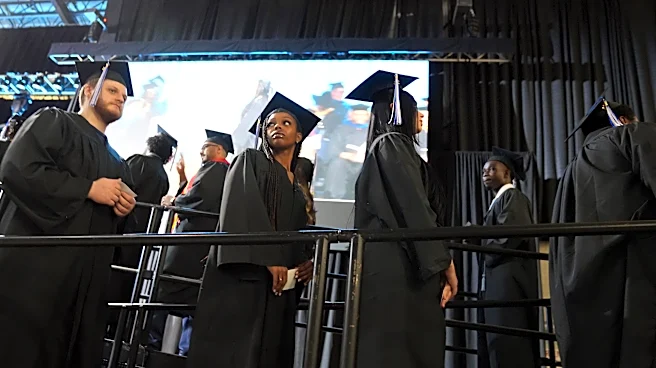




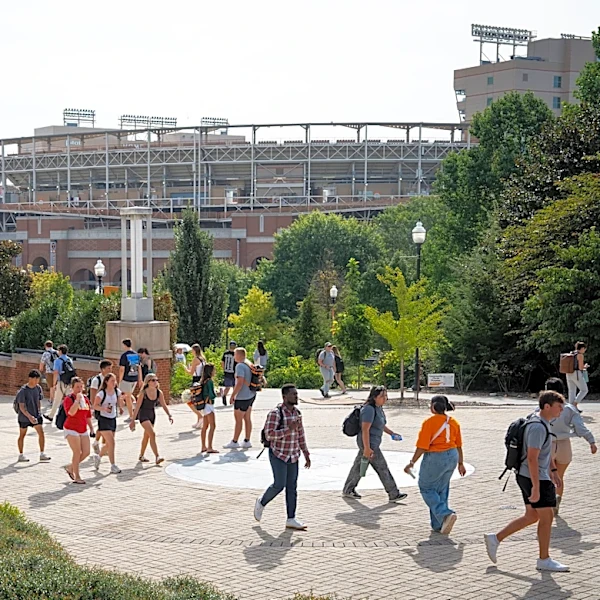


More Columbus City Schools graduates are getting to and through Columbus State Community College thanks to the Columbus Promise, according to a new report by a third-party evaluator.
A new three-year study published Sept. 9 by the W.E. Upjohn Institute for Employment Research found that the number of Columbus City Schools graduates who go on to earn associate degrees and certificates at Columbus State has doubled since the start of the Columbus Promise.
"I really feel like this is one of the really best pieces of evidence to date of what promise programs can do," Michelle Miller-Adams, a senior researcher with the Upjohn Institute, told The Dispatch.
The Columbus
Promise launched in 2022 as a college access program for Columbus City Schools students. The program – led by the school district, the City of Columbus, Columbus State Community College and the college access program I Know I Can – allows any high school graduate in the district to attend Columbus State tuition-free for six semesters.

It is a last-dollar scholarship, meaning it pays for any costs not covered by other aid like federal Pell Grants, and students receive a $500 stipend per semester. They also receive dedicated coaching and academic support.
The report found that each successive cohort of Columbus Promise students showed improvements in its academic performance, suggesting that retention and completion metrics will continue to rise in coming years, Miller-Adams said.
Its findings are also in line with some of Columbus State's internal data, Jen Gilbride-Brown, Columbus State’s vice president for student success and experience, told The Dispatch.
“This report confirms what matters most: our students are staying in school, passing their classes, and earning degrees that lead to great careers,” Gilbride-Brown said. “When you take away the stress and uncertainty of paying for tuition and give students focused coaching and support, they succeed.”
More students pursuing higher education with Columbus Promise
The Upjohn Institute – a private, not-for-profit, nonpartisan, independent research group based in Kalamazoo, Michigan – has provided independent third-party analyses of Columbus Promise since the program launched in 2022. This is the first report that has been able to analyze a cohort that had the full three years of Promise funding at the time of the evaluation, Miller-Adams said.
Because of that, the Upjohn Institute report was able to review the entire pilot period, covering the cohorts who enrolled at Columbus State in 2022, 2023 and 2024, and analyze data through summer 2025. The study was also able to use a more representative comparison group made up of Columbus City Schools graduates from the classes of 2017 through 2021 who enrolled at Columbus State within one year of high school graduation.
The new report looked at 2,237 CCS students from the high school classes of 2022, 2023, and 2024 who enrolled in the program. Upjohn Institute researchers compared results for these students against five years of data from a pre-Promise comparison group.
One of the questions that researchers were particularly interested in answering was seeing what impact that Columbus Promise had on the rate of college-going overall in the district.
In June, Ohio State University professor Vlad Kogan published his own analysis with the Fordham Institute of previous Upjohn Institute data related to the Columbus Promise. Kogan raised concern about whether the program was siphoning away students who would otherwise go to a four-year university and instead sent them to Columbus State.
"(CCS) did not have many students going to four-year schools, but for those students, being impacted in a negative way is consequential," Kogan told The Dispatch at the time.
Miller-Adams said the data doesn't reflect that concern.
The enrollment rate among Columbus City Schools graduates in this cohort at community colleges increased approximately 15 percentage points since the Columbus Promise was launched, and the public four-year college enrollment rate reported by the ODHE declined slightly from 9.1% to 8.7% over the same period, according to the report.
Overall public college or university enrollment, including both two-year and four-year enrollments, of class of 2022–2024 CCS graduates saw a 13.3 percentage point increase.
The report found that the Columbus Promise "substantially increased the six-month college enrollment rate of CCS graduates" mainly by enrolling students who would otherwise not attend, while having a marginal effect on students who would've otherwise attended four-year institutions.
"Community partners can also be assured that increased community college enrollment did not come at the expense of enrollment at bachelor’s-granting institutions," the report read. "Instead, the work of the partners has substantially widened the pipeline to higher education for students graduating from CCS."
Report affirms Columbus State findings on student supports
Gilbride-Brown said the Upjohn Institute report is encouraging because it also shows the college's support system for Promise students is working.
Gilbride-Brown said the Upjohn Institute report is also consistent with Columbus State’s internal data, which shows that student success is accelerating with each Columbus Promise class.
Through spring 2026, Columbus State’s own data shows that a total of 336 Promise students have completed credentials, compared with 182 CCS graduates from fall semester 2018 through spring semester 2022. Many Promise students have completed more than one credential, with 440 degrees and certificates awarded in total thus far.

The Upjohn Insitute report found that while Columbus Promise students who enrolled at Columbus State do not complete credentials at substantially higher rates than the 2017–2021 comparison group, the percentage of CCS graduates earning degrees or certificates has increased because of higher enrollment rates.
"Although an increase of 1.4 percentage points in associate degree attainment (as a share of all CCS graduates) may appear modest, it corresponds to 32 additional class of 2022 graduates earning an associate degree," according to the report. "Given the substantial increase in average lifetime earnings associated with an associate degree relative to a high school diploma, this represents a meaningful impact for both individual students and the local economy, particularly if many of these graduates remain in Columbus."
Gilbride-Brown said persistence data has also improved.
Enrollment persistence has grown with each new Columbus Promise cohort. Nearly 80% of students in the third cohort class returned for their second semester, up 7.5 percentage points over past baselines, according to the report. That builds on strong first-year retention from cohort 1 (76.0%) and cohort 2 (76.1%), with nearly 58% of cohort 2 continuing straight into their second full year of college.
Columbus State has seen an uptick in the number of students taking advantage of academic supports, like tutoring, and non-academic supports, like free COTA bus passes.
"The interventions are paying off, and we're feeling confident about the strength of this upward trajectory," she said.
What's next for the Columbus Promise?
The Columbus Promise faces some question marks in its future.
The program, which is funded through the city and private philanthropy, has been extended through the high school graduating class of 2027, but does not have continued funding for future classes. City leaders launched a campaign last February to fund the next phase of the program.
The community college announced on July 29 that, "after careful consideration," it would not move forward with a levy on the November ballot. Columbus State administrators had proposed a 10-year, 1.9-mill levy that would generate $95 million annually and would have been used largely to offer free tuition to Franklin County high school graduates.
But college leaders backed off the plan after it received significant pushback from local leaders, including former Columbus Mayor Michael Coleman and Franklin County Commissioner Kevin Boyce.
Columbus State President David Harrison previously told The Dispatch that there is "no immediate plan" to bring a different version of the levy before the college's board of trustees.

Gilbride-Brown said this most recent Upjohn Institute report will continue to be important as the college considers the Columbus Promise's next steps and "if we need to figure out another structure or strategy related to financial stability."
"There's a strong college commitment to making sure that happens, and we will continue to innovate," she said.
After analyzing the program and considering other Promise programs across the country, Miller-Adams said continuing to fund and support the Columbus Promise is "a really, really good investment." Not only is it "an inexpensive investment" compared to similar programs in other cities, she said, it's also "an investment in the future workforce."
"If you have this program that is working and doing what you need it to do, why wouldn't you figure out some way to fund it?" Miller-Adams said.
Higher education reporter Sheridan Hendrix can be reached at shendrix@dispatch.com and on Signal at @sheridan.120. You can follow her on Instagram at @sheridanwrites.
This article originally appeared on The Columbus Dispatch: New report finds Columbus Promise gets more students to and through college