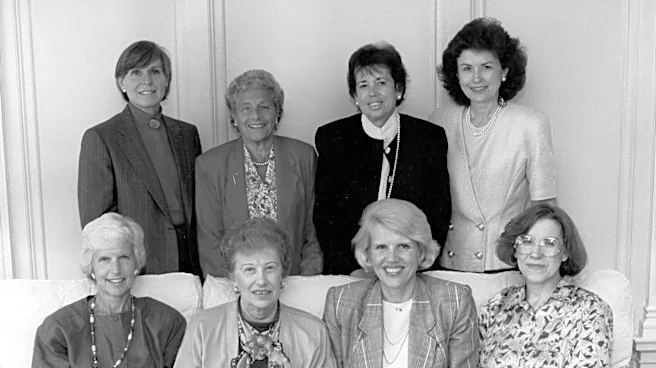

Fifty years ago, 13 women who were often excluded from the rooms where Columbus' civic conversations were happening decided to create a room of their own.
But they didn't create a club exclusively for women.
Instead, they founded the Columbus Metropolitan Club, an organization that would welcome people regardless of gender, race, religion or age to discuss the issues facing central Ohio. The club held its first public meeting Sept. 10, 1976.
Now, five decades later, CMC President and CEO Sophia Fifner believes that mission may be as important as ever.
"In a time period when so many Americans lack trust in institutions and their neighbors, when we have a loneliness epidemic, the idea that this organization still stands and is very strong ... is radical in 2026," Fifner said. "And it shouldn't be, but it's radical."
The Columbus Metropolitan Club will celebrate its 50th anniversary Sept. 10, marking five decades of bringing central Ohioans together for conversations about public policy, current events and issues affecting the community.
How did the Columbus Metropolitan Club begin?
CMC was founded in 1976 when women were frequently excluded from private lunch clubs and speaker groups where community leaders discussed current issues.
Thirteen women responded by creating their own organization, but from the beginning, they recruited people from all backgrounds to participate.
Fifner said that decision remains central to CMC's identity.
"They said, 'You know what, we are excluded from these conversations and we need to be a part of it,'" Fifner said. "We're not going to create a women's organization. We're going to create an organization that invites all people regardless of their background."
That commitment didn't mean avoiding disagreement.
Fifner pointed to an example from CMC's early decades, when the organization invited conservative activist Phyllis Schlafly to speak despite her opposition to the Equal Rights Amendment and despite some CMC founders holding sharply different views.
Fifner said the example demonstrates something CMC has tried to maintain throughout its history: creating a place where people can hear ideas they may strongly disagree with.

How does the Columbus Metropolitan Club work today?
Today, CMC hosts weekly public forums that explore public policy, current events and community issues. Its mission remains to connect people and ideas through community conversation.
Recent discussions have tackled issues including housing and homelessness, immigration, education, development and the city's use of Flock license plate reader cameras.
The conversations aren't scripted, Fifner said. Panelists are encouraged to speak their minds and audience members can ask questions.
What CMC asks in return is that participants listen and remain civil.
"There has never been a time where we have name calling on our stage because it's not part of our culture," Fifner said. "And I think that we built that culture very intentionally."
CMC isn't a direct-action organization, Fifner said. It doesn't lobby for particular outcomes or organize volunteer campaigns. Instead, she describes it as a "seed planter for civic engagement and participation."
"You have to know what's going on before you can take any action," Fifner said.
Fifner said the organization has also worked to make those conversations more accessible. Forums once held in formal settings such as the Athletic Club of Columbus or the Boathouse could leave some people feeling that CMC wasn't a space for them, she said.
CMC now holds its forums at the National Veterans Memorial and Museum and continues to livestream them for free, a practice that began during the COVID-19 pandemic.

What's next for the Columbus Metropolitan Club?
CMC will mark its anniversary with a celebration from 4 to 6 p.m. Sept. 10 at the National Veterans Memorial and Museum, 300 W. Broad St. Several of the organization's surviving founders are expected to participate.
But Fifner said the anniversary is intended to look forward as much as backward.
Through an initiative called "CMC Next," the organization plans to make its discussions easier to access outside its weekly forums, including turning content into shorter formats and eventually using technology to connect people who hear about an issue with additional resources and ways to get involved.
CMC also brings Columbus City Schools and Franklinton High School students to its forums and hopes to expand access for students in the future.
For Fifner, the organization's future ultimately comes back to the same idea that drove its founders 50 years ago: getting people into a room with their neighbors.
"Every city should have a space where all residents can gather, where they have a forum, a platform to come together to talk about issues that matter," Fifner said.
Trending reporter Amani Bayo can be reached at abayo@dispatch.com.
This article originally appeared on The Columbus Dispatch: 'We need to be a part of it.' How 13 women started CMC 50 years ago