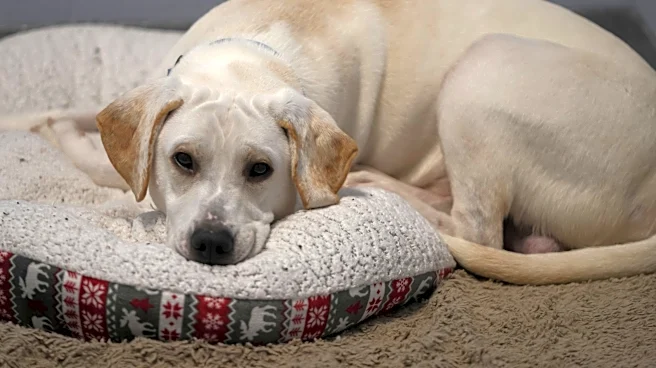








The music is the most obvious clue that Gigi’s sprawling campus isn’t a typical dog shelter. In lieu of an echoing chorus of barks and whimpers, the soundtrack is more reminiscent of a health resort or meditation class.
The soothing sounds trickle through wireless speakers located in each individual dog suite, and like most details at Gigi’s, they were intentionally implemented to put fearful dogs at ease.
“Even the wall color, the paint color has been very specifically selected to decrease the stress in a dog,” Chelsea DeRosa, Gigi’s director of marketing and communications, said. “The lights are a certain lumen because it decreases stress in a dog. Everything here is built in order to create the best environment for a dog to find a home.”
And
evidently, it works. The nonprofit recently had its biggest adoption day yet, DeRosa said, completing 16 adoptions in six hours. And the average shelter stay for a Gigi’s dog? Just 13 days.
Located in Canal Winchester, about a 20-minute drive southeast of downtown Columbus, Gigi’s is a 26,000-square-foot canine shelter, behavior and adoption center that got its start in 2018. The organization was founded and completely funded by the late George Skestos and his wife, Tina. It bears the name of their treasured Akita, whose silhouette is forever memorialized in the company’s logo.

From the beginning, Gigi’s mission has always been simple: to give homeless dogs in rural shelters a better chance at finding homes.
“Our general outlook on the problem is the dogs who don't make it aren't failing,” Gigi’s Executive Director Justin McKinniss said. “It's the systems around them. Four out of every five dogs in the counties that we serve historically would not find a shelter or find an adoption or a veterinarian in those counties.”
By transporting shelter dogs from Appalachian Ohio to Columbus-area shelters using its fleet of three transport vans, the nonprofit can give them better access to veterinary care and potential adopters.

According to Gigi’s 2025 annual impact report, the organization rescued 1,400 homeless dogs from rural southern Ohio shelters last year, driving a total of 40,869 miles to do so.
Recently, Gigi’s was given the opportunity to spread that reach further. On July 15, the organization officially launched Gigi’s Canine Transport Van Grant Program. The $2 million initiative funded by The Stanton Foundation will allow Gigi’s to provide 24 transport vans just like its own to other shelters, expanding its mission further along the Appalachian region outside of Ohio.
The vans, however, are just the beginning. Recipients will all be trained in Gigi’s Enriched Transport (GET) Protocol, developed by Dr. Meghan Herron, DACVB, Gigi’s senior director of behavior, research and education.
The protocol is designed to eliminate stress during transport through temperature and sound management, safe crate handling and utilization of behavior supplements and medication. Each van is also outfitted with an easy-to-sanitize interior to prevent disease transmission between trips.
“You can actually download [the protocol] online,” McKinniss said. “It's really accessible, and it has three standards in it. There's a good, better, best approach. And the best is going to be using psychopharmacology or behavioral medicine to decrease stress during transport.”
Animal welfare organizations can learn more and apply for a grant at gigis.org/transport-van-grants. Gigi’s will distribute the two dozen vans over a two-year period, announcing three to four recipients at a time on a quarterly basis.
“We’re using these as a way to encourage others to evaluate what we're doing as a method to improve their own operations,” McKinniss said. “So, it's really about building a network. It's about us starting to really more deeply understand those regions, too.”

It’s important to note that transport is just one of Gigi’s many focuses. After its journey, every Gigi’s dog is spayed or neutered and receives its vaccines, a microchip, veterinary care and behavior support prior to adoption.
The nonprofit also provided a whopping 9,800 vaccinations and preventative doses to dogs in rural shelters in 2025, and 2,872 dogs received free or low-cost veterinary care according to its most recent impact report. Additionally, 2,457 dogs and familiesreceived behavioral support services in 2025.
Since beginning its operation, Gigi’s has now served more than 20,000 dogs, DeRosa said. And they’re just getting started.
Diligent research is the key component fueling the organization’s growth and leadership in the shelter space.
In July, the Journal of the American Veterinary Medical Association published an article co-authored by Dr. Herron titled, “Retrospective evaluation of canine parvovirus monoclonal antibody supports faster clinical recovery in shelter dogs with naturally occurring canine parvovirus.”
“These things are hitting,” McKinniss said. “It's not just hitting in shelter journals – we’re kind of changing the game across all of veterinary medicine. So, people are really starting to take notes.”
While Gigi’s Canine Transport Van Grant Program is already a major step for the local nonprofit, McKinniss and DeRosa look forward to expanding its horizons even further.
“Here at Gigi's, research is really core in order for us to kind of set and define these evidence- and science-based protocols and research studies in order to improve the lives of shelter dogs across the country – and hopefully, even across the world,” DeRosa said.

Reporter Kelly Tucker can be reached at ktucker@dispatch.com.
This article was made possible by support from the Center for HumanKindness at The Columbus Foundation, which has partnered with The Columbus Dispatch to profile those making our community a better place. Help us lift up inspiring stories of kindness by suggesting people, initiatives, or organizations to feature by emailing kindness@dispatch.com. The Dispatch retains full editorial independence for all content. Learn more at Dispatch.com/Kindness.
This article originally appeared on The Columbus Dispatch: Ohio nonprofit launches program to save more dogs