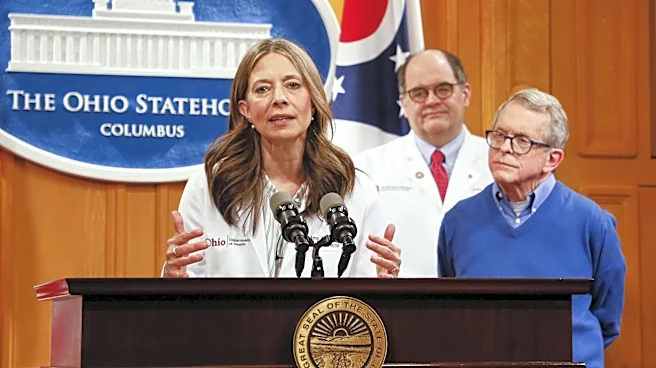

Inside the Ohio Statehouse press briefing room, Dr. Amy Acton donned a white lab coat and warned Ohioans that the COVID-19 pandemic would be a "long haul." Outside, protesters screamed that shelter-in-place
orders were tyranny, holding signs that read: "Amy Please Leave."
It was April 13, 2020, about a month after Republican Gov. Mike DeWine banned spectators at the Arnold Classic, closed public schools andcanceled in-person voting for the presidential primary. Even at that early stage, Ohio's leaders faced immense pressure to balance protecting Ohioans from a deadly disease and allowing them to work, learn and live their lives.
![Dr. Amy Acton, center, director of the Ohio Department of Health, answers a question during a press conference regarding the state's testing protocol and preparedness for COVID-19, or Coronavirus, on Saturday at the Statehouse. The state is currently awaiting results on several Ohioans being tested for Coronavirus, but there are no confirmed cases yet. [Joshua A. Bickel/Dispatch]](https://www.gannett-cdn.com/media/2020/03/09/USATODAY/usatsports/ghows-OH-200308466-f8c6748b.jpg)
Acton became the face of the state's COVID-19 response for many Ohioans. Daily news conferences with DeWine and then-Lt. Gov. Jon Husted gave Acton a platform to talk about flattening the curve, layering public health practices like Swiss cheese and reminding Ohioans that not all heroes wear capes.
Now, as Acton runs for governor, her role as Ohio's top health official during the pandemic has become a rallying cry for supporters and a line of attack for opponents.
Republican gubernatorial candidate Vivek Ramaswamy has called Ohio's "over-restrictive response to COVID" worse than the virus itself. He described Acton as "the woman who led Ohio worse than Fauci."
Ramaswamy criticized Ohio's COVID-19 response on a podcastwith Ohio Advocates for Medical Freedom, which opposes vaccine mandates and backed a doctor who claimed COVID-19 vaccines make people magnetic.
Acton has defended, even praised, Ohio's response to the pandemic.
"I was honored and privileged to work alongside Gov. Mike DeWine during one of the hardest times we faced," Acton told the statehouse bureau. "Together, we were able to flatten the curve, save a lot of lives. We actually opened earlier because we took swift and decisive action."
DeWine, a Republican who endorsed Ramaswamy in the 2026 race, has repeatedly said that he ordered closures and mask mandates, not his health director.
"People talk about her, but I've always been very, very clear at the time and now that if people didn't like my decisions or what the state was doing, the buck stopped with me. The fault lies with me," DeWine told the statehouse bureau in early 2026. "I'm the person who was elected. I'm the person who made the decisions."

Ohioans united behind COVID response. Then came the politics
In the initial weeks of the COVID-19 pandemic, Ohio was seen as a national leader for its swift response. The Buckeye State was the first to close public schools for an extended spring break, but the nation and much of the world followed shortly after.
In those early days, DeWine ordered all non-essential workers to stay at home. Unemployment rolls exploded, and the federal government stepped in with extra benefits. Ohio postponed elective surgeries to preserve personal protective equipment. Visitors to nursing homes were banned, then later restricted to outdoorsor limited numbers.
For some Ohioans, Acton's daily appearance on DeWine's news conferences became a calm presence in a frightening time. Her slogans were emblazoned on T-shirts. The daily COVID-19 news conferences were rebranded online as "Wine with DeWine" and "Snackin' with Acton." An Ohio animator created a "Laverne & Shirley"-esque theme song for the COVID updates. The Washington Post and Time profiled her.
For others, Acton became a symbol of the freedoms they lost, their shuttered businesses and their children's educational deficits from school closures. The public scrutinized her predictions, including her "guesstimating" that as many as 100,000 Ohioans were already infected in mid-March 2020 − a number that she walked back. She also estimated that Ohio would hit 10,000 new infections per day − a statistic that didn't materialize until months after she left the state health department. Protesters, some armed, stood outside her Bexley home to voice their dissent.

"There was probably a good six weeks of folks rowing together before things became overtly, overtly political," Acton said during a PBS docuseries titled "The Invisible Shield."
Meanwhile, the Republican-controlled Legislature passed laws to rescind public health orders and restrict how long they could last. DeWine vetoed the bill, sponsored by then-Sen. Rob McColley, but lawmakers voted to override DeWine's action.
“The truth of the matter is no one branch of government is meant to have unfettered control over our society indefinitely," McColley said before the February 2021 vote. Years later, McColley would become Ramaswamy's running mate and criticize Acton for COVID-era closures.
Acton resigned as state health director in June 2020, and served as an adviser for DeWine for another two months. Acton told Cincinnati's FOX19 that she left because then-Ohio House Speaker Larry Householder wanted her to sign a health order allowing 15,000 unmasked people to participate in an indoor event at a county fair.
On the day Acton announced her resignation, DeWine wrote on social media: "It’s true, not all heroes wear capes. Some of them wear a white coat embossed with the name Dr. Amy Acton."

The consequences of closures
The COVID-19 pandemic's harm extended beyond death tolls and hospitalization numbers across the United States.
Pandemic-era school closures had "a wide-ranging and long-lasting impact on education in the United States." It led to years of learning loss and exacerbated chronic absenteeism, particularly for children living in poverty, according to the Annie E. Casey Foundation.
Ramaswamy frequently mentions those educational losses on the campaign trail. He compares the short closure at St. Xavier, his private school alma mater, to Cincinnati Public Schools' extended time without in-person classes.
"Those kids in the Cincinnati public schools, they will never get those two years of their education back,"Ramaswamy said. "And I do not have a lot of patience for those who will preach about inequality while creating the very conditions for the inequality that they complain about."
Ramaswamy exaggerates how quickly St. X reopened (it took months, not five days) and how long Cincinnati schools were closed. (CPS started the 2020-2021 school year fully remote before moving to a "blended" model where students attended class in-person a few days each week. The district didn't return to full-time, in-person classes until after spring break in 2021.)
But the comparison still stands, and Republicans are hammering the point.
"Together, Amy Acton and Anthony Fauci wreaked havoc on our state and across this nation, leading to the greatest loss of education in our nation's history,"said state Sen. Kristina Roegner, R-Hudson, who backs Ramaswamy. "Those are educational years that can never be made up."

Beth Liston, a Democratic state senator, doctor and professor, said Ohio reacted to the best information that leaders had at the time while Acton was health director.
"Hindsight is going to make us question everything, and that is important so that we are better prepared for anything that may happen in the future, but Dr. Acton provided leadership and transparency, using the best information," Liston said. "There were no good choices."
Physical and mental health also suffered during the closures as Americans lost access to employment, income, food security, health care and education, according to an analysis of U.S. studies on lockdowns and school closures from Indiana University’s Fairbanks School of Public Health.
Meanwhile, Ohio's unemployment compensation system showed its cracks as an unprecedented number of people were forced to stay home. Fraud was rampant, particularly with the federal benefits. Nationwide,the U.S. Government Accountability Office estimated between $100 billion and $135 billion in fraud between April 2020 and May 2023.

Backers of Ohio's COVID-19 response say closures and other health orders worked. Ohio had a lower COVID death rate in 2020 − 87.3 deaths per 100,000 residents − than the national average, according to the U.S. Centers for Disease Control and Prevention.
"Dr. Acton courageously proposed and supported a scientifically accurate response for our state and her recommendations saved the lives of thousands of Ohioans," doctors with the Columbus Medical Association wrote in August 2020.
Ohio's hospital workers were stretched thin, but they didn't need overflow facilities, such as one constructed at theColumbus Convention Center. Public health practices, such as social distancing and masking, were used to prevent the contagious disease from spreading before vaccines were widely available.
"The hard part of my job is that when I knock it out of the park, you don't see what I've done," Acton said during the PBS documentary. "I've prevented something."

How much credit or blame should Acton get?
In the end, how much credit or blame should Acton receive for her tenure as the public face of Ohio's COVID-19 response?
At the beginning of Ohio's COVID response, Acton was a regular fixture on the daily news conferences and an influential person in COVID discussions. But Acton wasn't DeWine's sole adviser on the pandemic.
The governor held regular calls with hospital CEOs, mayors and business leaders to solicit input. He listened to cabinet members overseeing prisons, unemployment compensation, nursing homes, schools and other aspects of the pandemic response.
"She made suggestions to me, ideas to me," DeWine told the statehouse bureau. "I got ideas also from other people, and I ultimately made the decisions."
One of the DeWine administration's many advisers was Ramaswamy, who offered his input to Lt. Gov. Husted. Ramaswamy advocated for mandatory antibody testing to allow those with natural immunity or a past exposures to return to work, Ramaswamy said during an April 2020 interview with Rockefeller Capital Management.
"Those people are going to be able to get back to work pretty quickly, get back to normal life because effectively they have the immunity badge," Ramaswamy said in that interview. Others would be "segregated" and be first in line for a vaccine.
Years later, Ramaswamy told Ohio Advocates for Medical Freedom that letting people with natural immunity live their lives was a good compromise between lockdowns and reopening everything. “I thought that was reasonable at the time and I actually think it’s pretty reasonable looking back in retrospect,” he said.
One of Ramaswamy's companies also sought to create a national registry of COVID-19 patients by pooling medical records across the country, the Wall Street Journal reported in 2020. Ultimately, it becamea COVID research database with deidentified datathat couldn't be linked to a particular patient.
Acton campaign spokesperson Addie Bullock criticized Ramaswamy's actions during the pandemic, saying: "Ramaswamy is a billionaire scam artist who will do anything to make a buck and can’t be trusted to fight for Ohioans.”

COVID on the campaign trail
As the 2026 gubernatorial campaign ramps up, Republicans are carrying a cardboard cut-out of a masked Acton to county fairs, a reminder that she resigned rather than signing a health order related to them. A Ramaswamy ad featuring an April 2020 protester blames Acton for COVID closures' impact on nursing homes − but the woman's mother actually died in Kentucky.
Ohioans who protested pandemic closures are almost assuredly not voting for Acton this fall. "No Dr. Lockdown," said Stephanie Stock, the leader of Ohio Advocates for Medical Freedom, on her podcast.
But Acton backers polled multiple lines of attack related to COVID last year, and the results were largely positive, Acton said in August 2025. "The more you talk about COVID, the more people are like, 'Oh yeah, I remember and I like that.'"
She added: "When you go through something like a crisis, a really deep bond formed with Ohioans."
State government reporter Jessie Balmert can be reached at jbalmert@usatodayco.com or @jbalmert on X.
Tell us what you think
This article originally appeared on The Columbus Dispatch: Amy Acton’s COVID response at center of race for Ohio governor