







This is a column about the second most dangerous animal on Earth, and the most dangerous to humans (who now hold the No. 1 most dangerous animal spot). Mosquitoes kill about 700,000 people annually by spreading diseases such as dengue fever, yellow fever and malaria. The latter alone kills over 600,000 people annually.
Fortunately for Americans, malaria is very rare here. Perhaps six to seven people fall victim to it a year. Contrast that with Africa, where 95% of all malaria cases occur. Dengue fever is also very rare, and yellow fever is now unknown, although it was a significant problem until the early 1900s, when scientists learned about its biology and how to eliminate it.
In America, at least, mosquitoes are now more nuisance than existential
threat. But not so long ago, mosquitoes were our No. 1 predator, by a long shot. Nothing has even come close to the tiny insects in dispatching humans.
Mosquitoes appeared around 100 million years ago, and females evolved to suck the blood of various creatures, both cold-blooded and warm-blooded. When humans finally emerged, the bloodthirsty insects had had lots of easy pickings.
Since the dawn of Homo sapiens perhaps 300,000 years ago, we have produced about 108 billion people. To put our short tenure into context, the Earth is estimated to have formed around 4.5 billion years ago, and mammalian animals have existed for 225 million years.
Approximately half of ALL humans over the existence of our species have died due to mosquito bites. That’s over 50 billion people. Now, in the United States, there are perhaps an average of 200 mosquito-related deaths annually. As always, it is diseases spread by the bugs that do us in, and the big one now is West Nile disease. It accounts for over half of those deaths.

Are mosquitoes in Ohio?
While mosquitoes now rarely kill Ohioans, we have plenty of the buzzing suitors seeking our blood. About 60 species have been documented in the Buckeye state, but only a relative handful of species are doing most of the biting.
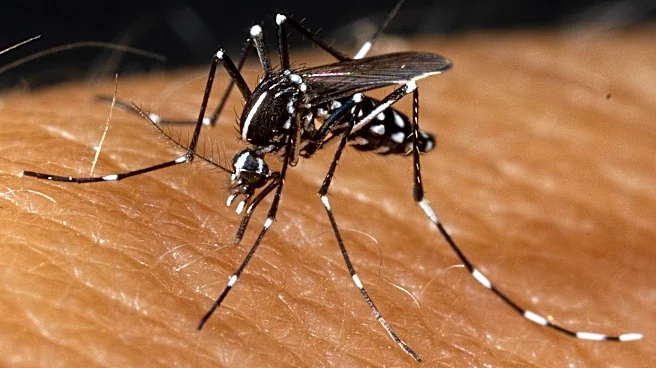
While only some of our native mosquitoes bother us, their ranks have been bolstered by several non-native species that have greatly increased. One is the Asian tiger mosquito (Aedes albopictus), pictured with this column. A common native biter is the floodwater mosquito (Aedes vexans), which ranges over much of the globe.
I realized that I needed a good mosquito photo for the column, so I enticed Shauna into the backyard to be my model. My claim was that I could not operate the camera efficiently while photographing myself getting bitten, and I stand by that. Within a few minutes, I had the shot and Shauna had an itchy welt. The protagonist? The Asian tiger mosquito.
There was another sound scientific reason that Shauna was the mosquito decoy. She apparently radiates much more carbon dioxide than I do. Mosquitoes track potential blood donors by tracking their CO2 emissions, and she apparently emits lots more than I. Field trip tip: Take along a heavy carbon dioxide emitter to draw the biting crowd.

Why are there so many mosquitoes in Ohio?
Due to all the rain in central Ohio, mosquitoes have been prolific this year. They can breed successfully in even ephemeral puddles. The life cycle for many species is astonishingly rapid, often only a week or two from egg to flighted adult.
I’m not naïve enough to try and sell the public on the virtues of mosquitoes, but I would make a few observations. For many organisms – frogs, fish, turtles, insects such as dragonfly larvae and much more – mosquito larvae are a huge food source. They are a base layer of aquatic food chains.
Adult mosquitoes are preyed upon by bats, birds such as swallows, adult dragonflies, spidersand others. Furthermore, the adults – especially nonbiting males (only female mosquitoes bite) – seek flower nectar and collectively represent a significant group of pollinators.

How to get rid of mosquitoes
Pointing out any virtues will not quash our urge to eradicate mosquitoes through chemistry. While some larvicides may target only mosquito larvae, others are nonspecific and kill all or most insects that they contact. Adulticides are chemicals targeting flighted adults, and these are typically sprayed from low-flying aircraft or from tanks on mosquito-fogging trucks.
Adulticides are broad-spectrum chemicals that kill all or most insect species that they encounter. Mosquito-foggers are rolling entomological Armageddons for the six-legged crowd, and the collateral damage involves scores of insects vital to food chains such as butterflies, moths, lady beetles, dragonflies and lacewings.
We’d do well – for our own species and scads of other animals – to rid the world of nonspecific mosquito-fogging. It’s a blunt force bomb, when what is called for is surgical precision targeting mosquitoes. Mosquito-fogging is surely a significant reason for overall insect declines in some areas.
A simple solution for homeowners is a “mosquito dunk.” A common, easily implemented control is the “bucket of doom.” Simply acquire a packet of mosquito dunks – dissolvable tablets – and plop one on a 5-gallon bucket of water.
Place it in your yard, and most female mosquitoes will lay eggs in the bucket. Chemicals will kill the larvae, thus greatly reducing the ranks of biting adults.
Naturalist Jim McCormac writes a column for The Dispatch on the first and third Sundays of the month. He also writes about nature at jimmccormac.blogspot.com.
This article originally appeared on The Columbus Dispatch: Mosquitoes killed thousands of humans. Ohio has many species