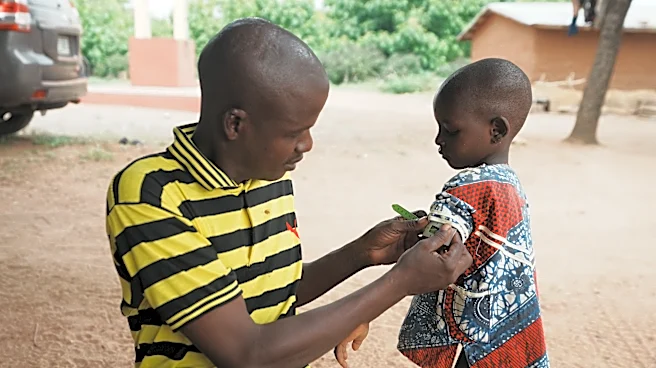






Safe drinking water isn’t always guaranteed in Malawi, a sub-Saharan African country where most residents access groundwater though communal hand pumps.
These pumps, which often endure 12 or more hours of use in a single day, are notorious for breaking down. When that happens, residents are forced to collect water from hand-dug wells or nearby springs that often carry water-borne diseases like cholera.
For many, an out-of-commission hand pump can quickly become a life-or-death situation.
“In communities like this, mothers are not naming their children until they turn at least a year old, as a coping mechanism,” said Greg Bixler, co-founder and CEO of the Christian nonprofit Design Outreach.
An estimated 200 million people in sub-Saharan Africa rely
on approximately 700,000 of these traditional hand pumps for clean water. Bixler and Design Outreach co-founder Abe Wright lead a team of engineers from their Gahanna-based lab to design solutions for this crisis.
Bixler and Wright met through an organization called Water for Good in 2010. Both men worked as engineers at the time – Bixler for Battelle, and Wright for Johnson & Johnson company DePuy Synthes. They each had the same question on their minds: How can engineering be used to help people around the world?
When they learned about the failing water pumps in Africa, they had their answer.

The two engineers formed Design Outreach in 2013 with a mission to alleviate global poverty through innovative, easily accessible products.
With the help of nearly 70 expert volunteers, they designed a new hand pump with a deeper reach and better durability than the traditional pumps. They installed their first LifePump in Malawi in November 2013. Today, LifePump operates in 12 countries, serving more than 468,000 people.
However, there were still 700,000 traditional hand pumps throughout sub-Saharan Africa with components that would continue to break down. The team of engineers had a solution for those, too.

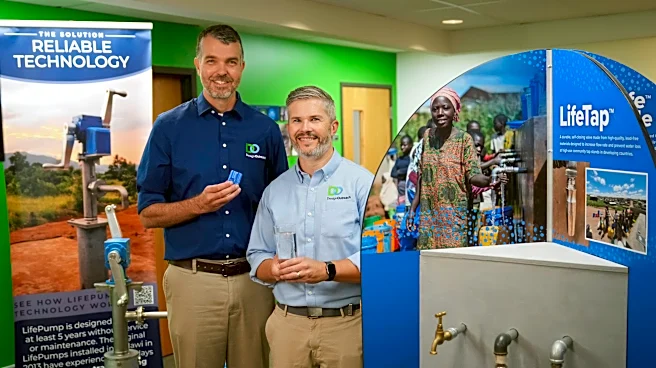
“This is a piece of plastic that is going to change the world,” said Bixler, holding up a small blue mechanism called the MaxLife Centralizer. The blue apparatus replaces a black rubber centralizer used in traditional hand pumps that Bixler and Wright learned accounted for 75% of hand pump failures.
“Pumps that were lasting even just three weeks with [the old centralizers] and breaking down are now running for over two years with these,” Bixler said, holding up the MaxLife Centralizer, “and then it was just that simple of a replacement.”
The MaxLife Centralizer is now installed in six countries, impacting more than 480,000 people.
Design Outreach has also joined forces with other international groups as a technical leader in the mission to replace lead components in traditional hand pumps. Bixler will join the discussion during World Water Week, hosted by the Stockholm International Water Institute in Sweden, from Aug. 23-27, to shine a global spotlight on the issue.
“This is one of those things that you don't hear about, and people don't talk about because it's like this giant black eye for the industry, if you want to call it that,” Bixler said. “There’s been a concerted effort by a lot of NGOs [non-governmental agencies] to start removing the leaded components, so that's one of the reasons I'm going to World Water Week.”
Since the very beginning of Design Outreach, Bixler and Wright have both been guided by their Christian faith, which helps them maintain what Bixler calls an abundance mentality versus a scarcity mentality. When considering what’s good enough for the communities they serve, Bixler reflects on Matthew 7:12 and the Golden Rule.

“Would I be OK with my own family and my three kids having a pump that's going to break down knowingly and be down two or three months a year, and sending my kids off to the river where there's crocodiles? Would I be OK with that? It’s an absolute no.”
With that standard ever-present in their minds, Bixler and Wright continue working to ensure families in sub-Saharan Africa have access to clean water with products deemed fit for their own families.
The nonprofit recently celebrated a major milestone: 1 million people reached through its products.
That includes the LifePump and MaxLife Centralizer, but also additional innovations including:
- LifePumpLink, the satellite-based remote LifePump monitoring system
- LifeTap, a self-closing valve for pumps designed to withstand excessive use
- KupolaCare Wound Therapy, a negative-pressure wound-therapy device that is easy to repair and sterilize and operates without electricity
“That's just scratching the surface, though,” Bixler said. “Our goal by 2030 is to reach 10 million people.”
Most of those 10 million people, Bixler said, will likely live in Malawi. He and Wright are committed to eradicating water poverty in the country with innovative, simple, reliable technology distributed through the local market.
“And we think we can do that for about a dollar a person,” Bixler said. “So, we'll change an entire country for $10 million, which is just an incredible thing to do.”

Reporter Kelly Tucker can be reached at ktucker@dispatch.com.
This article was made possible by support from the Center for HumanKindness at The Columbus Foundation, which has partnered with The Columbus Dispatch to profile those making our community a better place. Help us lift up inspiring stories of kindness by suggesting people, initiatives, or organizations to feature by emailing kindness@dispatch.com. The Dispatch retains full editorial independence for all content. Learn more at Dispatch.com/Kindness.
This article originally appeared on The Columbus Dispatch: Design Outreach aims to end global water poverty