







Bryce Mortera is a licensed pharmacist and lifelong Ohioan.
Ohio continues to carve up, reshape and remove the rural character of the Buckeye State.
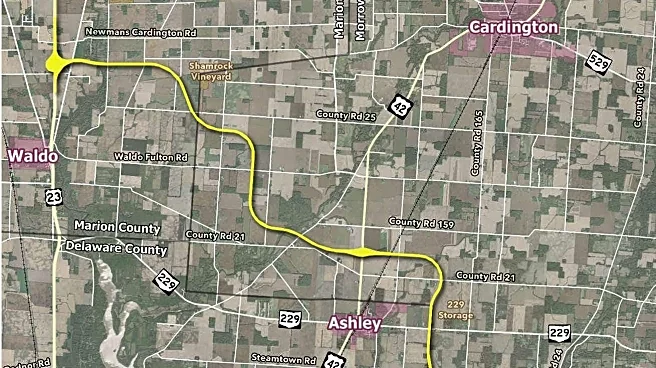
The proposed U.S. 23/I-71connector is just the latest example.
Since graduating from Mt. Vernon High School less than a decade ago, central Ohio has certainly matured, with Delaware and Morrow counties now placed second and ninth out of 88 counties in population growth. While this growth has its positives, it's not without challenges, and we should take the time to ask questions about how proposed solutions might reshape the area.
Three questions I’d like to put forward are:
- How does further highway expansion change the character of Ohio communities?
- What’s the opportunity cost of spending approximately $700 million on this one project?
- What are the long-term costs of adding a new highway here?
I want to recognize ODOT for its public input process and for sharing an expected capital cost for this proposal. But it’s now
on us to hold our state and local leaders accountable and consider our vision for our region.
A top-down approach that only knows large scale

Like many young people, I wanted a change of scenery and, for me, that meant moving to Cincinnati.
I loved living in southwest Ohio, but I never fully left my roots, frequently traveling back home to see family and friends.
Those familiar with this drive will notice a few things: first, the development pattern: rural, suburban and urban; and second, the continued expansion of roadways, further incentivizing expansion of large suburban-style developments at the cost of blurring urban and rural life. This observation isn’t just a feeling; it also shows up in the data on farmland lost to development:
- National Land Cover Database – 600,000 acres.
- Ohio Department of Agriculture – 6.9 million acres (1950-2000).
Before brushing this off as a “big city” problem, we should take note that these same patterns are appearing in small-town Ohio. A new subdivision often leads to a sudden influx of traffic, prompting calls for roadway expansion, more parking and the removal of the buildings that make up the very Main Streets that people are trying to visit. What’s been lost is our traditional and incremental development pattern; in its place, we’ve elected for a top-down approach that only knows large scale.
My second question highlights an idea that is rarely discussed in large infrastructure proposals: What are the trade-offs of investing stretched resources in one project? Why put all of our eggs in one basket?
ODOT has shared the upfront construction estimates and toll scenarios, but I'd like to see what Ohio’s 1,300 townships, 600 villages and 250 cities could do with that same pot of money at the local level.
For context, $700 million is worth approximately 580 miles of sidewalks, 670 miles of trails or 1,300 miles of protected bike lanes.
This figure also doesn’t account for the upkeep costs that will inevitably follow. With Ohio’s roads already earning a D+ on the American Society of Civil Engineers’ Report Card, this “new” highway is unlikely to feel new for very long. Is spending this much worth saving 6-22 minutes of driving time? That’s roughly $32,000,000 per minute saved.
Per the Federal Highway Administration, maintenance costs vary by land type, location and other factors. I’m no traffic engineer, but these are details our transportation officials should be upfront about, including who is responsible for maintaining these extra lane miles.
As the US-23/I-71 connector moves through the Ohio Legislature, I want to call out two actions: get familiar with the project and connect with your local representative.

I would like to share one final example to illustrate our current pattern, which is just a bit south of the proposed connector: Tanger Outlets.
This area is currently an orange-barrel mess and looks nothing like it did 10 years ago. New on- and off-ramps are underway to optimize traffic for the growing subdivisions – one of the only housing options ever built. Once complete, we’ll see a temporary reduction in drive time and another once-rural and connected community become part of a common pattern in Ohio: copy-and-paste suburbia, further void of the character it once had.
If you’re like me, you know and love Ohio for its variety of both urban and rural history, character and local main streets.
Let’s not forget we have the opportunity to advocate for better options to maintain our way of life.

Bryce Mortera is a licensed pharmacist and lifelong Ohioan. He is passionate about economic development and an advocate for incremental change and localism – he's an active member of Strong Towns Columbus, a group focused on creating safer, more economically viable communities throughout central Ohio.
This article originally appeared on The Columbus Dispatch: The Buckeye State doesn't need a $700 million highway to copy-and-paste suburbia | Opinion