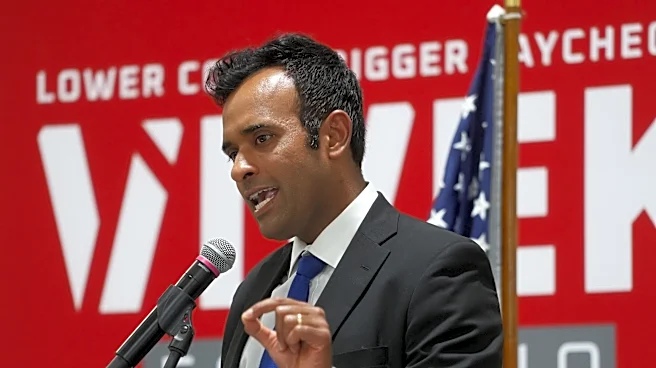






Whoever wins in November, Ohio's next governor will be someone who has never held elected office.
Unlike longtime politician Gov. Mike DeWine, neither Democratic Dr. Amy Acton nor Republican entrepreneur Vivek Ramaswamy has taken tough votes or public actions on controversial topics to define their political stances.
How would Ohio's gubernatorial hopefuls handle taxes, data centers, legal marijuana, the death penalty and abortion access? We asked Ramaswamy, Acton and Libertarian candidate Don Kissick to tell voters how they would handle 10 of the state's most pressing issues.
Here's what each said they would do:
How would you address Ohioans' growing frustrations with high property taxes?
Inflation, a subsequent increase in home values and Ohio's tax policy collectively led to high property tax bills, particularly in 2023.
In response, state lawmakers approved fixes, but some Ohioans are still pushing a 2027 ballot measure to eliminate property taxes altogether.
Solving Ohio's property tax woes will be a tall task for the next governor.

Ramaswamy pitched eliminating property taxes during his campaign launch, but has since scaled that back. He now wants to roll back property taxes to their level at the end of the COVID-19 pandemic.
"Vivek believes if you worked hard to buy your home, the government shouldn’t make it unaffordable to keep it," his campaign responded. "His plan will roll back property taxes to levels from before the end of the pandemic, delivering real relief for families and seniors. New construction will be protected, existing debt will be honored, first responders will not be harmed, schools will be supported, and local governments will keep operating − all while delivering the largest property tax cut in the history of the state."

Progressive think tank Innovation Ohio estimated the proposal would result in several billion dollars in reduced revenue for local services, including K-12 education, police and fire departments.
Acton does not want to eliminate all property taxes. She proposed targeting tax relief to seniors and middle-class Ohioans facing property tax spikes.
Acton wants to expand eligibility for Ohio's homestead exemption, which allows lower-income homeowners age 65 and older and people with disabilities to exempt the first $29,000 of their home’s value from taxation.
Acton also proposed a rebate of up to $1,000 for some homeowners whose property tax bill increased more than 4% over the previous year. To be eligible, Ohioans would have to have a household income below $132,000 and a home valued at or below $350,000.
"Dr. Acton is laser-focused on lowering costs for Ohioans, including through property tax relief," according to her campaign. "Through her property tax relief plan, she will expand the homestead exemption to protect more Ohio seniors; put more money in Ohioans’ pockets with a property tax spike rebate; crack down on predatory collection practices to protect taxpayers; and push to finally fully implement the bipartisan Fair School Funding Plan to fund our public schools and remove this burden from property taxpayers. It’s time we finally deliver meaningful relief to Ohio families and seniors."

Would you cut income taxes?
Ohio Republicans have slashed income taxes for years, but the state still collects about $10 billion each year to pay for prisons, Medicaid, education and other services.
Ramaswamy wants to eliminate income taxes on capital gains in his first two-year budget and phase out all income taxes over eight to 10 years. Because capital gains income is concentrated among higher-income investors, eliminating those taxes would primarily benefit wealthier Ohioans, including Ramaswamy.
Ramaswamy says laying out a plan to make Ohio a zero-income tax state will attract businesses to the Buckeye State. He would pay for the cuts with economic growth and "a holistic review" of where Ohio could cut spending.
"Vivek will eliminate Ohio's state income tax by phasing it out over time − making Ohio one of 10 states with no income tax, alongside Florida, Texas, and Tennessee," according to Ramaswamy's campaign. "This delivers two key benefits: (1) Ohioans can keep more of every paycheck to make their lives more affordable, and (2) Ohio can attract greater investment and more high-paying jobs to the state."
Acton's proposal is less sweeping. Acton wants to expand an income tax break for low- and moderate-income Ohioans called the earned income tax credit. Acton would make the tax credit refundable so lower-income families can benefit from it.
Acton also proposed a child tax credit of $1,000 per year for families with children under 7 and $500 for children between 7 and 18 years old earning up to $85,000.
"Dr. Acton’s number one priority as governor will be to secure a tax cut for Ohio’s working families to put money back in their pockets, lift families out of poverty, and make sure Ohioans see their hard work pay off," Acton's campaign responded.

Would you ban data centers in Ohio?
Ohioans' frustration over the proliferation of data centers and the secrecy surrounding them has become a key election issue in 2026.
Neither Acton nor Ramaswamy proposed banning all data centers in Ohio, but they do want to extract concessions from the ones that build here.
Acton promised a "conditional moratorium" on new data centers unless they covered their own utility costs, used 100% union labor and built on brownfields, not farmland. Acton also wants to ban non-disclosure agreements and rein in "out-of-control long-term tax incentives."
"Dr. Acton supports a conditional moratorium on data centers to ensure they cover 100% of their utility costs, exclusively build with union labor, operate with full transparency, support the needs of local communities, live by Ohio’s environmental standards and bring jobs to former industrial areas that have been left behind," her campaign wrote. "If companies coming into Ohio cannot meet our conditions, they cannot do business in Ohio."
Ramaswamy wants to sweeten the pot for those who live near data centers by forcing companies to pay for residents' electricity billsand lower homeowners' property taxes. Ramaswamy pledged to sign an executive order to halt new data centers on his first day in office, then work with lawmakers to put the requirements in state law.
"Vivek’s position is simple: if a data center project doesn’t clearly benefit Ohioans and operators refuse to meet these standards, then a project will not get built in Ohio. Period," his campaign wrote.

What improvements would you make to K-12 education in Ohio?
Ohio's public schools educate 1.6 million students and cost about $14 billion each year. In recent years, Ohio's GOP lawmakers approved a universal school voucher program, which spends about $1 billion in taxpayer dollars on private school tuition.
Acton wants to reform Ohio's voucher system, which her campaign says "funnels billions of Ohio taxpayer dollars to private schools and wealthy Ohioans with no accountability." She also backs a bipartisan school funding model first approved in 2021 that current GOP lawmakers have said is too expensive.
"As governor, Dr. Acton will tackle the corrupt school voucher system, push for needed transparency and fully fund Ohio’s public schools so every Ohio student has access to a high-quality, public school education," according to her campaign.
Ramaswamy, on the other hand, would continue Ohio's private school vouchers and expand them.
"He believes every Ohio family should have the right to choose the best school for their kids, and he supports expanding Ohio's voucher and EdChoice programs alongside ensuring that public schools are well-funded to achieve their missions," according to Ramaswamy's campaign.
The Republican gubernatorial candidate also supports merit-based pay for teachers and policies that ensure students can read by the end of third grade. Ohio has tried and abandoned similar conceptsbefore.
"Vivek has been clear that improving educational outcomes for Ohio's students is a top priority for him. He believes that Ohio’s education standards need strengthened – in reading, writing, math, civics, physical education, and health," his campaign responded. "As governor, he’ll fight to make Ohio schools the best in America by putting parents back in charge, rewarding great teachers and getting ideological agendas and distractions out of the classroom so schools can focus on the fundamentals of learning."
Ramaswamy says he can achieve this while still adequately funding Ohio's schools.
"He will work with lawmakers on a bipartisan basis to ensure the state's funding formula funds students, rather than systems, while empowering parents and families and relieving pressure from a system that is overly reliant on local property tax revenue," Ramaswamy's campaign replied.
What is your plan for Ohio's public universities?
Ohio is home to 14 public universities, 24 regional branch campuses and 22 community colleges. While enrollment was largely stable last year, universities are facing "the demographic cliff," when the number of U.S. high school graduates declines because of fewer births.
In March 2026, Ramaswamy floated the idea of consolidating Ohio universities to help pay for eliminating the state's income tax. "I want us to have the best universities, but we have too many of them," Ramaswamy said in a video posted on Threads.
In the months since, Ramaswamy has softened that message, saying Ohio must reform its "fragmented" public universities.
"Vivek’s goal is simple: make college more affordable, make degrees from Ohio colleges more valuable and bring accountability to the bureaucratic bloat driving up tuition, squeezing families, putting politics ahead of learning and accelerating the enrollment cliff," according to his campaign.
"As governor, he will cut unnecessary administrative overhead to reduce in-state tuition while backing colleges and universities that are serious about becoming centers of excellence in the high-demand fields our economy needs most. All of this helps Ohio families, ends the exodus of young graduates from our state, and helps build a stronger workforce for the in-demand fields of tomorrow."
Acton wants Ohio’s colleges and universities to “operate as efficiently as possible, including sharing services and functions when appropriate, without reducing the footprint or accessibility of higher education across our state,” spokeswoman Addie Bullock said.
She also wants to continue DeWine’s merit scholarship for in-state students attending Ohio universities, make it easier for students to enroll in Ohio higher education and increase state funding for higher education.
“Ohio funds higher education at a much lower rate than other states in our country. As a result, Ohio students and families are forced to pay a higher percentage of tuition than other states,” Bullock said.
Acton opposes changes in the higher education overhaul Senate Bill 1, which eliminated degrees if only a few students earned them.
“Eliminating such programs undermines the broader mission of higher education and curtails the advancement of fields that are strategic for Ohio while cutting off opportunities for young Ohioans to pursue promising career and job paths,” Bullock said.

How prevalent is Medicaid fraud and how would you address it?
One in four Ohioans, more than 3 million people, use Medicaid for healthcare. The state-federal program, which cost $34.2 billion in fiscal year 2024, provides free or low-cost health coverage to low-income individuals, including children, pregnant patients, older adults and people with disabilities.
Concerns about Medicaid fraud surfaced in May 2026 after the conservative Daily Wire reported allegations involving home health care providers.
Ramaswamy proposed working with federal leaders to bring more Medicaid savings back to Ohio, increasing prosecution of Medicaid fraud and simplifying how Medicaid is administered. He estimated these changes could save Ohio billions, which could pay for copays and health savings accounts.
"Medicaid should be a springboard for hardworking Ohioans to get back on their feet, not a money pit for bad actors who drive up healthcare costs for everyone else," Ramaswamy's campaign responded.
"Recent investigative reporting, along with what Vivek has heard traveling all 88 counties, points to serious fraud and abuse in home health care, non-emergency medical transportation, and addiction treatment − areas where Ohio spends billions in Medicaid dollars. Additionally, Ohio’s Medicaid budget has nearly doubled to $47 billion in a decade while enrollment stayed nearly flat – driven in no small part by waste and abuse."
Acton said she would prioritize rooting out Medicaid fraud, waste and abuse while ensuring that Ohioans can access affordable, quality healthcare. She supports work requirements for Medicaid and has pitched forgiveness of medical debt.
"Dr. Acton is fighting to lower healthcare costs, protect Medicaid and Medicare access, and end the rampant corruption in Ohio’s statehouse which has allowed fraud, waste and abuse for far too long," her campaign said.

Did you vote to legalize marijuana in 2023?
In 2023, Ohio voters legalized recreational marijuana. Now, state law allows adults 21 and over to grow and use marijuana legally, and the state imposes a 10% tax on sales.
Ramaswamy opposed the ballot measure legalizing marijuana in Ohio, in part because it conflicts with federal law. "He will work with law enforcement and regulating bodies to ensure that Ohioans are safe," his campaign said.
Acton voted to legalize marijuana in 2023. The Democrat will "respect the clear will of the voters and ensure that Ohio adults 21 and older can safely make their own decisions," said Acton's spokeswoman Bullock, adding that Acton would oppose efforts to recriminalize recreational marijuana or eliminate the 10% tax on sales.
When should abortion be legal in Ohio?
In 2023, Ohio voters approved a constitutional amendment that protects access to abortion until viability and other reproductive rights.
"As a doctor and a public servant, Dr. Acton firmly believes that every Ohioan deserves the right to make their own reproductive health care decisions, free from government interference," Bullock said. "As governor, Dr. Acton will always protect reproductive freedom so that every Ohioan can access safe, legal reproductive care."
Planned Parenthood Advocates of Ohio endorsed Acton, calling her a "longtime champion of sexual and reproductive health."
Ramaswamy "strongly opposed Issue 1 in 2023 and will support pro-life policies while respecting the legal constraints of the 2023 constitutional amendment," according to his campaign. He described himself as "unapologetically pro-life" and called abortion "a form of murder" during a FOX News interview.
Ramaswamy was endorsed by Ohio Right to Life and the Right to Life Action Coalition of Ohio. Both oppose abortion in cases of rape or incest.
"Vivek is pro-life and believes every life has dignity," according to his campaign. "Vivek supports policies that expand access to (anti-abortion) crisis pregnancy centers and make adoption easier for families."

Issues facing LGBTQ Ohioans
In recent years, GOP lawmakers have banned gender-affirming care for minorsand transgender girls in women's sports. A 2024 law required K-12 and college students to use bathrooms and locker rooms that match their sex at birth. Ohio lawmakers are also considering legislation to restrict certain drag shows to bars and nightclubs.
Meanwhile, LGBTQ Ohioans are gathering signatures for the 2027 ballot to repeal a 2004 constitutional amendment that defined marriage as "a union between one man and one woman." They also want to prohibit state and local governments from discriminating against LGBTQ residents.
Acton supports repealing the 2004 definition of marriage and would push for anti-discrimination laws to ensure LGBTQ Ohioans aren't unjustly fired, denied housing or equal pay.
"As governor, Dr. Acton will be committed to ensuring all Ohioans, including members of the LGBT community, are treated fairly and equally under the law," her spokeswoman said.
Acton drew fire from transgender Ohioans after she told the Toledo Blade: “I do not support boys playing in girls’ sports. This is already settled law in Ohio, and as governor I will enforce and uphold the law.”
Ramaswamy, on the other hand,is backed by the leader of the Center for Christian Virtue, a group that has successfully lobbied for multiple bills aimed at transgender Ohioans. Ramaswamy said in a debate that "transgenderism, especially in kids, is a mental health disorder."
When asked about LGBTQ issues, Ramaswamy's campaign responded: "Vivek believes every Ohioan deserves to be treated with dignity and respect. His focus is on what brings people together: lowering costs, delivering bigger paychecks through good-paying jobs, unleashing Ohio energy, and giving every child a great education. That’s his focus."
Will you reinstate the death penalty in Ohio?
Ohio did not execute anyone on death row during DeWine's tenure as governor. That could change depending on who is elected to replace him.
Ramaswamy supports the death penalty only "in the most egregious cases, and applied only after the legal process has established absolute certainty on every element of the crime, the facts and the law."
Acton did not express a personal opinion on the death penalty, but her spokesperson said the Democrat would respect Ohio's current moratorium on executions, which DeWine imposed because of trouble accessing execution drugs.
"As governor, Dr. Acton will take a hard look at the death penalty and will listen to Ohioans on this issue."

Where does Libertarian Don Kissick stand on the issues?
Acton and Ramaswamy are the major party political candidates in the 2026 governor's race. But Libertarian Don Kissick's name will also appear on the ballot.
Kissick is a Navy veteran from northwest Ohio. He ran unsuccessfully for U.S. Senate in 2024 and congressional seats in 2018 and 2010.
Here's how Kissick would tackle Ohio's big issues:
- Property taxes: "Our long-term goal is to abolish property taxes. I fundamentally reject a system where someone can pay off their mortgage and still lose their home because they can no longer afford to pay the government for the privilege of owning it."
- Income taxes: "I support continuing to reduce Ohio's income tax burden alongside meaningful reductions in government spending."
- Data centers: "Ohio moved far too quickly into subsidizing massive data-center development without adequately understanding what these projects could mean for communities decades from now. I support a temporary moratorium on new large-scale data-center development while Ohio conducts a comprehensive assessment of the long-term externalities."
- K-12 education: "I support funding following the student. Families should have meaningful choices among traditional public schools, charter schools, private schools, career-technical education and homeschooling. I would maintain EdChoice, with basic financial transparency and accountability wherever taxpayer dollars are involved."
- Universities: "Declining enrollment is a market signal Ohio universities cannot ignore. We shouldn't indefinitely subsidize institutions or programs students increasingly aren't choosing. Universities should consolidate unnecessary administrative functions, coordinate programs between campuses and align more programs with actual workforce demand."
- Medicaid: "Medicaid fraud is real and should be aggressively prosecuted, but we should distinguish between actual fraud and simply assuming that people receiving assistance are doing something wrong. I would focus enforcement particularly on provider fraud, fraudulent billing, duplicate claims, identity verification and better data sharing. If someone is stealing from taxpayers, prosecute them."
- Marijuana: "I voted yes on Issue 2 in 2023 because I support legal marijuana for adults."
- Abortion: "Ohioans made their decision in 2023 and placed reproductive rights directly into the Ohio Constitution. As governor, I would respect that decision regardless of my own personal beliefs."
- LGBTQ Ohioans: "I support repealing Ohio's 2004 constitutional language defining marriage exclusively as between one man and one woman. Consenting adults should be allowed to marry whom they choose, and government should treat them equally under the law. Marriage equality is entirely consistent with individual liberty and limited government."
- Death penalty: "I oppose the death penalty and would not resume executions as governor. There may be no more extraordinary power we can give government than allowing it to deliberately take a person's life. Government makes mistakes. Wrongful convictions happen. Evidence changes. An execution cannot be reversed."
State government reporter Jessie Balmert can be reached at jbalmert@usatodayco.com or @jbalmert on X.
This article originally appeared on The Columbus Dispatch: Where do Acton, Ramaswamy stand on key issues in Ohio governor race?