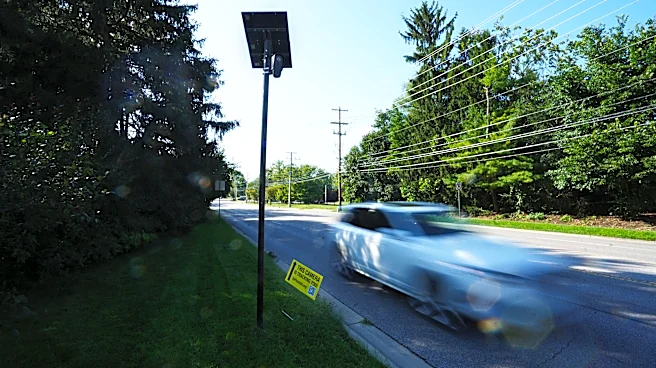






Two Reynoldsburg police officers resigned amid investigations into accusations that they misused Flock Safety license plate reading cameras.
In Columbus, an officer may face discipline after a city investigation found he used the cameras to investigate a personal, off-duty traffic crash in Gahanna.
Columbus Mayor Andrew Ginther also ordered police to stop sharing data from Flock cameras statewide after an audit found thousands of possibly immigration enforcement-related searches. He ordered more changes Aug. 28.
A majority of Columbus City Council members also told The Dispatch this week they would entertain getting rid of Flock cameras − and soon − because they don't believe existing safeguards do enough to satisfy their concerns.
Across the country,
at least 19 police and sheriff’s office employees in five states were arrested, fired, put on administrative leave or placed under investigation over the last two months for using Flock's vast network of cameras to track cars’ locations for potentially improper or illegal purposes.
But it wasn't their police supervisors who spotted their irregular search activity. It was USA TODAY reporters.
In each of those cases and more than a dozen others, the USA TODAY Network, to which The Columbus Dispatch belongs, flagged their patterns of questionable searches before their own agencies did. Only after reporters contacted their employers did the agencies spring into action.
Their cases illustrate a dynamic that is playing out in communities across the country. As Flock and other brands of automated license plate readers become ubiquitous in nearly every state, many law enforcement agencies have done little to monitor how their own employees use them.
Some of that work instead has fallen on journalists, activists and others concerned that anyone with access to the company’s private camera networks can follow virtually any driver's movements with a query as effortless as a Google search.
Search our Flock database
If you cannot see the Flock Search History tool below, click here.
Yet in direct response to increasing public scrutiny over abuse of its technology, Flock in December 2025 changed its systems to make officers' misuse exponentially more difficult for the public to unearth.
To reveal the officers' surveillance, USA TODAY analyzed more than 75 million searches of Flock license plate reader data spanning three-and-a-half years and more than 6,300 agencies – a fraction of the total number of searches by Flock users during that period.
The analysis identified hundreds of examples of law enforcement personnel searching single license plates hundreds or even thousands of times over prolonged periods, while justifying many of their searches with vague or nonsensical reasons, such as “SUS,” “TRAFFIC,” “INQUIRY,” “INVESTIGATION,” “TEST,” or a single letter of the alphabet, like “A,” “B” or “Z.” Where reporters could determine the targeted cars’ owners, they found several registered to the searching officers’ ex-partners, co-workers, family members and other people they knew personally.
Altogether, USA TODAY’s analysis surfaced 240 Flock users whose frequent and persistent searches stood out from more casual users. Reporters contacted the police agencies that employed 67 of them. In about half those cases, the agencies confirmed or launched investigations for potential misuse. The agencies did not respond in a quarter of the cases. For the other quarter, the agencies said they lacked sufficient information or the uses appeared legitimate.
Flock blacks out key data
USA TODAY’s analysis was possible because until December, Flock customers could access monthly usage audits that showed the initials of each person who searched the company’s camera data, the tags they had searched and their stated reasons for searching. In many states, those audits are public records that provide transparency into how officers use the system.
But Flock changed its software in December to black out most officer initials, license plate numbers and reasons from those logs, which will make large-scale analyses like USA TODAY’s virtually impossible in the future.
Flock declined to answer detailed questions from USA TODAY, providing only an emailed statement.
“Any officer abuse of our system is completely unacceptable, and the people that abuse our system should absolutely be held accountable,” said the statement from Paris Lewbell, Flock’s public relations manager. “We are committed to setting a baseline for where safeguards and transparency for our industry should be, and welcome further conversations and regulations from local communities about the rules of the road that they want to set for public safety technology.”
Lewbell said that Flock began redacting key details from audit logs because of a “pattern of people using publicly released audit data to identify undercover officers by name – publishing their contact information alongside details of active investigations.” When pressed by USA TODAY for specific examples, Flock did not provide any.
Amid a spate of headlines and police-officer arrests over abuse of its technology, Flock in January rolled out a new tool that helps their customers – thousands of police agencies, homeowners associations and private companies – flag people who abuse the system.
The company says the feature will detect officers’ abnormal search activity and shut off their access until an agency administrator can review it. In addition, Flock started requiring users to enter specific case numbers and offense types associated with each search.
That tool, however, allows agencies to audit their officers' search activity only dating back to January 2026. And Flock won’t require agencies to adopt it until next year.
Asked why the public should trust internal auditing as an adequate replacement for public oversight, given that many agencies allowed their own officers’ conduct to go unchecked for years, Flock did not respond.
Flock's redactions are "catastrophic" both for transparency and agencies' ability to spot improper searches by outside officers, said Dave Maass, director of investigations at the Electronic Frontier Foundation, a nonprofit whose mission is to ensure that technology supports freedom, justice and civil liberties.
"Flock encourages agencies to share their data nationwide, and now it's making it impossible for agencies to audit their data when it comes from an external entity," he said. "Flock is doing it solely to cover its butt. It wants to cut down on the reporting about abusive searches."
The change reflects the stance that Flock chief communications officer Joshua Thomas took one year ago in response to concerns about officers abusing its technology.
“It is not Flock’s job,” he said, “to police the police.”
Retracing officers’ steps
Flock’s changes make it much harder for the public to root out future abuse. But it was too late to cover up what was already out.
Before the changes took effect, many news organizations and civilians had uploaded agencies’ audit logs to Muckrock.com, a nonprofit newsroom and resource hub where journalists and others frequently share government documents and data obtained through public records requests.
From there, a USA TODAY reporter downloaded audit logs released by more than 120 police agencies in 24 states and obtained even more logs through additional records requests. Together, the logs contain records of more than 75 million license plate searches conducted from January 2023 to July 2026 by officers from 6,300 agencies – about a third of all law enforcement agencies in the U.S.
Because so many officers who looked up license plates ran their searches across not only their own agencies’ camera networks, but hundreds or thousands of others’, their searches still showed up in the data even when their own agencies refused to release it. That allowed USA TODAY to create a picture of at least 208,000 officers’ Flock usage.
USA TODAY’s analysis resulted in a list of many of the nation’s most prolific Flock users, many of whom had used the service to repeatedly search single tags. In many cases, they entered nebulous and implausible reasons for their searches, including “PLATE,” “TAG,” “POLICE” or “BOB.” Many of their searches spiked in the wee hours of the night.
Those users represent only the ones USA TODAY knows about. Of the 75 million individual search records USA TODAY obtained, just 14 million were fully unredacted.
Because most of the unredacted logs listed only the officers’ initials, reporters spent weeks scouring agencies’ websites, city staff directories, statewide badge registries and news articles to reveal the officers’ identities.
In some cases, USA TODAY identified the specific people officers had monitored by matching their license plates to parking or speeding tickets. When contacted by reporters, several of those people said they had been entirely unaware that officers had used Flock to track them.
Many of the agencies the officers worked for said they, too, were unaware.
Recent Flock reforms go only so far
The more agencies USA TODAY reporters contacted, the more apparent it became that many were not conducting routine audits of their officers’ Flock use.
USA TODAY submitted public records requests to 30 police agencies that employed prolific Flock users for any internal audits, investigations or reviews they had conducted of their officers’ Flock activities since January 2023.
Of the 14 that responded, four – the Eastpointe Police Department in Michigan, Albany County Sheriff’s Office in New York, Gurnee Police Department in Illinois and Mentor Police Department in Ohio – said they had no responsive records. Five denied the requests, saying that the records were part of pending investigations or disciplinary cases, that the request was too broad or that any such audits are exempt under laws governing the disclosure of license plate reader data.
The other five agencies – the Newton County Sheriff’s Office in Indiana, Braintree Police Department in Massachusetts, Lufkin Police Department in Texas and Georgia’s Braselton and Norcross police departments – provided records indicating that they had begun conducting audits only this year, when Flock introduced its “Audit Assistance” feature, which the company says is intended to help agencies detect unusual search activity.
Flock made that feature optional. About a third of agencies that use Flock had turned it on voluntarily as of early August, April Sigona, a Flock strategic communications consultant, told USA TODAY. But amid an onslaught of officer arrests and negative press coverage over misuse, Flock in August said it will make the feature mandatory for all law-enforcement customers by the end of 2026.
In an interview with USA TODAY, Flock CEO Langley declined to say what specific criteria meet Flock’s internal threshold for unusual activity. He said that the feature generally is designed to flag repeated searches of a single plate and late-night queries.
Jeanine Santucci contributed reporting.
Kenny Jacoby is an investigative reporter for USA TODAY. Contact him at kjacoby@usatoday.com.
Austin Fast is an investigative data reporter at USA TODAY. Contact him at afast@usatoday.com.
Jack Lemnus is a TCPalm enterprise reporter. Contact him at jack.lemnus@tcpalm.com, 772-409-1345, or follow him on X @JackLemnus.
This article originally appeared on The Columbus Dispatch: See if police tracked your car with Flock using new USA Today database