







It’s late August; school buses are a familiar sight on central Ohio roadways, and that means that school students have returned to the classroom for the start of another school year. For students in some area schools, returning to the classroom also brings return-to-school gardening.
School gardens are an effective tool in the curriculum for many classroom teachers. Hands-on learning in the school garden can help to reinforce many concepts taught in the classroom in academic disciplines such as science, math, literature, social studies and others. Students also develop interpersonal skills such as teamwork and communication when working on school gardening projects. Experiential learning in school gardens also complements and enhances specific
state learning standards set by the Ohio Department of Education and Workforce.
But in Ohio, the school calendar and the growing season don’t align very well. The growing season for most fruits and vegetables kicks into full swing in May each year, just as students begin summer break. While involving students in school gardening activities during the summer break is not impossible, there are many barriers that prevent many schools from maintaining school gardens during the summer months.
Aligning growing season with the school calendar
For the past several years, Columbus City Schools has utilized a novel approach to school gardening which allows teachers to operate school gardens during the school year and throughout the winter months – outside of the typical Ohio growing season calendar for most crops.
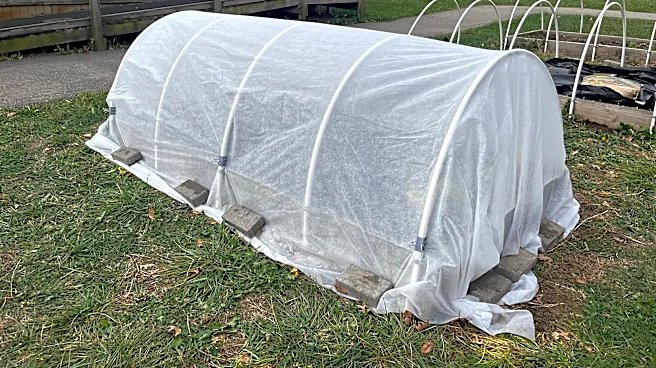
Through the use of outdoor raised-bed gardens and season-extension techniques such as row covers and low tunnels, students are able to grow cool-season crops throughout the fall months and into the winter.
In September, students plant crops such as radish, snap peas and cilantro in outdoor raised beds located at school buildings. Cool-season crops are those crops which do not require warmer temperatures to germinate, grow and mature. Most cool-season crops are not killed by frost and cold temperatures.

Other cool-season crops include root crops such as carrots and beets, lettuce, greens, green onions and cruciferous or brassica crops such as cabbage, kale, broccoli, Brussels sprouts, cauliflower and bok choy.
Students monitor weather and utilize row covers to protect crops from hard frosts and freezes. Row covers consist of cloth material which allows sunlight and rainfall to penetrate the cloth and reach the growing plants. The cloth is attached to hoops to keep the cloth above the growing plants. In fall and early winter, this creates the perfect microclimate for cool-season crops to flourish.
In November, students plant kale and spinach which grow during winter and are harvested in January and February and processed into kale chips and spinach smoothies that are enjoyed by the students. They harvest and enjoy the other fall-planted vegetables before winter break begins in December.
When students return to school in January, they grow lettuce indoors and in February, the process starts all over when students again plant cool-season crops in outdoor beds that they harvest before the school year ends in May.
While growing vegetables outdoors during the fall, winter and early spring can be a challenge in central Ohio, soil moisture is typically more favorable than in the hot and dry summer, and insects and disease pressure is greatly reduced during cooler weather.
CCS is the largest school system in Ohio
Columbus City Schools is the largest school system in Ohio with more than 45,000 students and more than 100 school buildings. Columbus City Schools may also have the largest school gardening program in Ohio, as more than 65 school buildings include at least one outdoor raised-bed garden and more than 350 individual classrooms have an individual indoor growing station.
Additionally, many school buildings grow vegetables and herbs indoors through the use of hydroponic gardens. Hydroponic growing systems grow plants without soil. Instead of growing in soil, roots grow in water mixed with specialized fertilizer and are provided with supplemental light.
Students grow basil and heirloom cherry tomatoes in indoor hydroponic towers and have also grown some crops which are not typically grown in hydroponic systems, including watermelon, okra, sweet corn and eggplant.
Teaching the teachers
Columbus City Schools also conducts professional development training programs to help teachers incorporate school gardening into their curricula and support achievement of state learning standards through hands-on gardening lessons. Classroom teachers participate in the professional development programs voluntarily on their own time, several times during the school year.
Classroom teachers in Columbus City Schools report positive student outcomes due to incorporating school gardens into their curricula, including improved attendance on days when students will be gardening. Some students who struggle academically have become leaders in school garden projects.
Students also participate in field trips throughout the year to learn about agriculture and food systems.
Mike Hogan is Extension Educator, Agriculture & Natural Resources and associate professor with Ohio State University Extension. He can be reached at hogan.1@osu.edu.
This article originally appeared on The Columbus Dispatch: Ohio students garden through the winter months