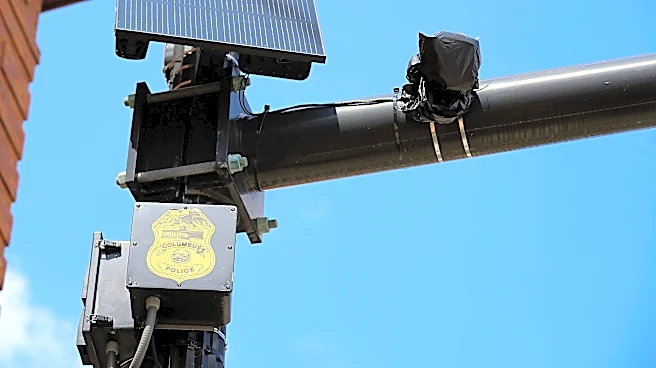







Columbus covered its controversial Flock Safety automated license plate reader cameras while the city investigates evidence of misuse by a police officer.
But even if the city dumps Flock automated license plate readers (ALPRs) – which police say are invaluable for criminal leads and finding missing people – the company's surveillance network will remain firmly entrenched across central Ohio. The 66 cameras Columbus has blinded for now are only a fraction of the more than 700 similar Flock cameras The Dispatch has documented across the region.
The Dispatch requested documents and data on Flock from nearly 40 local agencies. The records − from those that responded − show a vast network tracking central Ohioans' movements across suburban communities
and within the city.
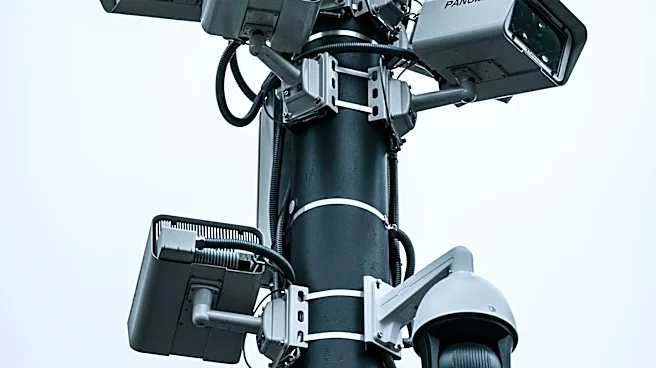
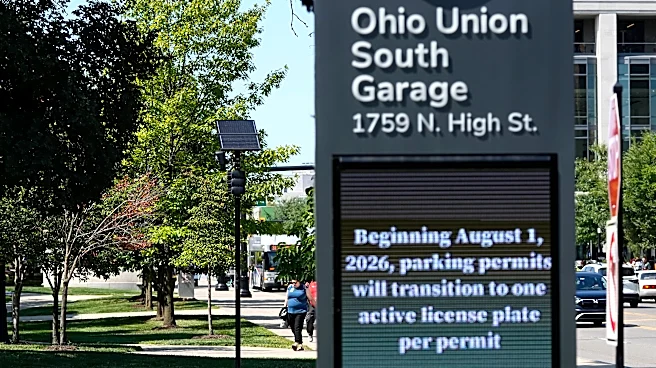
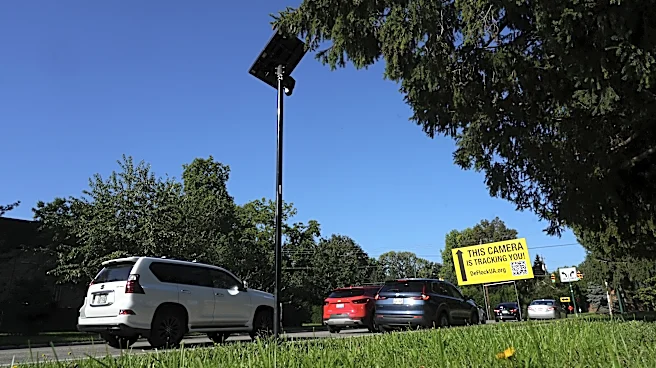
With little public attention, the solar-powered cameras proliferated over the last several years on central Ohio roads in every city in Franklin County along with many villages and townships. They stand on poles at private businesses, schools, apartment buildings and subdivisions.
Flock Safety, an Atlanta-based, privately-held company founded in 2017 and now valued at over $8 billion, has been feeling some heat over increased scrutiny nationally: Wired reported Sept. 18 that the company is offering voluntary buyouts to its 1,500 employees.
Although Flock Safety is nearly a decade old, opposition reached a fever pitch this summer in central Ohio and across the nation amid allegations of misuse and fears of widespread surveillance.
A Columbus officer is accused of searching a license plate hundreds of times with no law enforcement purpose. Two Reynoldsburg police officers resigned amid investigations into alleged misuse. In July, a Columbus audit found over 15,000 possibly immigration-related searches of Columbus Flock data in violation of city law.
Opposition to Flock bridges the political spectrum, from a leftist Worthington teen to a politically independent Reynoldsburg mother to Republican state lawmakers.
Critics cite oversurveillance concerns and reports of officers stalking women or officers confronting innocent people at gunpoint after the AI tech misidentified a plate. The issue resonates for those apposed to artificial intelligence and the data centers that power AI, harsh immigration enforcement, policing of women getting abortions and the wealthy investors backing Flock.
Sandra Coates, 33, a lifelong Reynoldsburg resident and mother of six, says she's concerned about data being collected on law-abiding citizens without a warrant.
"They're just spreading further and further," said Coates, who's active with an anti-Flock group called Flockoff Reynoldsburg. "And it's expanding into other ALPRs, drones, and just the whole idea of a mass surveillance state is concerning to me. I don't want my kids to grow up in that kind of world."
Reynoldsburg became the first city in central Ohio to announce it will discontinue its use of Flock cameras on Sept. 9. Hilliard also paused its program Sept. 14 and Worthington suspended external sharing Sept. 21.
Despite the mounting criticism, most central Ohio agencies continue with Flock. They have scrambled to implement new safeguards and audits. Columbus stopped sharing with the national network and then the statewide network this summer with the intention of preventing local data from being used for immigration searches by other law enforcement. Some, but not all, suburbs have done the same in recent months.
Whitehall and Sunbury have not changed their systems to prevent outside law enforcement from searching local data related to immigration and reproductive healthcare.
Ohio State University contracts for 77 Flock ALPR cameras around campus, more than any law enforcement agency in central Ohio. And despite an emerging pattern of officer abuse, OSU has never audited its data. A spokesperson said OSU is working toward audits later this fall.
The Franklin County Sheriff's Office would not disclose the number of mobile Flock cameras it has. Spokesperson Maria Durant said auditing procedures are in development and declined to share additional details. After an initial sweep of the data, Sheriff Dallas Baldwin said earlier this month a deputy was being investigated for misuse.
It’s impossible to publicly report exactly how many Flock cameras are in central Ohio. Flock will not disclose camera locations. Besides local government contracts, businesses have contracted for Flock cameras, including Lowe’s, Easton Town Center and Kroger as well as residential developments.
Nobody in city government appears to be tracking how many private Flock cameras are watching city roads. The Columbus Department of Public Service, which issues permits for privately funded Flock cameras to be attached to city and private utility poles, directed The Dispatch to the Division of Police for a list. Police directed The Dispatch to the Department of Public Service.
Amid the Flock controversy, some politicians have considered switching vendors. Anti-surveillance activists emphasize they don't want central Ohio cities to simply turn to a different ALPR vendor.
How does Flock work in Columbus suburbs?
Reynoldsburg, OSU police, Upper Arlington and Minerva Park were among the first adopters of Flock in central Ohio.
OSU started installing Flock cameras in late 2021 as part of an on- and off-campus safety boost, spokesperson Dan Hedman said. University officials declined an interview request with the OSU police chief.
Unlike some earlier plate readers mounted on police cruisers, Flock's fixed cameras can share data with statewide and national law enforcement agencies.

Many agencies surveyed by The Dispatch said they do “intermittent” audits of Flock use – and none said cases of misuse were found.
While a few agencies, such as Dublin police, set up a policy for auditing use before Flock cameras were installed, others like New Albany and Columbus had the systems for years before checking the data for possible misuse.
Rules vary widely around central Ohio. Flock first implemented filters on immigration and reproductive health-related searches in November 2025 but rollout has not been uniform since then.
At least nine local agencies share data on the national network and 13 agencies share with the state network. That means other agencies around the country and the state can access local camera data.
Federal immigration law enforcement used to have a pilot program to directly access Flock but the company ended the program in 2025 amid public backlash. Local agencies that still share on the state and national networks – including Delaware police and sheriff’s office, Sunbury, Whitehall, Obetz, Powell and Gahanna – also are still connected to law enforcement agencies that have cooperation agreements with U.S. Immigration and Customs Enforcement.
On the other hand, Dublin stopped externally sharing its data with anyone in July.
Reynoldsburg thought the city opted out of the national network from the start. However, Mayor Joe Begeny said at a July council meeting that Flock mistakenly added the city to the national network in 2023, including for immigration-related searches, and city officials didn’t catch that until residents raised concerns in April.
A Flock spokesperson said in an email that agencies have control over sharing settings.
Most local law enforcement agencies responded to a brief set of questions the Dispatch shared about how Flock works and how data is shared. Two – the Franklin County Sheriff's Office and the Columbus Regional Airport Authority Police Department – largely declined to comment. An airport spokesperson confirmed that the agency has 13 Flock cameras and has been under contract with Flock since 2024.
Which agencies still don’t have transparency portals?
As part of a rollout of several reforms, Flock Safety encouraged agencies on Aug. 13 to set up its public transparency portal feature showing the public that can show an agency's policies, data retention period, sharing partners and search activity.
Over half of the agencies in Franklin and Delaware counties have turned on a transparency portal, as of early September, although the level of details provided vary.
When The Dispatch asked some without portals when they would be posted, several said that they were working on it.
OSU does not have a transparency portal and does not have plans to publish one. A spokesperson said “nothing to share related to this."
Resistance to Flock grows around central Ohio
In recent months, grassroots groups have popped up across central Ohio and the country to fight Flock, including the Safety Not Surveillance Coalition in Columbus, Deflock Upper Arlington, Deflock Worthington and Flockoff Reynoldsburg.
Paul Shannon, 42, cofounder of Deflock Upper Arlington, says his group had about 50 attendees at its most recent meeting. Group members include people on the political left and the right, he said.
"Less than 1% of the searches coming through our cameras originate from UAPD," Shannon said. "We're really harping on the fact that you're using UA tax dollars to build surveillance infrastructure that's mostly just serving non-UA agencies."

Ellie Miles, 19, who graduated from Worthington Kilbourne High School in 2025, said she first learned about Flock cameras from a TikTok video and her heart sank when she found out they were installed at Kilbourne and other schools. Worthington Schools ended its Flock contract Sept. 1 but there are 14 cameras contracted through the city of Worthington.
"We as American people need to start looking out for each other more than letting large corporations do whatever they want just because they have money," Miles said.
A Republican state lawmakers said he would introduce legislation to ban mass surveillance technology, including Flock, without a search warrant and the sale of surveillance data.
Dave Maass, the director of investigations at the non-profit advocacy group the Electronic Frontier Foundation, said that cross-partisan opposition to ALPR technology is growing because people are starting to see that the trade-off of “eroding core freedoms” is not worth “solving a few more car thefts per year.”
“I don’t think anyone who thinks about this for more than five seconds is going to think it’s a legitimate trade-off,” Maass said.
Does Flock work?
Hard data on whether Flock Safety ALPRs help keep people safe is hard to find. Terrence Hinton, a professor of sociology at OSU, said that academic research has not kept up with the pace of deployment of Flock cameras and that the peer-reviewed research in a few years will have more answers.
Chad Marlow, a senior policy counsel with the American Civil Liberties Union, said at a Sept. 23 U.S. Senate hearing that research shows surveillance cameras have "no effect" on crime besides car thefts in parking lots and public transportation.
Researchers working for Flock published a study in early 2024 that suggested Flock can reduce clearance times, but it was not published in an academic journal. Other research on ALPRs has not shown the cameras lead to a reduction in violent crime.
Police and some municipal leaders point to anecdotes about Flock helping to find stolen vehicles, reunite missing people and solve criminal investigations. The Columbus Division of Police has said Flock data aided in 60% of recent homicide arrests.
Deputy Columbus Police Chief Justin Coleman pointed to an incident from Aug. 17 when two were shot outside Antioch Jordan Church on Woodland Avenue during a funeral. The shooter drove a stolen car with no license plate, but police used Flock data to find the vehicle within 15 minutes and arrest the suspects within hours.
"We would not have found that vehicle in a timely manner without (Flock)," Coleman said. "That's just one of the most recent examples."
Begeny said Flock helped Reynoldsburg police recover dozens of stolen vehicles.
“Without this technology, most of these cases would not be solved and they would not be ended in such an efficient manner,” Reynoldsburg Police Chief Curtis Baker said in a July meeting.
Some agencies still adding cameras
Some agencies still are adding the technology. That includes Perry Township, home to nearly 4,000 people interspersed around northwestern Columbus.
"The number of cities that have signed up during this time is ten times the number of who have paused," Trevor Chandler, senior director of public affairs for Flock Safety, said during an August panel in Columbus.
Perry Township signed a two-year contract with Flock on July 24 for two cameras that will be deployed “where and when they are most needed” in areas with increased criminal activity, Police Chief Steve Cesaro said.
The cameras will be on the statewide network but won't share data nationally. Cesaro added that rules about use, searches, access and audits are still in progress. Before the cameras are first deployed, the township will publish a Flock transparency portal, he said.
“As a smaller agency with limited staffing, we felt this approach would provide us with an additional investigative and patrol tool that allows us to strategically deploy technology where it can have the greatest impact,” Cesaro said.
Anna Lynn Winfrey (awinfrey@dispatch.com) and Jordan Laird (jlaird@dispatch.com) are reporters for the Columbus Dispatch.
This article originally appeared on The Columbus Dispatch: Columbus paused using Flock cameras. They're still everywhere