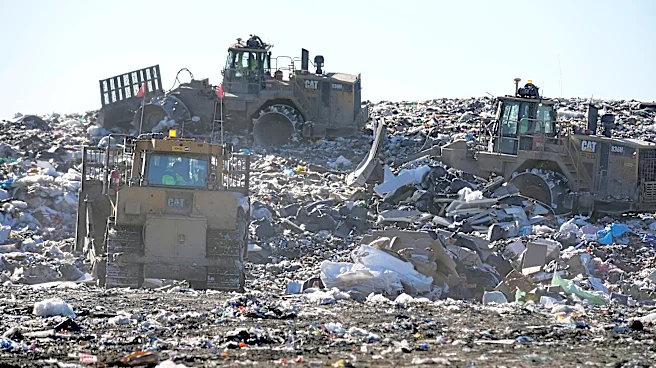








A distant flock of birds circles above open bags of trash — a scene you might find after a midnight raid by hungry racoons in your backyard. Here, gross tonnage measures the trash dumped by a constant parade of trash emptying from 5 a.m. to 5 p.m. The landfill is a stew of frenzied labor amid a cloying floral scent blended with rotting fruit, musty basement and diapers.
Welcome to the top of the Franklin County Sanitary Landfill in the far southwestern corner of Franklin County. At about 1,200 feet above sea level, consider it our Everest, 200 feet above surrounding ground and the highest man-made mound of earth in the county.
The Columbus region is growing at about 1% per year, twice the national average. The landfill's intake mirrors that growth.
And with new homes feeding the waste stream, the landfill is expected to reach its capacity in 40 years. It's a grim deadline that landfill officials say residents can help extend.
Currently, about three-fourths of everything in the landfill shouldn't be there. Food and corrugated cardboard are the landfill's top culprits by weight, according to the Solid Waste Authority of Central Ohio (SWACO), which manages the operation.
Food, if not saved as leftovers, can be composted or put in a kitchen disposal. Cardboard recycled. And heavy objects donated or sold as scrap.
"We view the landfill as an asset, something we want to protect and prolong the life of," said Hanna Greer-Brown, SWACO spokesperson. "In order to do that, we need everybody who uses it to be kind of thinking the same way."
"We try to make it really convenient, and free, not to bring it to the landfill," she said of items that can instead go to a SWACO household hazardous waste disposal site.
An ever-expanding mountain fed by consumer appetite
On the terraced drive up the landfill's side, earthmovers have dug out what appears to be a large swimming pool, a sprawling one, the size of about 20 football fields.
This 25-acre earthen cutout will be covered by a black synthetic liner that will cover a 2 1/2-foot thick clay liner, sand and a network of drainage pipes to collect liquid at the bottom. That liquid will be drained into a master lagoon that pumps out landfill liquid into pipes crossing Interstate 71 east into the Southerly Water Reclamation Plant at 6977 S. High St.
"This is what the bottom of a landfill looks like," said Adam Burleson, senior operations manager with 37 years in the waste industry.

This crater just south of London-Groveport Road in Jackson Township near Grove City will soon be filled, not with water, but with remnants of our throw-away society: outdated clothes, televisions, toys, bicycles, mattresses. furniture, food containers and food. A seemingly endless list.
This will become the landfill's eighth cell, or sprawling addition, to the massive hill seen from Interstate 71 that has steadily grown since it opened four decades ago.

SWACO conducts regular audits of what it receives from the 41 communities in Franklin County it serves. A waste characterization study helps determine which areas need help recycling or composting. Education is Greer-Brown's mission.
Thousands of visitors, including many school groups, visit annually and hear her conservation appeal.
"We like people to see this. When you throw something away at home, it doesn't actually go away. It comes here," she said. "It's an eye-opening experience for people to maybe think about what they're consuming and what they do with it, and maybe makes composting and recycling a little more appealing to them."
What's it like on the county's highest man-made mountain?
On a beautiful fall morning, a virtual aviary of barn swallows, sparrows, turkey vultures and hawks watch from above. Every new garbage truck opens its tailgate and expels, on average, 15 tons of compacted waste. A typical truck visits as many as 1,000 homes before leaving for the landfill.
The bulldozers push trash toward vehicles with spiked wheels. They, in turn, spread and compact the refuse, into a slurry of muddy earth. The goal is to cram the most weight into a cubic yard as possible and extend the life of the landfill. About 1,600 pounds per cubic yard is the standard that is constantly measured.
"It's like when you put your foot in the kitchen garbage can and make more room. We're doing the same thing here," said Burleson.
The landfill's capacity, whenever it is reached, will leave a massive mound that future generations may ask about.
"Eventually when we cap it, the moisture will all drain down and it will be a dry tomb," said Burleson. "Forever."
A gentler, natural side of a landfill
Growing along the landfill's sides are tall grasses, clover, wildflowers and scrub plants, helping control erosion and appearance. There are also six working beehives on the site to help pollinate, added two years ago to improve biodiversity.
The bees can travel five miles and "not only help pollinator patches we put in, but it will also help the farmers ... the trees and everything else in this area," said Burleson.
At the top, there's a clear view of downtown Columbus 14 miles away, a tranquil setting belying the violent process of unloading and mangling.
This burial ground amid the swirling, noisy frenzy of engines, diesel exhaust and avian pickers is guided by the garbage truck drivers eager to return to the suburbs for more.
A slight westerly breeze on this morning may have lessened the odor – akin to a hot day beside an alley dumpster in the University District. Off-putting, but not unbearable. The sweet foulness is built into the operation.
The landfill wants to be a good neighbor, and uses a perimeter misting system that dispenses atomized fragrance, kiwi-watermelon, lilac or cinnamon, sometimes referred to as "landfill perfume." Shopping malls like Easton Town Center are know to do the same to encourage sales. For a landfill, it's more of a deodorant.

Collecting methane, creating fuel source, hoping message is heard
In a large building with a green roof, workers are collecting the byproduct of decomposition of decomposing matter.
"The whole landfill is under a vacuum and we suck the methane out. They take the gas, clean it and make it to where they send right into the pipeline for natural gas to be used," said Burleson. "We sell our gas to them and its renewable."
Burleson said the operation is safe, with truck operators in air-conditioned, fully enclosed cabs.
The Ohio EPA controls much of the landfill's operation.
"After we close the site, it has to be monitored for 30 years. And that's just the initial time. Back before they came out with the regulations we follow, somebody would just find a valley or ravine and throw their trash in it. And that's the opposite of what we want to be doing."

When the operation closes, a new location will be found. Trash disposal won't stop.
Before the mid-1980s, a similar landfill was used at what is now Phoenix Golf Links, 3413 Jackson Pike, where gasses still vent and are burned off. And Gowdy Field, Columbus parkland and baseball complex near Grandview Heights, was a landfill in the 1960s before that.
There's no telling what is buried within the current or former depths.
"We're not allowed to scavenge," Burleson said. "If it's in the trash, it's getting compacted. People bring in boats sometimes. We've had a couple of mobile homes brought in. I haven't heard of any bodies."
Growth and development reporter Dean Narciso can be reached at dnarciso@dispatch.com.
This article originally appeared on The Columbus Dispatch: Franklin County's landfill will reach capacity in 40 years. Can it last longer?