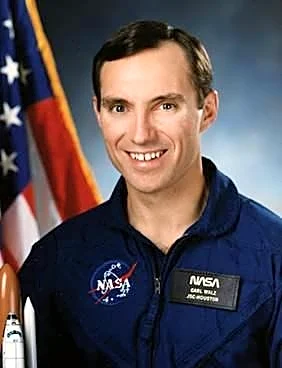








Carl Walz had no idea how to get to space, but when he watched fellow Ohioan Neil Armstrong step foot on the moon from his parents' living room TV in July 1969, he knew he wanted to become an astronaut.
There was no clear path for aspiring astronauts at the time, with the space race still in its early stages. But Walz was determined to figure it out.
His mom, on the other hand, wasn't too thrilled with her son's otherworldly ambitions.
"My mom hated it, but I persevered," Walz joked. "They were very proud. It's just when you see your kid apply for something that's fairly dangerous, it's hard not to worry."
Getting from Ohio to outer space
Walz grew up in the northeast Ohio suburb of Euclid and attended Kent State University, where he joined the Air Force ROTC program thinking it would
give him a leg up on the competition to become an astronaut. He eventually rose to the rank of Air Force colonel before he retired.
He applied to NASA for the first time in 1987 and was rejected. So he applied a second time and still didn't make the cut.
Thinking the third time might be the charm, Walz applied yet again. He got close, but still didn't get the job.
Walz wasn't discouraged, though, and his fourth application was accepted in 1990. He began his space career with NASA shortly thereafter.
"At that time, I had no idea how to get to that point. I knew these guys were military and had technical degrees," Walz said. "It just all came together. There were no real clear footsteps out there to follow in to get to the moon or into space at the time. You just kind of figured it out."

Multiple missions lead to space record
Those four applications to NASA would translate to four missions.
Walz took his first trip to space in 1993. On that mission, he said astronauts deployed two satellites, and he got to participate in a seven-hour spacewalk outside of the ship.
"That first mission is really special. The first time you get into space is really cool because you get to look out at the Earth," he said. "It was just so beautiful over the Atlantic Ocean."
On his fourth and final mission, which stretched from December 2001 through June 2002, Walz set the then-record for the longest space flight. He worked at the International Space Station for more than six months, he said.
After that fourth trip, Walz took a job at NASA headquarters. Now "semi-retired," as he put it, Walz is still involved in space endeavors.

Life after NASA
He continues to help consult with NASA and other companies that are trying to propel space travel forward. His son, an engineer, followed in his footsteps by working on spacecraft.
Walz said he's happy that a new space race has kicked off with NASA's Artemis missions set to bring Americans back to the moon for the first time in decades.
"NASA is trying to do some really ambitious stuff, and they need help, so we're trying to share what we know and see if we can help get them over the finish line," Walz said.
Although his days in space may be long behind him, Walz said he still appreciates the astronauts before him who helped pave the way for him and so many others. He said he still stays in touch with astronauts he met at NASA, and from time to time, he walks through the visitor's center at the NASA Glenn Research Center in Cleveland.
It's a little odd, he said, to see his own gear and suits on display in museums around Ohio.

One of his suits is on display in the rotunda of the Ohio Statehouse through Nov. 3. The suit, Walz joked, was one of the most uncomfortable ones he had to wear while in space.
"It's kind of cool," he said. "It really doesn't feel like it's been that long at all."
Dispatch investigative reporter Max Filby can be reached by email at mfilby@dispatch.com. Find him on X at the handle @MaxFilby or on Facebook at @ReporterMaxFilby.
This article originally appeared on The Columbus Dispatch: Carl Walz went from watching Neil Armstrong to setting a space record