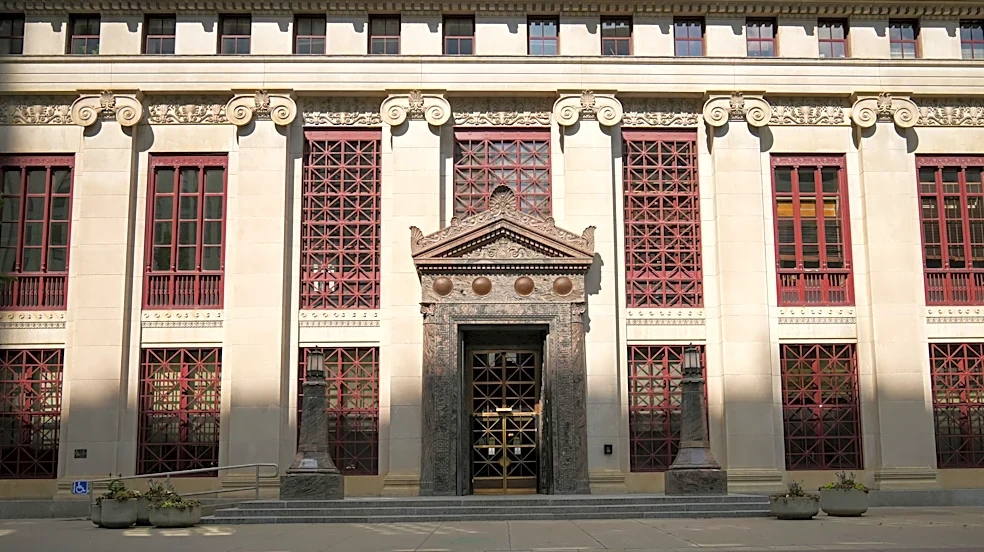









In an escalation of Columbus City Hall's budget fight, Council President Shannon Hardin is introducing two pieces of legislation aimed at restricting how Mayor Andrew Ginther's administration budgets as council prepares to consider a scaled-back bond sale.
Meanwhile, the understaffed Columbus Division of Fire has continued to blow through its overtime budget for 2026, erasing any modest cuts by Columbus Division of Police on overtime spending. Columbus budgeted about $9.5 million for Division of Fire overtime this year, but the division has spent nearly $17 million on overtime as of Oct. 16, according to numbers from City Council's Legislative Research Office. The city is projected to go over budget on police and fire overtime by at least $23
million this year.
The budget fight between Hardin and Ginther, who are both running for mayor in 2027, will be on display on Oct. 19 during a council hearing at 9 a.m. and council's regular meeting at 5 p.m. At the latter meeting, council will vote on one of the ordinances Hardin is proposing to rein in the Ginther administration on the budget. The other ordinance will be on first-read and voted on at a future meeting.
Hardin has accused Ginther's administration of mismanaging the city finances, of being deliberately opaque and of using the city's capital funds to cover the city's payroll. Ginther and his team have said the city faces financial pressures but is responsibly managing tax dollars. Restricting budgeting tools, they say, could put essential city services at risk.
"I'm becoming less and less comfortable with the mayor's ability to take seriously our budgetary concerns," Hardin previously told The Dispatch in explaining why he is introducing legislation to codify fiscally conservative practices.
Ginther's chief of staff, Elon Simms, told The Dispatch in an emailed statement that Hardin's proposed restrictions are not good policy.
"It unnecessarily limits our ability to manage financial challenges and puts essential city services at risk," Simms said. "Council President Hardin owes residents more than political theatre. He owes them an explanation of how restricting these resources strengthens the city’s finances, protects essential services, or improves our ability to meet the needs of a growing Columbus.”
What would Hardin's two proposals do
Council will vote on emergency on Hardin's proposal to direct the city auditor to estimate police and fire overtime expenses for 2027 to inform the operating budget. The city charter obligates Ginther to present council with a proposed operating budget for next year by Nov. 15.
Hardin's other proposal, on first-read, would update city code to curb how much the city can tap into the city's debt services fund, called the Income Tax Set Aside (ITSA) subfund. Hardin, City Auditor Jacquelin Lewis and some other members of council have expressed concerns about the Ginther administration increasingly paying operating costs with the ITSA fund, which is meant to pay the city's debt obligations on capital projects.
Lewis has warned that the credit agencies are watching. A downgrade of the city's triple-A bond rating from the credit agencies could make borrowing for future projects more expensive.
If passed, Hardin's proposed code change would essentially require the city to reduce its use of ITSA for qualifying non-debt expenses by 10% each year.
Context: Budget pressures facing Columbus
Simms said the Ginther administration will present information at the budget hearing on the pressures facing Columbus, including rising personnel costs, inflation and the demands of a growing city at the same time that state funding cuts over years have forced Ohio cities to rely more on local income tax revenue.

Columbus police and fire personnel costs, which represent a large share of the city's budget, have been driven higher by large pay bumps that began with new collective bargaining agreements in 2024. For a time, the city had an influx of federal pandemic cash that helped cover some of those expenses, but the city by federal law had to spend that by the end of 2024.
Ginther's finance director, Chris Long, has previously acknowledged that tapping ITSA for operating expenses is not a long-term solution, and the Ginther administration is taking steps to balance the budget. This includes not filling hundreds of vacant positions on the city payroll outside the Department of Public Safety.
In 2026, the city is tapping into about $50 million from ITSA to pay for non-debt items and balance the city's over $1.2-billion operating budget. For context, the city brought in nearly $920 million in income tax in 2025 so about $230 million went into the Income Tax Set Aside subfund.
A smaller capital bond sale
City Council will also vote at their Oct. 19 meeting on a reduced capital bond sale. The city delayed the sale in June after Lewis said she wasn't comfortable with the size of the sale. Council will consider 10 revised ordinances to authorize bond sales up to $381 million to fund capital projects, down from the approximately $518 million sale originally proposed by the Ginther administration.
The bond sale is for the 2025 capital budget since the city is about a year behind on bond sales because the COVID-19 pandemic delayed a sale for a year.
Ginther has recently pressured council to pass his historically large $2.8 billion 2026 capital budget proposal by holding media interviews at ongoing capital projects. Hardin has suggested reducing the size of the capital budget as the two politicians wrestle over the city's finances on multiple fronts.

Hardin and other council members have accused Ginther of his own political games for creating a false sense of urgency around passing the 2026 capital budget he proposed in September before the bond sale for the 2025 capital budget is even approved.
"The mayor is out there like Oprah, telling neighborhoods, 'You get a car, and you get a car,' when the city still hasn't paid for the car we promised them years ago," Hardin previously told The Dispatch.
At an Oct. 13 media availability Ginther held next to ongoing construction on East Broad Street, Ginther said passing the 2026 capital budget would help city projects stay on track.
"The people of Columbus deserve a council that is focused on the most pressing needs of the community as we continue to grow and that means we need to continue to invest with critical projects like this," Ginther said.
Government and politics reporter Jordan Laird can be reached at jlaird@dispatch.com. Follow her on X, Instagram and Bluesky at @LairdWrites.
This article originally appeared on The Columbus Dispatch: Hardin pushes fiscal controls, smaller bond sale in budget fight with Ginther