






Spotted lanternfly
(lycorma delicatula) populations increased exponentially in some parts of Greater Columbus this summer. The colorful moth-like adult stage of this insect was most noticeable starting in August, and large populations of the adults can still be found as they are currently laying eggs, which will hatch next spring. They will continue to lay eggs until they are killed by cold weather later this fall.These insects have spread so widely throughout Franklin County and the rest of the state that the entire state is under quarantine for this pest, and the public no longer needs to report where the pest has been found.
While some chemical insecticides have been proven to kill this insect, applying insecticides to the locations where
the insect is located can be challenging and can also harm beneficial insects in the landscape. If your home landscape was inundated with this exotic and invasive insect this year, you may want to search for and remove egg masses this fall. Egg removal before hatching offers the best opportunity for reducing populations of this insect next summer.

Understand the life cycle
There is one generation of spotted lanternfly each year in Ohio. The adult insects lay eggs from September to November, which hatch from April to June the following year. Egg masses are laid on the surfaces of trees, decks, fence posts, houses, outdoor equipment, rocks, etc., and are protected with a mud-like covering. Each egg mass contains an average of about 35 individual eggs.
After hatching and before reaching adulthood, the insect goes through four nymphal stages called instars. Newly hatched nymphs are less than 1/8 inch long and can be hard to find and are sometimes mistaken for small ticks or spiders. With each molt to the next instar, the nymphs roughly double in size. The first three instars are black with white spots. The last (fourth) instar is red with white dots and black stripes and is approximately 1/2 inch long.

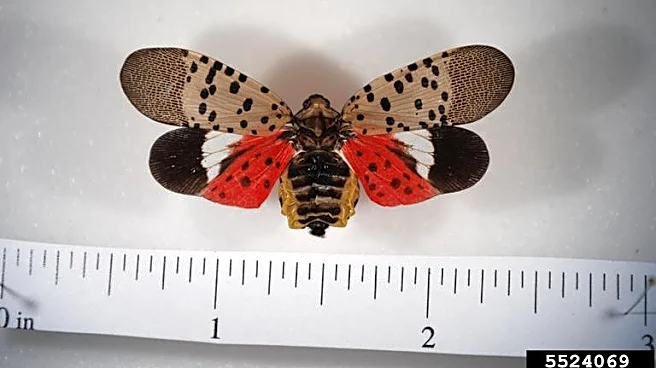
Nymphs become adults in August and remain active as adults until they are killed by hard freezes later in the fall. Adults are the most obvious and easily detectable stage because they are large (about 1 inch) and highly mobile. Adults have black abdomens with yellow bands that become visible as they mature. Their forewings are gray with black spots, and the tips are black with gray veins, while their hind wings are red, black and white.
Only the adults have wings and can fly. However, because adults walk more than fly, their wings often remain closed, leaving only the forewings visible. This makes them more difficult to identify in low numbers, from a distance, or when they are high in a tree.

Fall and winter a window for control
The key to preventing a larger explosion of spotted lanternfly nymphs next spring is to locate and destroy egg masses this fall and winter. The insect typically lays its eggs in a variety of places and on a wide range of surfaces. One common place to find eggs is on or near trees where the adult insects were observed this summer. Trees preferred by spotted lanternfly during the fall include red maple, silver maple and willows, so these trees are an excellent place to start looking for egg masses.
Egg masses can be destroyed by scraping them from the surface where they were laid into a solution of alcohol or soapy water and then disposed of in household trash. Eggs also can be destroyed by thoroughly smashing them. Avoid damaging the bark of trees and woody ornamentals when scraping or smashing egg masses.
It is important to keep in mind that you will not be able to reach all the egg masses deposited on a tree. Researchers have documented that less than 2% of the egg masses laid on large trees were at a reachable height of up to 10 feet from the ground, leaving 98% of the egg masses above reach on larger trees. We do not recommend using ladders or climbing trees to get to egg masses.
Each destroyed egg mass can remove about 35 spotted lanternflies from the next year's generation, but you are unlikely to destroy all egg masses in your landscape, and continued management strategies may be necessary next spring and summer.
Mike Hogan is Extension Educator, Agriculture & Natural Resources and associate professor with Ohio State University Extension. He can be reached at hogan.1@osu.edu.
This article originally appeared on The Columbus Dispatch: How to find and destroy spotted lanternfly eggs in your yard