





Something like one-third of Americans believe in reincarnation. Apparently, these wishful thinkers mostly want to come back as animals. Golden retrievers, eagles and tortoises are popular rebirths.
I have a word of advice for the reincarnation crowd: caterpillars. As in, don’t come back as one. I’ll circle back to that in a bit.
Caterpillars are the larvae of butterflies and moths, mostly the latter. Worldwide, moth species outnumber butterflies by a factor of eight. In Ohio, the imbalance is far greater, with moths probably bettering butterflies by a factor of nearly 20.
As George Carlin once said, “The caterpillar does all the work, but the butterfly gets all the credit.” How true that is. People marvel over showy butterflies and cool moths that come
to their lights, but many probably don’t even know that they were once a caterpillar.

That’s a shame, as caterpillars are a huge part of our natural world. Believe it or not, they are, by biomass, often the largest group of herbivores in many places. Not white-tailed deer. Take all the deer in 71,000-acre Shawnee State Forest in southern Ohio. I don’t know how many deer that would be, but they’d make an enormous pile.
Now somehow harvest every single caterpillar in Shawnee in early September, when their numbers are the greatest. The caterpillar pile would dwarf the deer heap.
Virtually all caterpillars are vegan, and their fare is wild plants. Plants do not want to be eaten, we must assume, and they practice better living through chemistry to battle the ravenous caterpillars.
Plants produce myriad compounds that evolved to ward off caterpillar consumption. Caterpillars continually evolve resistance to these phytocompounds, and some species always crack the chemical code and can eat even the most toxic species.
The best-known local example of this is the monarch butterfly. It only eats members of the milkweed family, and these plants are rich in toxic cardiac glycosides. Excepting the butterfly, milkweed tussock moths and a handful of other moth caterpillars, little can eat these poisonous plants.

Milkweeds’ opposite is the white oak (Quercus alba). Over 500 species of caterpillars use it as a host plant, nearly all of them moths. Possibly the oldest plant in the state is the famous white oak in Old Logan Cemetery in Hocking County. That behemoth has spawned millions of caterpillars over its long life.
Humans are beneficiaries of this age-old evolutionary warfare between plants and caterpillars. Many anti-caterpillar phytochemicals are used in foodstuff, medicines, spices, dyes, rubber and much more.
Perhaps the greatest ecological role of caterpillars is transforming plant tissue into an edible form of protein that can be eaten by birds. Few birds eat leaves, but rare indeed would be the bird that would reject a caterpillar. They are nature’s hot dogs; little steaks on legs. They are the major component of many songbirds’ diets. Were caterpillars to vanish, so would orioles, tanagers, vireos, warblers and many others. Forests would fall silent.
Even vegetarian songbirds such as sparrows harvest caterpillars when they have chicks in the nest. Nestlings need rich protein sources to fuel their growth, and caterpillars fit the bill.
It isn’t just birds that hunt caterpillars. A favorite of black bears is one of the most reviled caterpillars by humans. Eastern tent caterpillars make large silken nests in black cherry trees in late spring. Many people despise them, and I have heard of ecological ignoramuses using blow torches to burn them from the trees. But black bears love them, and a bruin can eat up to 25,000 (22 pounds!) tent caterpillars a day.
There are perhaps 100black bears in Ohio, and their numbers are increasing. This is a wonderful case of a once-vanquished mammal coming back, and caterpillars are helping to fuel their recovery.
Predation rates of caterpillars are astronomical (take note, reincarnationists). Probably only a few percent survive the predatorial gauntlet. Thus, moths and butterflies carpet-bomb reproduce by laying hundreds of eggs to ensure some survive to adulthood. Caterpillars are a base layer of food webs.

Caterpillars are masters of disguise and are incredibly adept at hiding. Furthermore, most species are nocturnal and active when most birds are not. Special tactics must be employed to find them. Caterpillar-hunters must venture into the dark forest and employ special blacklight flashlights. Many caterpillar species fluoresce brightly under ultraviolet light, greatly upping the odds of finding them. Some groups, such as sphinx moth caterpillars, glow so brightly that they appear to be plugged into a light socket.
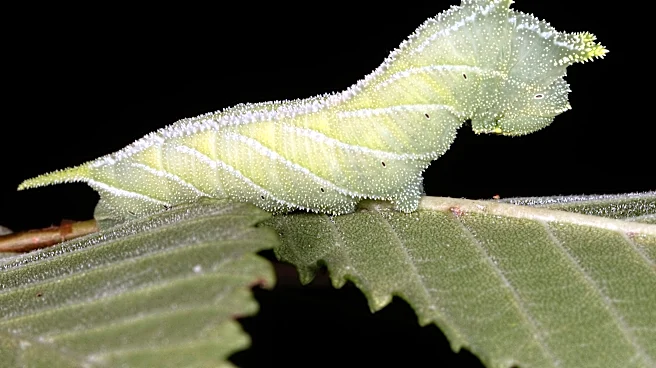
Moth and butterfly larvae are tubular objets d'art and make fascinating photographic subjects. Hunting them and trying to portray their amazing artistry with a camera becomes addictive.
On Aug. 22, Shauna and I traveled to the backwoods of Jackson County to the 195-acre spread of our friends Julie and Rod Sheets. It was larval madness, and it seemed that every tree produced interesting subjects. Some of my captures from that nocturnal safari accompany this article.
To learn more about caterpillars, visit The Caterpillar Lab at thecaterpillarlab.org.
Naturalist Jim McCormac writes a column for The Dispatch on the first and third Sundays of the month. He also writes about nature at jimmccormac.blogspot.com.
This article originally appeared on The Columbus Dispatch: Caterpillars are the unsung heroes of nature