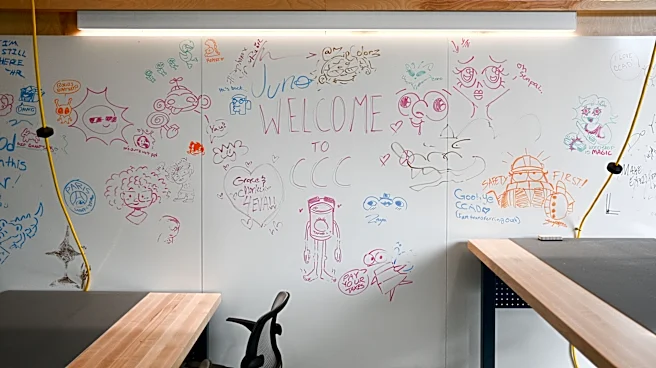





After years of imagining how to transform its campus' eastern gateway, the Columbus College of Art & Design officially opened its new Center for Creative Collaboration this semester, a 27,000-square-foot space designed for students, faculty, businesses and community partners to learn, make and collaborate together.
It is the college's first major new building project in decades, since completing the Design Square Apartments residence hall in 2006, CCAD President Melanie Corn told The Dispatch during a recent building tour.
"We're a smaller campus, so we don't get to build a new building every year," Corn said.

That means CCAD had to be thoughtful about what the space should be. It needed permanence but also the ability to be flexible for years
to come. Fall enrollment is still down from pre-pandemic figures, with 761 students enrolled this fall, according to the college. But CCAD did see a 22% increase in committed students from Franklin and Delaware counties following the launch of its Creative Pathway initiative.
"We don't know what the future of art and design education will look like in 20 years," Miranda Kridler, CCAD's vice president of planning and operations, said during the tour.
The Center for Creative Collaboration isn't entirely new build. The project gutted and significantly built upon Battelle Hall, a 1940s-era Chrysler body shop that CCAD converted into design studios and workshops in the 1970s. That initial renovation covered up much of the building's original character and eliminated most of its natural light. It's surface parking lot left much to be desired in terms of green space.
In addition to tearing out Battelle Hall's interior, the renovation built out an 8,000-square-foot, two-story addition, installed an elevator, and reopened covered windows to reintroduce natural light to the space.
Corn said college leaders started to think about reimagining the space in 2018 and submitted renovation plans to the city in 2024. By then, CCAD's "Here for Change" capital campaign, which recently raised more than $25 million for the college and exceeded it $20-million goal, was already underway.
A majority of funding for the $15 million Center for Creative Collaboration came from the capital campaign, and Corn said that zero tuition dollars were used for the project. Additional funding came from CCAD selling off a studio space on Grant Avenue for $3.6 million to Columbus Fashion Alliance, $1.4 million from the city of Columbus and a $1 million federal grant.
CCAD broke ground on the project in 2025 and opened its doors to students at the start of fall semester.
The Center for Creative Collaboration, in some ways, serves the same purpose as it's predecessor, which housed the college's sculpture, jewelry and metal studios, a wood shop, a welding shop and classroom spaces.

Those spaces are still present in the Center for Creative Collaboration, but now with so much more, Corn said. All of CCAD's digital fabrication and design innovation labs are also housed in the building, eliminating the need for students to cross campus to use different tools.
All first-year students are required to take classes in the building regardless of their major. Corn said it gives students a chance to be exposed to new tools and mediums, as well as an opportunity to level the playing field. Not every freshman came from a high school with enormous art programs.
"There are a lot of tools that students might not know," she said. "Early exposure is key."
First-year students in the building's new fabrication studio watched as a laser cutter whirred away at pieces of wood. Later, they'll use those pieces in the updated wood shop down the hall to build caddies to hold supplies they'll use throughout their college career.
"The life-cycle of a project can happen under one roof," Kridler said.

CCAD doesn't have an official student union, so Corn said the building was also designed with downtime in mind, particularly for its commuter students. About 60% of CCAD students live off campus, and long studio classes are sometimes hours apart. The Center for Creative Collaboration has both large communal spaces, sound-proof nooks, and kitchenettes around the building for students to use for studying, eating or relaxing between classes.
"Students want to hang out here while they're making," Corn said. "Their practice is 24/7."
The Center for Creative Collaboration is also a space for businesses and community partners to work with students on projects. Beginning this year, every CCAD student will graduate with a business concentration. Students will learn skills like invoicing, social media marketing, grant writing and negotiating a contract.
Students are also required to graduate with at least one experiential learning opportunity under their belt, whether it be an internship, a co-op or working with a real-world client in class. CCAD students and faculty have spent 300,000 hours working with more than 300 local and regional organizations since expanding its experiential learning requirement in 2019, according to the college.

The new creative center building is another example of how CCAD is cementing its place in central Ohio's creative economy and in its pocket of Downtown, Corn said.
Whether its freshmen getting their first taste of college life, community members enjoying evening and weekend art classes, or businesses wanting to work with students, Corn said the Center for Creative Collaboration is "an invitation to experience CCAD's creative campus."
Higher education reporter Sheridan Hendrix can be reached at shendrix@dispatch.com and on Signal at @sheridan.120. You can follow her on Instagram at @sheridanwrites.
This article originally appeared on The Columbus Dispatch: CCAD unveils new $15 million Center for Creative Collaboration