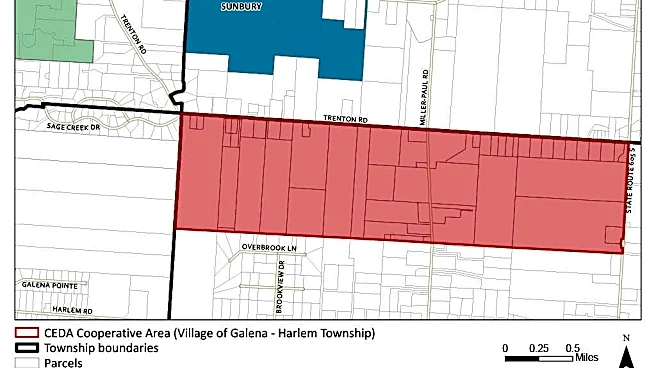







Harlem Township and the Village of Galena have approved a 50-year economic development agreement for a 1,000-acre cooperative area in the northwest corner of the township to share infrastructure, increase revenue and reduce annexation pressure.
The Cooperative Economic Development Agreement (CEDA) will allow Harlem Township to protect its boundaries while still encouraging development, while Galena can provide utility services and diversify its revenue. The goal between the two Delaware County communities is to maintain small-town charm without getting left behind or losing financial security.
The cooperative district represents the area in Harlem Township where Galena has the ability to provide sewer services, according to an FAQ document. Harlem will
oversee planning and zoning for the areas included in the CEDA. There is no current plan to change the zoning in the cooperative area, and Harlem Township's land use plan will control the area.
While the agreement is in place, neither the village nor the township can facilitate or accept an annexation of land within the cooperative district, according to the FAQ.
The township and village held public hearings on the proposed agreement before it was adopted and said most residents who attended supported the deal.

Harlem Township benefits from Galena's infrastructure
There isn't currently an imminent development problem to be solved, Harlem Township Trustee Adam Holliday told The Dispatch. The village and township are interested in staying proactive while central Ohio development booms.
"I don't think we want to take an isolationist point of view trying to prevent the growth," Holliday said. "We think that where we live is a wonderful place to be, and we wouldn't fault anyone else from wanting to live there. Do we want considerable sizable infrastructure and huge buildings taking up a lot of that beautiful space? Maybe not. But that's why we need to be intentional with what that growth and development looks like for the generation to come."
The availability of infrastructure drives development, Holliday said. The township does not have the necessary infrastructure to support certain businesses. However, Galena has its own sewer system.
With the CEDA, if someone wanted to set up business in the northwest corner of the township, where the CEDA land is, they would not need to annex their property into nearby Sunbury or Galena for sewer services.
"Harlem will now be able to provide financial resources to build and grow out the infrastructure while maintaining that land as part of Harlem Township," Holliday said.
What's in it for Galena?
While Harlem Township protects its boundaries, Galena can help instill trust in its residents that it will maintain its village status, Galena Mayor Jeff Kinnell said. Additionally, the CEDA allows Galena to stay relevant while maintaining financial security.
This agreement will let Galena have a seat at the table, Galena Councilmember Gillian Doucette said.
"If a landowner in this corridor does have the opportunity to sell to a developer or some type of development, the township and village have already worked out a path forward," Doucette said. "So there's not the scramble for trying to find sewer utility or annexation out of anyone's control. We've already agreed to the partnership."
Doucette grew up in Harlem Township, and she has family still living there. She said she wants Harlem's land to be protected, and she wants to see Galena diversify its income. Encouraging development in a designated zone like the cooperative area can produce "creative revenue streams," Doucette said.
As part of the CEDA arrangement, Joint Economic Development Districts (JEDDs) are under consideration. A JEDD allows the village to collect income tax in the area even though the land remains in the township, according to the FAQ. JEDDs may be expanded when needed for new development, and revenue will be split evenly between Harlem and Galena.
However, those who have property within the CEDA boundary will not be held to additional taxes.
Additionally, all net revenue from economic development incentives like tax increment financing (TIF) or JEDDs will be shared equally. TIFs use future gains in property taxes to pay for infrastructure and redevelopment in an area.
"For us, it's the mix of revenue that we're missing in the village right now," Kinnell said. "We really don't have a lot of commercial. We're working to establish more of a mixed-use plan for the village to diversify our revenue some. But this agreement allows us to use all those vehicles depending on the situation that would be faced when the time comes."
What kind of developments do Harlem and Galena prefer?
Galena is interested in mixed-use commercial primarily in the form of small businesses, Kinnell told The Dispatch. The village's zoning code limits the size of buildings allowed and encourages owner-occupied buildings, which Kinnell said is "not so necessarily true with townships."
"Our infrastructure doesn't necessarily support the kind of traffic that high-density development provides," Kinnell said. "And that's another reason we're interested in the outcomes of these things, and that's why we want to have a seat at the table. Because we'd like to drive outcomes that don't lead to that kind of intensity in our roads and in our schools and you name it."
Harlem Township is interested in "smart development," Holliday said. Residents don't want high-rise apartment buildings or "huge technology infrastructure buildings," Holliday said.
"But I also don't think we want 26 square miles of one, 2,500-square-foot house on every two and a half acre plot," Holliday said. "That's just that's not what folks want really."
When creating mixed-use development areas, specificity and proper articulation of township needs is important, Holliday said.
"The township is evolving," Holliday said. "It's no longer an agrarian community. It's a transient community. People live here, but they're driving outside of the township to spend their money. They're going outside of the township for all of these things. And so as that growth and development continues to encroach continuously closer on where we live, we want to be able to provide what that looks like."
Dispatch Reporter Nora Igelnik can be reached at nigelnik@dispatch.com.
This article originally appeared on The Columbus Dispatch: Harlem Twp., Galena OK 1,000-acre cooperative area to control growth, up revenue