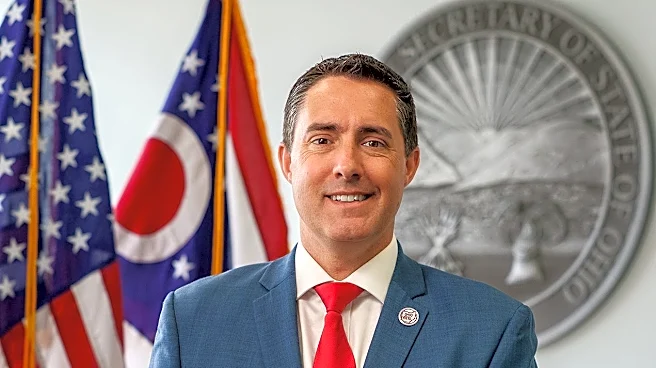

Ohio voters this fall will decide who should serve as the state's financial watchdog, choosing between Republican Secretary of State Frank LaRose and Democratic Maple Heights Mayor Annette Blackwell for
auditor.
The Ohio auditor is responsible for reviewing financial records of all public offices and investigating fraud and corruption within public agencies. The auditor also sits on the seven-member Ohio Redistricting Commission, which draws lines for state legislative districts and can play a role in congressional redistricting.
Republican Keith Faber has served in the role since 2019 and is now running against Democratic attorney John Kulewicz for attorney general.

LaRose, 47, is on his second, four-year term as secretary of state, and term limits bar him from running again. He ran for U.S. Senate in the GOP primary in 2024 but lost to Bernie Moreno. LaRose grew up in Northeast Ohio and later enlisted in the United States Army, serving as a Green Beret.
Blackwell, 64, has served as mayor of Maple Heights, a Cleveland-area city of roughly 23,000, since 2016, with her current term slated to end in December 2027. Before public office, she worked for companies including KeyBank, University Hospitals of Cleveland, Deloitte and Ryan LLC.
The Dispatch asked LaRose and Blackwell the same four questions about their ambitions for office. Here's what they had to say.

Why did you choose to run for state auditor?
LaRose
Many Ohio families are worried about cost of living, and to LaRose, "unaffordable government" is one factor that contributes to those concerns. He said performance audits can help keep costs down by improving government efficiency.
"It's finding ways to make government operate more affordably so that they're not asking you for more of your hard-earned dollars, and that's something that I'm really passionate about − making sure the government delivers on the things that it needs to deliver but does so in an efficient way," LaRose said.
LaRose said combating fraud would be another priority. Regardless of party, whether it's somebody "stealing Medicaid benefits" or "a crooked bureaucrat," he said fraud is an "ugly form of crime" he'd focus on stopping if elected.
Blackwell
When Blackwell stepped into office as mayor of Maple Heights, she said the city was in "fiscal emergency." Since developing and carrying out a five-year fiscal recovery plan in four years, the city has been released from fiscal emergency and received four Clean Audit Awards, Blackwell said.
"I know what it takes to fix a broken budget," she said. "I've done it here in Maple Heights, and I think it's time that we have a proven fiscal reformer as our auditor."
Blackwell also pointed to her time before public office, when she worked in fields such as property tax consulting and installment lending. She said across her entire career, she's managed real budgets in a way that translates well to the auditor's role.
If elected, what would you want to accomplish, and what do you think you reasonably could?
LaRose
LaRose said one of his priorities would be standardizing government data so agencies can more easily identify trends, inefficiencies and potential fraud.
"Both fraud, which is a criminal act, and waste, which is usually the result of negligence or sloppiness, can be a bit of a needle-in-the-haystack exercise," he said. "But modern data science, particularly empowered by AI, can be your metal detector so that you're digging in the right part of the haystack."
LaRose also wants to require performance audits in certain circumstances for local governments "so we can come in and help them find ways to operate more efficiently." Audits are currently mandatory for certain state agencies but largely optional for local government entities, he said.
Blackwell
Though holding bad actors accountable is an important part of the state auditor's role, Blackwell also wants to find ways to "protect local government funds from being raided," she said. During her time as mayor, she said she watched state lawmakers reduce funding even as communities like Maple Heights struggled financially, a challenge she largely attributes to a 2008 property tax reappraisal that caused home values to fall by more than 30%.
"I want to be an office that identifies the many ways that entities find themselves in a fiscal crisis and be more of a partner," she said.
"I certainly want to hold bad actors accountable, no matter how powerful or connected, but I don't just focus on the bad actors," she added. "Maple Heights was not a bad actor, that's not what happened to us."
What makes you the most qualified candidate for state auditor?
LaRose
LaRose pointed to his eight years as secretary of state and eight years in the Ohio Senate as a "proven track record" for his readiness to be state auditor.
"I bring a soldier's attention to detail. I have served for many years in the military and still continue to. I bring a tireless work ethic; I think that's just something I'm known for," he said. "Working to make government more efficient was a main focus of my time in the state Legislature. If you look at the transparency that we've delivered and the trust, my role as secretary of state is all about making sure Ohioans know that they can trust their elections. My role as state auditor will be making sure that Ohioans know that they can trust that their dollars are being spent according to the law and efficiently."
Blackwell
Blackwell said her combined professional experience – both in public office and in the private sector working in the financial space – has "prepared [her] for this next level."
"I don't go in trying to figure out what the job is. What I did in Maple Heights – I had not held public office – but it was an easy transition for me," Blackwell said. "I didn't understand local government, but I understood business. And Maple Heights is a $50 million business. So I understand business very well at a relatable, relevant level. I go in ready day one."
"There hasn't been a Democrat – I'm going to go there for just a few seconds – in this office for a very long time, since 1995, and there's never been a person that looks like me," she added. "I think representation matters, especially in the area of sitting on the redistricting commission."
Do you think the state auditor should continue to be a separately elected official, and why or why not?
Both candidates agreed Ohio's system of electing its state auditor, rather than having the position appointed by the governor, is the right one.
LaRose
"One of the responsibilities is to audit state agencies, and of course those state agencies report to the governor – that's the way that should work, those are cabinet officials that serve at the pleasure of the governor," he said. "You need to have an independent state auditor who can hold those kind of entities accountable, not somebody who is appointed by the governor because of the natural conflict that would bring up."
Blackwell
"I want to make sure we've had a chance to vet his or her credentials, they have a work record that says that they're qualified for the job, there is a record of their effectiveness, their success," she said. "How does this person appear? How do they represent me? I want a good representative, and you get to do that when the people are choosing. When it's appointed, you get what you get."
This article originally appeared on The Columbus Dispatch: Frank LaRose, Annette Blackwell face off for Ohio auditor