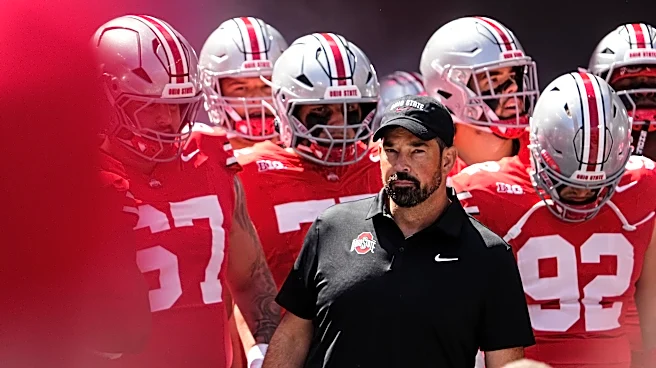





As Ohio State shifted its attention to Texas this week, coach Ryan Day welcomed the challenge on the horizon.
“This is why we're here,” Day said. “We come to Ohio State to play in games like this.”
The Buckeyes’ visit to Texas marks one of the most anticipated games of the year, a rare meeting between historic blue-bloods and two of the leading national championship contenders.

“It’s great for college football,” Day said. “This is going to be an unbelievable atmosphere against a great opponent. Everybody in the country will be watching.”
It also happens to be the type of high-stakes nonconference game that schools are weighing against the risks of missing
the College Football Playoff.
After Texas was left out of the 12-team postseason in December, coach Steve Sarkisian questioned the schedulingof the home-and-home series with Ohio State, which handed the Longhorns one of their three losses in 2025.
But the Buckeyes’ nonconference scheduling philosophy has remained unchanged.
“We want to lean in to these games until somebody tells us that we shouldn't,” Ohio State athletic director Ross Bjork said.
The home-and-home with Texas is the first in a run of games against SEC powerhouses over the coming years. The Buckeyes face Alabama in 2027 and 2028, then Georgia in 2030 and 2031.
Ohio State has long prioritized scheduling high-profile nonconference games. Before the series with Texas, it also had a home-and-home with Notre Dame in 2022 and 2023, following ones with Oklahoma and Virginia Tech during the previous decade.
“If there's data that shows that these games hurt you if you come out on the wrong end, that's where you look at it differently,” Bjork said. “But, right now, there shouldn't be data that says don't play Texas, don't play Alabama, don't play Georgia.”
Even as Ohio State remains committed to marquee nonconference matchups, it has not scheduled a new home-and-home in over half a decade. The agreements with Georgia and Alabama were finalized in 2019 and 2020, respectively.
Bjork pointed to the uncertainty over the playoff format as the primary reason for the holding pattern. The CFP announced this week that it is evaluating a potential expansion to 24 teams. There have been previous proposals for 16- or 20-team fields in recent months as well.
“Until the playoff expands and we see what that timing is, there’s no reason to do anything,” Bjork said, “and then I think we’ll have time.”
The Buckeyes’ nonconference schedules, which involve three games during the regular season, are filled through 2029.
Other factors have impacted scheduling as well. The SEC moved from eight to nine conference games this year. The Big Ten has discussed switching from nine to 10 conference games. The conferences have also discussed a scheduling agreement.
“There’s still a lot of fluid things,” Bjork said.
Ohio State sees several reasons to continue playing premier nonconference opponents.
Day pointed to the value of an early barometer for the Buckeyes, seeing games like Texas as an opportunity for a better self-evaluation in August or September. While the Buckeyes are atop the US LBM Coaches Poll, the Longhorns are No. 3.
“It will give us a great data point on where we are and early feedback on things,” he said.
The matchups are also significant draws, generating wide television audiences and attracting larger stadium crowds.
Bjork said earlier this year that Ohio State generated around $19 million in ticket sales when it hosted Texas last season, more than twice the amount of revenue from their other nonconference games at Ohio Stadium.
Not only do the big-name brands heighten interest among fans, but they also open the possibility for more competitive games.
“The closer the games, the higher the TV ratings,” Bjork said. “The higher the TV ratings, it leads to revenue. What do we all need in this environment? We need more revenue. The revenue piece in nonconference and conference cannot be overlooked.”
The Buckeyes have largely fared well in these nonconference games. While they lost to Oregon, which was previously a member of the Pac-12, in 2021, they swept their series with Notre Dame in addition to prevailing over Texas a year ago.
The win over the Irish in 2022 helped the Buckeyes to make the playoff, which was in its second to last year of a four-team field.
“Maybe we’d look at it differently if it did hurt us,” Bjork said.
But they have yet to find evidence of a downside.
“These games should matter,” Bjork said, “and we’re going to keep playing them.”
Joey Kaufman covers Ohio State football for The Columbus Dispatch. Email him at jkaufman@dispatch.com and follow him on @joeyrkaufman on X.
This article originally appeared on The Columbus Dispatch: Why Ohio State football remains committed to marquee nonconference matchups