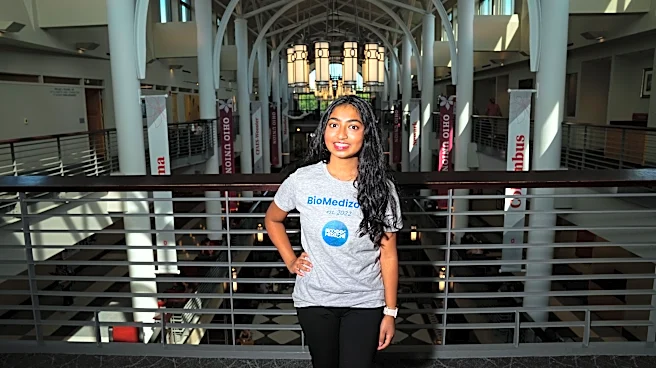





Before Anvi Palav was even old enough to carry a driver’s license, she already had her sights set on changing the world – and a plan for how to do it.
Palav founded the student-led nonprofit organization BioMedizonein 2022. The 19-year-old Ohio State University neuroscience major and full-ride Stamps Eminence Scholar was just 15 years old when she launched the program.
BioMedizone is a global initiative to provide high school students – especially those in underserved communities – with access to biomedical research and education. The nonprofit connects students with research opportunities, mentorship, internships, educational programs, career development resources and various STEM events.
To date, Palav said BioMedizone has impacted 3,000 students
in 68 countries, providing an estimated $1.5 million in free biomedical educational instruction and research programming.
BioMedizone helps bridge the educational gap
Conversations with her grandfather sparked the idea for Palav. He told her about the education system in rural India, where he had worked as a school principal. When she visited some of the schools herself, she was struck by the lack of extracurriculars available to students compared to U.S. schools.
Palav’s original vision for BioMedizone was simply to expand access to biomedical research and education to students everywhere. But within the first year, it became clear which young learners needed these programs the most.
“We just consistently had more people from developing countries or more low-income students that were more involved with our initiatives,” she said. “And all of the feedback we got from them was really that they just wouldn't have had this opportunity if it wasn't for us.”
Based on that response, after careful reflection, Palav decided to pivot BioMedizone’s mission to specifically reach students in underserved areas.

What does BioMedizone offer?
BioMedizone’s offerings include Camp Biomed, a virtual networking and research event with virtual labs and lectures led by doctors, professors and scientists from around the world. Students who attend the camp complete their own research projects, which they present to advisory board members and experts for the opportunity to earn sponsorships.
One of organization’s latest initiatives, Project Biovera, aims to support students in underserved countries by developing and implementing an interactive curriculum, science labs and mentorship programs. Participants in the project will also write and publish children’s books designed to improve scientific literacy.
Palav is particularly enthusiastic about The Junior Lab, a virtual research initiative that launched in early 2026. Participants in The Junior Lab work together in research and development teams consisting of 10 members. Current Junior Lab projects include a neurorehabilitation app for implementation in neurology clinics across the U.S. and an independent geospatial health data analytics project.
“What makes me super excited is the fact that something that we create and do research on could potentially make an impact on patients,” Palav said. “It’s definitely something new. It's not something BioMedizone has done before.”

Being a leader means overcoming challenges
Balancing the many responsibilities that come with running a globally reaching nonprofit in addition to being a full-time student hasn’t been an easy task for Palav, but she said her first year at Ohio State has impacted her approach to leadership.
“Networking, learning more about business and learning more about entrepreneurship are all really helpful things that OSU has just given me that have made me a better leader,” she said.
Despite her often hectic schedule, Palav said her biggest challenge has been securing funding as a young person.
“I feel like people do not trust the youth anymore,” she said. “I want to be a better leader. And I think trusting students to make research decisions, to get more experience in research, to take ownership of certain projects … young leaders can’t grow unless they’re trusted.”
BioMedizone aims to have larger reach
BioMedizone mainly relies on fundraising, but Palav said she and the BioMedizone team have recently begun applying for grants. The group has ambitious goals for the organization’s future, so the more funding they can secure, the better. In the next five years, Palav said they plan to push their impact from 3,000 students to 10,000.
“We want to try to reach every country there is in the world,” she said. “It's going to be hard, and it might not even end up happening, but I think seeing those numbers get higher and higher every year, it's definitely going to help us be more ambitious about it, and help us to be more hopeful.”

Reporter Kelly Tucker can be reached at ktucker@dispatch.com.
This article was made possible by support from the Center for HumanKindness at The Columbus Foundation, which has partnered with The Columbus Dispatch to profile those making our community a better place. Help us lift up inspiring stories of kindness by suggesting people, initiatives, or organizations to feature by emailing kindness@dispatch.com. The Dispatch retains full editorial independence for all content. Learn more at Dispatch.com/Kindness.
This article originally appeared on The Columbus Dispatch: BioMedizone opens doors to science for underserved students