




Thomas Suddes is a former legislative reporter and writes from Ohio University.
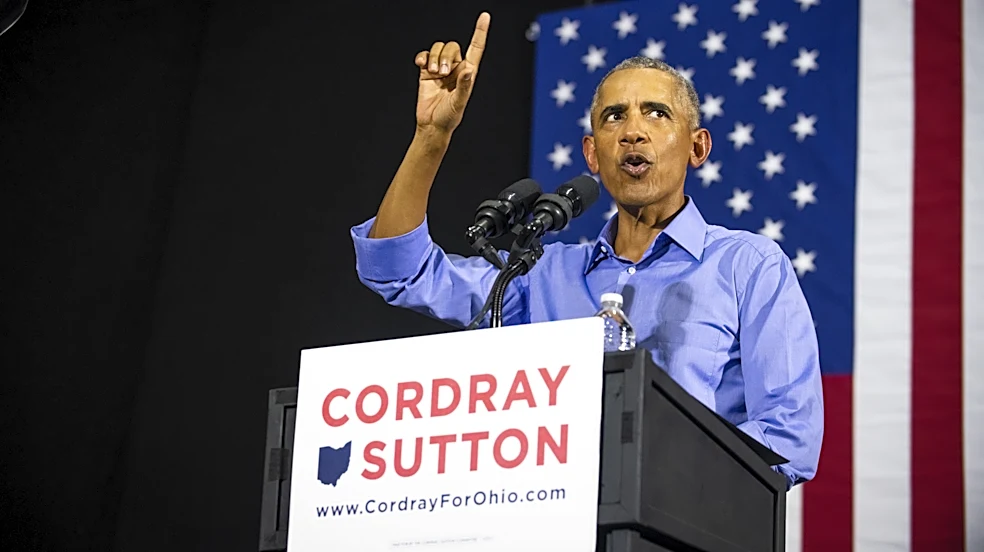
Former President Barack Obama’s Oct. 24 Cleveland visit is the clearest signal yet, if one were needed, of Democrats’ powerful determination to elect Dr. Amy Acton as Ohio’s next governor and replace Ohio’s appointed U.S. senator with former Sen. Sherrod Brown.
Acton and Brown’s respective Republican GOP competitors are tech billionaire Vivek Ramaswamy for governor and Sen. Jon Husted, appointed to the Senate by Gov. Mike DeWine when then-Sen. J.D. Vance resigned to become vice president.
Both Ramaswamy and Husted are residents of Upper Arlington; Acton and Brown, of Bexley.
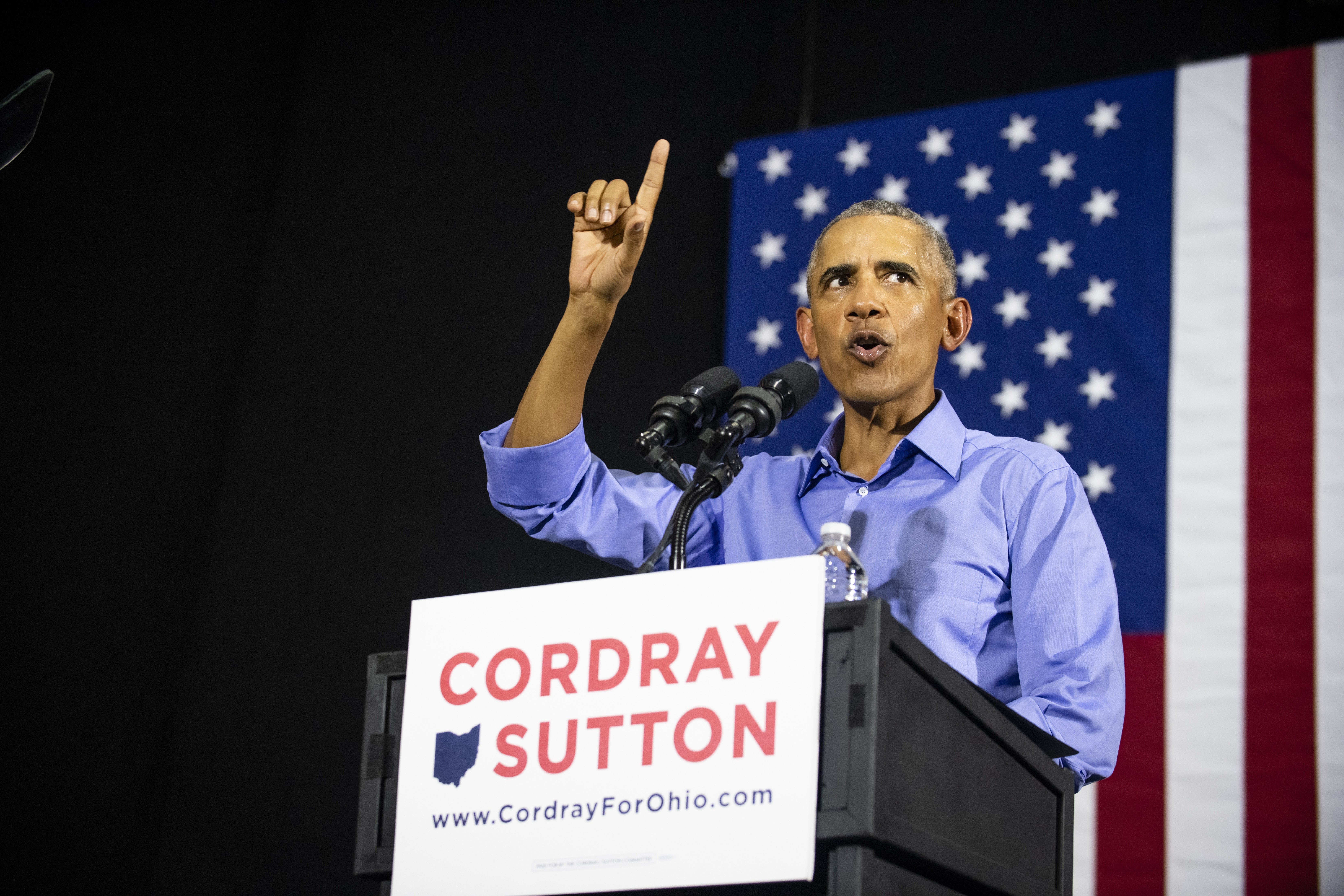
Ohio Democrats have long had a voter-turnout … um … challenge … in Greater Cleveland. Presumably,
Obama’s appearance could – Democrats hope, will – boost Democratic turnout in Cuyahoga County.
That’s critical because voter turnout has been slipping there. In 2008, when Obama first carried Ohio, 667,000 Cuyahoga County residents cast ballots.
In 2024, when former Vice President Kamala Harris, also a Black Democrat, was the party’s presidential nominee, a total of 582,000 Cuyahoga County residents cast ballots.
True, some of that decline is due to population losses, but far from all of it. And voting margins matter.
In 1948, Harry Truman only carried Ohio by 7,000 votes statewide – but carried Cuyahoga County by 43,000 votes.
And in 1976, Jimmy Carter only carried Ohio by 11,000 votes statewide – but carried Cuyahoga by 96,000.
Arguably, in each instance, Cuyahoga’s vote was decisive in how Ohio’s presidential electors cast their votes – for Carter in 1976, for Truman in 1948.
True, the Ramaswamy-Acton contest is not for the presidency, but in a way, it arguably is. Ramaswamy, originally a Cincinnatian, is an all-but-declared candidate for Republicans’ 2028 presidential nomination. (So is Vance, a Butler County native who now lives in Cincinnati), which should lead to some interesting intrigue among Ohio Republicans.
Can Obama appeal to Black Ohioans?
And it’s been a while since an Ohioan was on a presidential ticket; the last was then-Gov. John W. Bricker, vice presidential running mate to 1944 GOP presidential nominee Thomas Dewey of New York.
As charismatic as Obama indisputably is, he may nonetheless have a challenging argument to make among some Cleveland Democrats, especially Black Clevelanders who still suffer economic and social disparities despite eons of promises from politicians of every party and faction.
The challenges are strikingly documented in a report earlier this year by the Racism as a Public Health Crisis Coalition, which makes clear how steep – and critical – are the structural inequities between Black and white Clevelanders, inequities long lamented but addressed only episodically.
Rectifying those injustices is by no means an impossible task. But it requires focus not only in Greater Cleveland but also in Columbus and Washington. That’d be Acton’s or Ramaswamy’s task at the Statehouse, and Brown’s or Husted’s at the Capitol.
And it’ll be Barack Obama’s task Saturday to make the case that Acton and Brown are not only more likely to deliver those changes, but also more capable of doing so than Ramaswamy and Husted.
DeWine's last stand
In round numbers, Mike DeWine has about two months plus a couple weeks remaining in his term as Ohio’s governor. And there’s some unfinished business looming.
First, you have to wonder if the governor will have more to say – or do – about capital punishment and the 105 inmates awaiting execution on Ohio’s Death Row.
DeWine has made it clear that he opposes the death penalty. But he’s chief executive of a state whose General Assembly – mirroring widespread public opinion – supports the death penalty.
It’s unlikely that DeWine would, say like then-Illinois Gov. George Ryan, a Republican, commute to life sentences the death sentences of 167 Illinois prisoners just before Ryan left office in Illinois in 2003.
But DeWine is Catholic, and the Catechism of the Catholic Church teaches that “‘the death penalty is inadmissible because it is an attack on the inviolability and dignity of the person,’ and [the church] works with determination for its abolition worldwide.”
Earlier this year, DeWine declared his opposition to the death penalty; in contrast, a generation ago, as a state senator and former Greene County prosecuting attorney, DeWine was an author of Ohio’s current death-penalty law.
The governor is in an unenviable position, something people of good will, whatever their politics, will recognize – regardless of what, if anything, DeWine does about clemency.

Thomas Suddes is a former legislative reporter and writes from Ohio University.
This article originally appeared on The Columbus Dispatch: This Ohio city is key to Democrats hopes and Obama knows it | Opinion