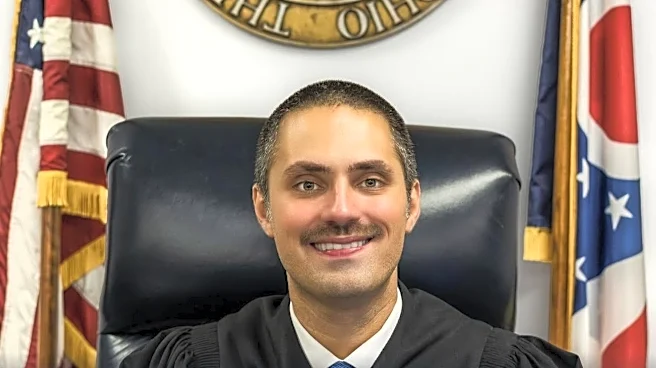



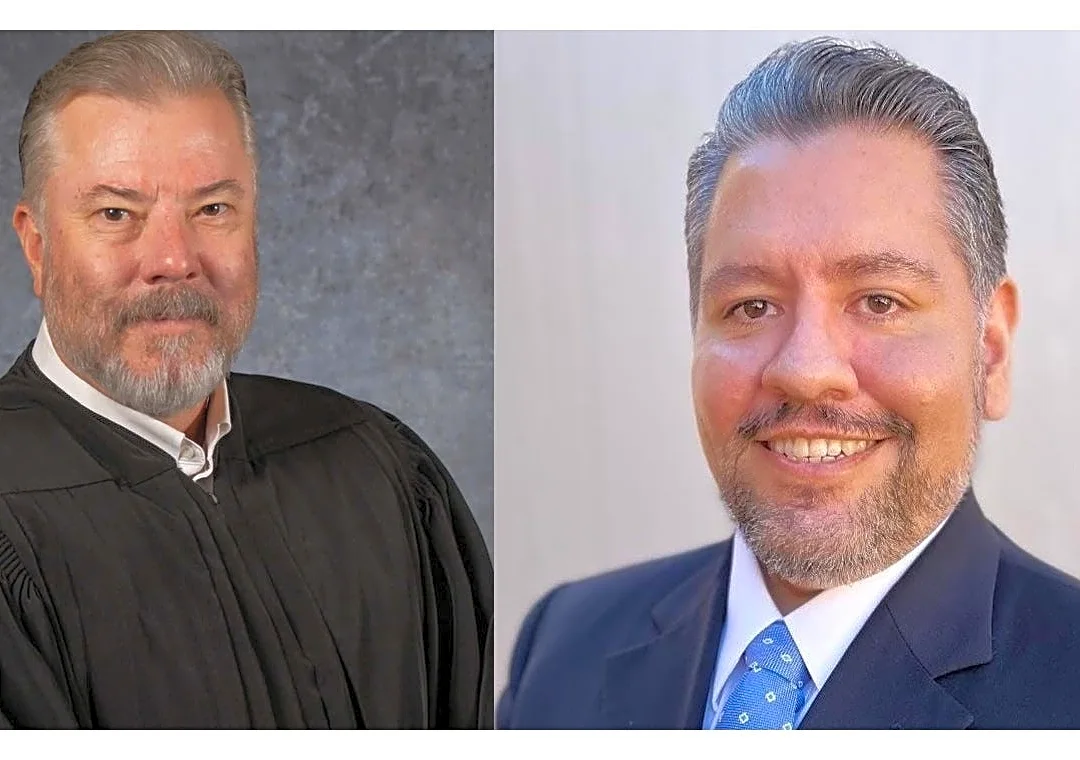
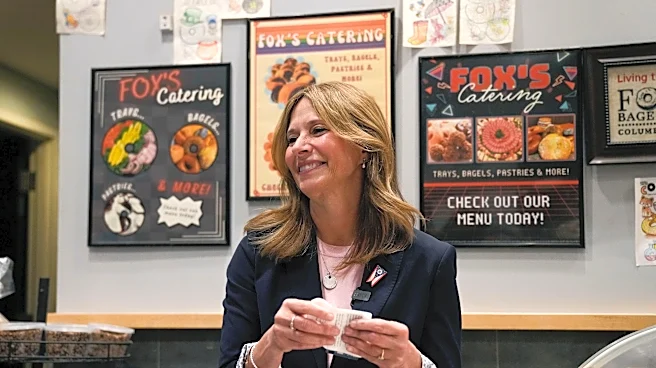


Voters will choose between two candidates for judge in the Licking County Probate-Juvenile Court, where Judge Deborah Lang is running for reelection.
Lang, a Republican, faces a challenge from Democrat Michael Dalsanto.
Ohio's general election is Nov. 3, with polls open from 6:30 a.m. to 7:30 p.m. Voters also may cast their ballots early at the Licking County Board of Elections
, located at 20 S. 2nd St. in Newark.The information below was supplied by candidates responding to a questionnaire. The Dispatch only edited responses for length or clarity.
Michael Dalsanto

Age: 40
Party: Democrat
Campaign website: DalsantoForJudge.com
Background: Advocating for kids isn't new to Michael Dalsanto. Dalsanto is a practicing trial attorney and an American government teacher
at Watkins Memorial High School, where he also teaches a dual-enrollment college course through Columbus State. For years, Dalsanto has served as a guardian ad litem in Licking County Juvenile Court, representing the best interests of children. He was recently elected president of the Southwest Licking Education Association, representing about 300 educators, and has served as acting judge in Licking County Municipal Court.
Why are you the best candidate? Too many people treat a judgeship as a destination: a title, a reward, a safe seat to hold. The actual job becomes secondary to keeping the seat. That's not me. Juvenile and Probate Court handles the hardest moments in a family's life: a child removed from home, a teenager's first serious mistake, a guardianship for a parent who can't manage alone. Those families deserve a judge whose first priority is the work. My career shows where my priorities are. I spent years in this courthouse as a guardian ad litem, in living rooms, schools and courtrooms, figuring out what children actually needed. I teach teenagers every day, and I've learned that kids do their best when an adult takes the time to really know them. I'm not running to be called judge. I'm running because I know this court, I know how to get the most out of kids, and I know that this court can do better.
What do you see as the most important aspect of the role of a judge in the juvenile court and why? Knowing what you're doing, caring about the job, and showing up on time. Every person in a juvenile courtroom has taken time they can't easily spare to be there: a parent missing a shift, a grandparent who drove across the county, a kid missing school. A judge who respects that time and treats everyone in the room with dignity earns the trust that makes this court work. Knowing what you're doing comes from perspective. As a guardian ad litem, I worked alongside parents, case workers, foster families, teachers, attorneys and the kids themselves, seeing these cases from every angle. That's what lets a judge find the resolution that works for everyone, not just the one that closes the file. Caring about the job means remembering that for the family in front of you, this just might be the most important day of their life.
What role and responsibility does the juvenile court have in protecting the community while also weighing a need for rehabilitation? This question gets juvenile court wrong. It treats community safety and rehabilitation as competing goals. They aren't. Nearly every young person in juvenile court comes back to our neighborhoods, usually within months. You can't lock anyone up forever. The real question is who they are when they come home. I try to focus on preventing the next victim. Juvenile court has something adult court rarely gets: a real chance to stop a pattern before it starts. Wasting that chance is how you create an endless cycle full of victims where nobody wins. It's easy to talk about being "tough on crime," but sending a juvenile to detention is both the simplest and most expensive choice. The hard choice (and the one that takes a good judge) is using the court's resources to hold a kid accountable, change their life, and ultimately make the community safer. Rehabilitation isn't the soft option; it's the long-term, cost-effective and moral solution.
What role and responsibility does the court hold in ensuring a child's safety in whether they are placed with family or in the custody of the county? The court is responsible for a child's safety in two ways: safe today, and safe for the rest of their childhood. Short-term safety sometimes means removal, and a judge has to be willing to make that call. But long-term safety comes from stability, and for most children, stability means their family. The court's job is to keep children home whenever it's safe to do so, and when removal is necessary, to get them home. Ohio law requires that agencies make reasonable efforts to prevent removal and reunify families, and I will hold them to it. When a child can't go home, relatives and family friends should be the first placement explored, not the last. As a guardian ad litem, I saw what families became with the right support, and so I view juvenile court's responsibility as being to provide the supports a family needs to get through a crisis and get things back on track.
Deborah G. Lang

Age: 46
Party: Republican
Campaign website: LangForJudge.com
Background: Deborah G. Lang has been Licking County's Probate/Juvenile Court Judge since 2021. She grew up in Licking County, where her family has lived for generations. Lang received her undergraduate degree at The Ohio State University and law degree at Case Western Reserve University. After five years as a family law attorney and as an adjunct professor of law at Case Western, Lang sought to return home and have a greater impact on her community. She served as a magistrate in the Licking County Domestic Relations Court for more than a decade, until Lang was elected as the Probate/Juvenile Court Judge.
Why are you the best candidate? I am the best candidate for this position for many reasons. I have more than 15 years of experience on the bench and have dedicated my career to helping families in conflict while protecting the children in our community. As Licking County’s Probate/Juvenile Court Judge, I have implemented technological advancements as well as many new programs to help families and children who are struggling. Two years ago, we opened the Assessment and Resource Center, and we recently launched a mentorship program for court-involved youth, both of which have received positive community feedback. I have spent six years presiding over hundreds of cases in both the Probate and Juvenile Courts. I serve on both the Juvenile Law and Procedure and Probate Law and Procedure Committees for the Ohio Judicial Conference and have presented at various judicial conferences about the innovations implemented in my court so others may learn from our example. Aside from all of my professional accomplishments, my legal knowledge, and 15 years of experience on the bench, I am the best candidate because I have proven myself to be a fair, impartial, hardworking judge who is dedicated to keeping Licking County a safe and thriving community for families to live and grow.
What do you see as the most important aspect of the role of a judge in the juvenile court and why? As the Juvenile Court judge, in delinquency cases (where a child has committed an offense), the most important aspect of my role is working to rehabilitate the child while ensuring safety for the child, their family, and the community. In cases of abuse, neglect, or dependency, when a child is removed from their parent or guardian, it is ensuring that the best interests of the child are being served, from the beginning of the case to its conclusion.
What role and responsibility does the juvenile court have in protecting the community while also weighing a need for rehabilitation? The Juvenile Court judge has a vital role in protecting the community from youth offenders. While the aim of Juvenile Court is rehabilitation, if I cannot ensure the safety of the youth, their family, or the larger community, then I will detain the youth so I know everyone remains safe and start from there to create a plan for rehabilitation. For example: I have a zero-tolerance policy regarding school threats. If a child makes a threat of any kind to bring violence to a school (whether threatening to bring a gun/weapon, or something else that could endanger kids and/or adults at the school or school activity) that child will be detained in a locked facility until that threat can be investigated. The risk is too great to do otherwise, even if that child is young, even if they think it was clearly "a joke." It is my job to ensure Licking County is safe from violent juvenile offenders, and as I tell the children and families in my court: I will do everything I can to help you find a better path, but not at the expense of innocent people. Community safety is paramount.
What role and responsibility does the court hold in ensuring a child's safety in whether they are placed with family or in the custody of the county? The court holds a great deal of responsibility in ensuring a child's safety when determining whether to place them with family or in county custody. While I have compassion for struggling parents and guardians, my compassion for the adults ends where the safety of the child is at risk if they remain with that parent or guardian. While it is always hoped that a parent will successfully work to rehabilitate themselves so they can reunify with their child, it is what is in the child's best interest that matters most. If placement with family (whether a parent or extended family) endangers a child's safety, then the court must place the child outside of that family.
This article originally appeared on The Columbus Dispatch: Meet the candidates in the Licking County Probate-Juvenile Court judge race