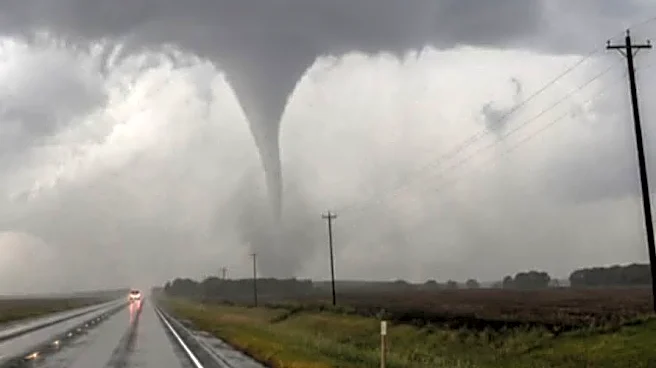




The National Weather Service has confirmed two more tornadoes touched down in Central Ohio.
The NWS office in Wilmington confirmed tornadoes
struck during severe weather Aug. 15, days after the possible derecho that struck Columbus and Central Ohio on Aug. 11. That storm brought hurricane-force winds, cut power to tens of thousands of people, caused severe flooding and spawned a tornado in south Columbus. Four inches or more of rain fell during that storm.The two newest tornadoes, both confirmed via video evidence, touched down north of Dayton and Springfield, the NWS announced Monday, Aug. 17. One was confirmed north of Fletcher in Miami County, north of Dayton. The other touched down north of St. Paris in Champaign County, Ohio, north of Springfield.
Additional details, including their ratings on the Enhance Fujita scale, path and wind speeds, are pending.
How does NWS confirm tornadoes?
After suspected tornadoes are spotted, crews from National Weather Service survey possible tornado damage in person.
The pattern of damage, not how much damage was caused, determines whether it was a tornado, according to the weather service. For tornadoes, with their violently rotating columns of air, damage often has a chaotic appearance, with larger uprooted trees often crossing each other. Weather service surveyors often look at larger uproots of trees to get a true idea of where the wind was blowing from.
What's the difference between a tornado, a macroburst and a microburst?
The National Weather Service defines a microburst as a localized column of sinking air within a thunderstorm. Wind speeds in microbursts can reach up to 100 mph or higher, which is equivalent to an EF1 tornado. Winds this high can cause major damage to homes and other structures and level hundreds of trees.
The difference between a microburst and a macroburst is the size, according to the National Oceanic and Atmospheric Administration. A macroburst is larger than 2.5 miles, while a microburst is smaller than that. A microburst is also short-lived, usually lasting 5 or 10 minutes.
Again, the weather service looks at the pattern of damage to determine a microburst or macroburst. Damage from both looks flattened out, with trees pointing in the same direction or fanning out from one another.
How are tornadoes rated?
The Enhanced Fujita Scale classifies tornadoes into the following categories:
- EF0: Weak, with wind speeds of 65 to 85 mph
- EF1: Weak, 86 to 110 mph
- EF2: Strong, 111 to 135 mph
- EF3: Strong, 136 to 165 mph
- EF4: Violent, 166 to 200 mph
- EF5: Violent, greater than 200 mph
This article originally appeared on The Columbus Dispatch: Weather service confirms 2 Ohio tornadoes. Where they touched down