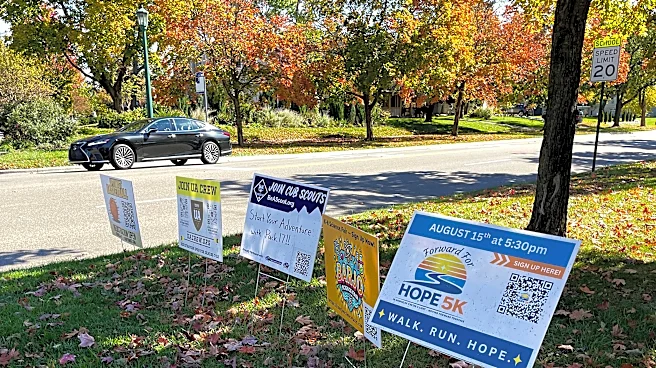




Just outside Barrington Elementary School in Upper Arlington, there are about seven yard signs, mostly in the right-of-way along Northwest Boulevard. The signs have been there a while, announcing upcoming activities: a play, a science festival and others. No one has complained.
However, less than a mile south, along Henthorn Road, there are six political signs in front of a nicely tended Cape Cod. And here, someone has complained.
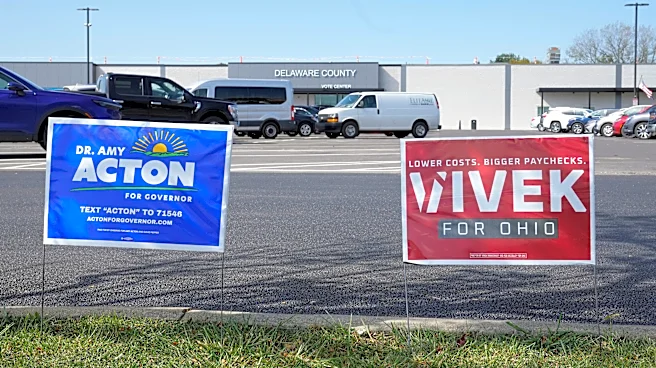
Drive through Upper Arlington two weeks before a major election and you'll find lots of political signs. But 'lots' can be too many. Five is the limit.
Joe Topazio, the city's code compliance officer, sent the Henthorn homeowner, who didn't want to be named, a letter stating that he found seven yard signs and asking her
to remove two.

If she fails to do so, she'd face a fourth-degree misdemeanor, normally a fine of up to $150. But the city also may assess a $1,000 per day fine for non-compliance.
That's wrong, said Jim Becker, the homeowner's attorney. "The size of this penalty will definitely get a court's attention," he said, noting that he's prepared to challenge it, possibly through a preliminary injunction order.
"This is a First Amendment issue," said Becker. "And both federal and state courts have said that political yard signage is one of the most protected forms of speech in this country."
To Becker and others on the receiving end of the city's sign ordinance, it's as scary as a Halloween display, with potential violators subject to the same penalties as assault and battery, domestic violence and DUI.
According to many city codes, signs can't be located in the public right-of-way, can't exceed eight square feet in size and can't be higher than four feet tall.
Some cities, like New Albany and Worthington, don't restrict the number of signs you can post.
Becker's focus is the content of "political" expression. The city removed the word "political" from its ordinance several years ago, to make it "viewpoint neutral." Even so, Becker said, residents are entitled to First Amendment protection.
And a five sign limit isn't appropriate Becker said. "Almost all UA residents are going to have 25 issues or candidates on Nov. 3. They're in essence saying 'You can only take a stance on 20%.'"
Voters will have three ballot issues and 22 candidates, from U.S. Senator down to state legislator.
Legal experts agree with Becker, questioning the city's approach and fines.
"I'm skeptical of that personally. As a free speech organization, I would certainly have some concerns," said Brennen VanderVeen, program counsel for the Philadelphia-based Foundation for Individual Rights and Expression (FIRE), which supports free speech issues.
The city's code may not single out political signs from any other subject. But it also is complaint driven. So if you don't like someone's politics, you can call the city to enforce the law.
That's what happened to the woman on Henthorn. "Eight political signs in their yard as of 9/29 at 9 p.m.," the complainant wrote. "Sorry for photo quality; it was dark when I walked by."
The Henthorn home and two others have recently received notices for being over the five sign limit, each driven by a complaint.
One of them was Ohio Secretary of State Frank LaRose and his wife, Lauren, whose home had six signs that someone apparently took issue with. LaRose didn't return an Oct. 21 call from The Dispatch. The sixth sign has since been removed.
Specific government interest, not just esthetics, needed for enforcement
While not a strict violation of the First Amendment, experts like VanderVeen still oppose such arbitrary limits on signs.
"The legal standard is that the restrictions, to be constitutional, have to significantly advance a government interest and offer alternative ways to communicate," said VanderVeen. In communities, the government interest might be a sign blocking traffic, creating health or safety hazards or being ugly or offensive. Limits on speech based solely on esthetics are "exceptionally weak justifications."
It is unclear if the signs around Barrington are permissible, even though they're at a busy intersection.
"The First Amendment allows you to have more than one opinion at a time or more than five opinions for that matter," VanderVeen said.
Courts routinely tamp down free speech sign ordinances partly because yard signs are cheap and effective.
"Most of us are not in a position to get our message out there. And this is a relatively inexpensive way to do so," Vanderveen said.
Number and size limits on signs on private, residential property are particularly suspect, because the government has limited interest in regulating speech “from the home," according to the American Civil Liberties Union of Pennsylvania.
Evolving laws on yard signs
Cities have found ways to counter political expression if it interferes with perceived community standards.
"Municipalities often try to come up with new and unique ways to limit yard signs," said David Carey, managing legal director of the American Civil Liberties Union of Ohio, noting that size, placement on yards and seasonal regulations have been tried.
Upper Arlington's code singled out political signs prior to 2007, when the code was updated. It still restricts them by size and number.
Now, being content neutral, the ordinance merely lumps all yard signs together.
But since code enforcement action happens when neighbors complain – often about a political disagreement – the enforcement is indirectly political.
Carey believes that restricts free speech.
"The right to critique the government is one of the most jealously guarded areas of speech," he said.
Advice to Upper Arlington
As for Upper Arlington's law, Carey said, "I would say you are dealing with a very dangerous area here ... this is a very valuable speech that is guarded by the First Amendment.
"[The city] needs to narrowly tailor this to speech concerns about safety," he said.
Safety, free speech and Constitutional issues aside, Steve Stivers finds humor in the yard signs at his Upper Arlington home where his family has lived since 2011.
"I know we have not had any code enforcement officers knocking at my door," said Stivers, a former state senator and member of the U.S. House of Representatives, now CEO of the Ohio Chamber of Commerce. He wasn't sure how many he had, but he guessed it well exceeded five.
Stivers often accepts yard signs for causes and issues he supports, considering it his right to express himself, he said. "And I don't get offended when my neighbors have seven or more signs. I think a [city] limit is a very arbitrary restriction of free speech."
Upper Arlington City Councilman Nic Fortkamp said "any real pushback" on yard signs has been minimal. "But if it does (return), I'd be happy to have that discussion." Fortkamp has held office since January. His home has five political signs.
Becker said it's been more than two weeks since he called Upper Arlington City Attorney Darren Shulman to try and resolve his client's yard sign issue.
"I've made multiple calls. And I've never heard back."
Shulman said he was at a wedding when Becker called. He was referred to other staff, Shulman said. "He got his answer. He was told how to file his appeal."
Growth and development reporter Dean Narciso can be reached at dnarciso@dispatch.com.
This article originally appeared on The Columbus Dispatch: How many is too many? Political signs at heart of Upper Arlington debate