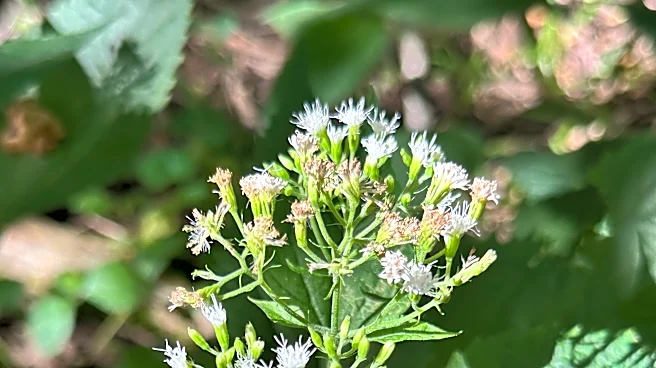









Editor’s note: Once a month, OSU Extension Master Gardener Volunteers in Franklin County profile a plant that occurs naturally in central Ohio.
Deep in the dappled shade of eastern woodlands, along forest edges and within moist, disturbed soils lie little colonies of airy, white blooms. This late-fall bloomer has a dramatic claim to fame: It is widely believed to have killed Abraham Lincoln’s mother.
Ageratina altissima, commonly known as white snakeroot, carries a descriptive name full of history. Ageratina borrows from the Greek for "un-aging," a nod to its long-lasting blooms, while Altissima comes from the Latin word meaning “tallest” or “highest,” and its common name of "snakeroot" comes from the mistaken belief among early settlers that
its roots could cure snakebite.
In the early 1800s, settlers expanding into the Midwest and Upper South started to encounter an illness with no obvious cause. Victims trembled, vomited and grew weak before many died.
Unable to locate the source of this illness, pioneers and early doctors called it “the trembles” or “the slows.”
Thousands perished, including Mrs. Nancy Hanks Lincoln, mother of 9-year-old future president Abraham Lincoln, in 1818. A decade later, Dr. Anna Pierce Hobbs Bixby, guided by an unnamed Shawnee healer, traced the illness to cattle that grazed on white snakeroot.
White snakeroot contains a natural toxin called tremetol, which has a bitter taste meant to deter wild mammals from eating it. Domesticated animals that brought it over from Europe did not have such an aversion, which led to the toxin passing through the cow’s body and concentrating in its meat and milk. The illness was later dubbed “milk sickness” in reference to this discovery.
White snakeroot can be found in scattered shaded eastern woodlands, from Canada to the Gulf Coast, including throughout Ohio. Ranging from 2-4 feet tall, it sends up sharply toothed, heart-shaped leaves topped in late summer and fall by delicate, button-like clusters of tiny white flowers. It is one of the very last wildflowers to bloom before frost.
That late timing is huge for pollinators. As most flowers fade and die back, white snakeroot offers nectar and pollen just when pollinators need it most. Anything from bumblebees and sweat bees to leaf-cutter bees and small carpenter bees can be found visiting regularly, alongside migrating monarch and painted lady butterflies fueling up for their journeys south. It also serves as a caterpillar host for moths, such as the eupatorium borer and ruby tiger. Deer and rabbits, wisely, leave it alone.
Originally disliked for its association with illness, white snakeroot is more friend than foe in the modern landscape. Those with shady corners or wooded lots should consider making room for this beautiful native.

Growing conditions
Hardiness zones: 3-9
Sun: part sun to part shade
Water: average to moist
Soil: loam or clay
Maintenance: easy to grow, short-lived perennial
Propagation: seed, division of rhizomatic roots
Pests and diseases: none of significance
This article originally appeared on The Columbus Dispatch: White snakeroot killed many in the 1800s. Now it feeds monarchs