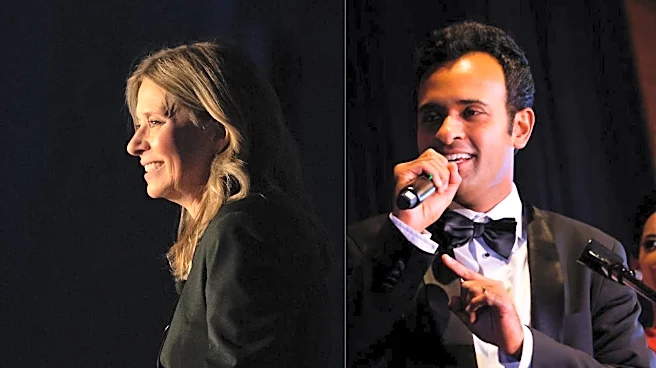

Vivek Ramaswamy's bid to become Ohio's first Indian American governor is prompting conversations across the country about representation and assimilation, but one particular community weighs the political
race's significance more personally.
In the upcoming gubernatorial election, Democrat Amy Acton, the state's former health director under Gov. Mike DeWine, is up against Republican Vivek Ramaswamy, finance and pharma billionaire and former Department of Government Efficiency (DOGE) architect. The polls say the race is close, and either way the pendulum swings, Ohio will see its first elected woman or Indian American governor.
Notably, the race also carries special significance for many Indian Americans in Ohio. Ramaswamy himself was raised in Cincinnati and later moved to Upper Arlington.
His campaign raises overlapping questions about representation, the meaning of the American Dream and whether generational divides are reshaping political attitudes within the Indian American community.

The Dispatch spoke with four Indian Americans in central Ohio involved in civic life – some of whom have met Ramaswamy – to discuss his campaign and how some Indian Americans across the political spectrum view the governor's race.
Ramaswamy's campaign did not respond to The Dispatch's interview request.
Representation matters, but not equally to everyone
Ohio Rep. Anita Somani, D-Dublin, said her family's history helped shape her views on politics. Her parents immigrated to the U.S. from India when Somani was six months old. Her father, Peter Somani, a Republican, was the first Asian American to be appointed to an Ohio governor's cabinet, serving as director of the Ohio Department of Health under former Gov. George Voinovich.
Somani, who is also an OBGYN at OhioHealth, grew up as a moderate Republican, but said her views changed in 2016. In general, she said her past "voting record is pretty mixed."
According to the 2024 American Community Survey 5-Year Estimates, 23,468 Franklin County residents identified as Indian out of a population of 1.33 million, or about 1.8%. In Delaware County, 11,353 people identified as Indian out of a population of 226,834, or around 5%.
If someone does not vote with the "tribe," then they may be ostracized, Somani said.
"I think some Indians are supporting Vivek for that reason, that they look at him and they see representation of themselves rather than looking at what he represents and what kind of quality candidate (he may be)," Somani said.

Neil Patel, a Republican who supports Ramaswamy, has also had a varied political journey. Patel has lived in Ohio since 1985 and is a former Democrat, but now votes primarily Republican. He's run for various elected positions in state and federal government, both as a Democrat and a Republican.
Indian Americans don't vote based solely on identity representation, Patel said. But seeing an Indian American like Ramaswamy run for president and governor is important.
"We want to support him as the first Indian American, but I'm not supporting (him) as the first Indian American only," Patel said. "[It's also] because I'm a stronger conservative myself too. That's the reason I'm supporting Vivek Ramaswamy.”

The public underestimates how many Indian Americans support Ramaswamy, Patel said. His estimate is that 65% to 75% of Indian Americans will vote for him.
Somani has heard from other Indians in the community that they think it would be great to have an Indian governor. Personal ties are also at play, she said, because when she was running for the Ohio House as a Democrat, Republicans supported her because they knew her personally or they knew her parents.
"And then there were a lot of people who didn't know me who were like, oh, well, we're going to support her because she's Indian," Somani said.
Even if it's helped Somani in the past, she said voting decisions should not be based on identity alone because outcomes often vary.

Despite Somani's differences with Republicans like Patel and Ramaswamy, she thinks Ramaswamy's candidacies may have a positive effect on people's perceptions of Indian Americans in civic life.
"I think we have to go back and look at how America evolved, and every immigrant class at some point was ostracized or looked down upon," Somani said. "And then they assimilate, and they contribute, and they're your neighbor, they're your friends. Sometimes they become your family. And that's what leads to somebody like him being able to say, yeah, I'm going to run for office in a very red state.”
The American Dream and generational divides
Ramaswamy, the son of Indian immigrants, is an Ivy League-educated billionaire and entrepreneur whose 2024 bid for the Republican nomination for president received significant attention. His relationship with President Donald Trump and Tesla and SpaceX CEO Elon Musk led to his involvement in creating DOGE. His career trajectory represents the true American Dream for many immigrants.
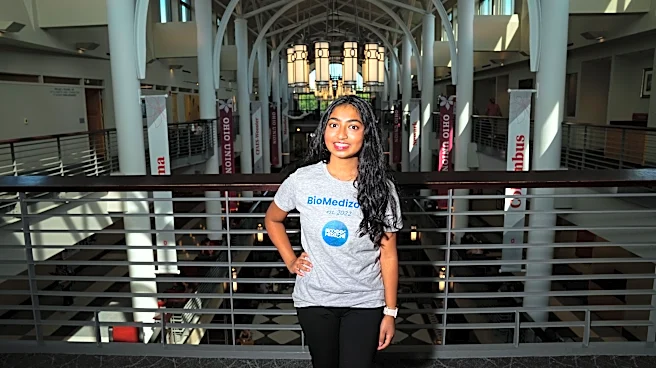
Diva Sony, an Ohio State University student, past Dublin City Schools Board of Education candidate, and Union County Democratic Party vice chair, said older and younger Indian Americans often view the American Dream differently.

Moving to the U.S. means "that you have achieved everything in a way," Sony said, especially for older Indians. Ramaswamy pushes that idea further as a child of immigrants who achieved enormous financial and educational success, Sony said.
"He is the epitome of the American dream," Sony said. "He is everything that an immigrant dreams of when they come here. So I do think that sways people in a way in that it makes them take him more seriously."
But younger Indian Americans may be less drawn to that message, she said.
"Younger generations, I don't think, feel [the American Dream] as acutely, as personally," Sony said. "Partly because we were born and raised here, so we don't have those kind of rose-tinted glasses in the way that our parents might. Also on that same line, younger generations just aren't as favorable in opinion towards billionaires in general."
Ramaswamy's billionaire status contributes to generational differences in politics
While interviewees agreed that Ramaswamy's success story carries appeal, they differed on whether younger Indian Americans view that success the same way their parents do.
As Sony noted, younger voters are more wary of billionaires. Younger adults are much more likely than the oldest to say being extremely rich is morally wrong, according to the Pew Research Center. For example, 33% of those ages 18-29 surveyed said having billions of dollars is morally wrong, compared to 10% for those 65 or older.
Ram Kasarla, a Republican and former president of the Federation of Indian Associations, said reactions to Ramaswamy often reflect differing views of wealth and business success.
"Some people see it as a negative point, 'Oh, he's a billionaire, he can spend money,'" Kasarla said. "But that's not what I see because I see the discipline to become a billionaire, and I see the struggle, and I see he can create jobs. So that's the only point I saw negativity among Indians."
Older generations are more likely to support Ramaswamy, Kasarla said, because of the prospect of tax cuts and benefits for business owners. Ramaswamy has floated ideas toeliminate the state income tax, even saying consolidating Ohio's universities could be a way to execute the plan.
Republicans like Ramaswamy could help win over younger voters by helping to lessen the burden of education costs, Kasarla said.
Political lines may not even be drawn on generational identity in the first place, Somani said, but rather economic status. Younger Indians "are definitely way more on the Democratic side," she said, but "economic and education levels" define a person's politics more than their age.
One thing that all the interviewees could agree on is that Ramaswamy is not shy about his own Indian identity and Hindu faith.
"Seeing that he's able to continue to use his name and not have to whitewash the pronunciation of the name or the spelling or anything like that or go by a nickname, that's something that gives people like me hope," Sony said. "If I do decide to continue to pursue politics in this way, I won't have to pretend like I'm not Indian to do it."
This article originally appeared on The Columbus Dispatch: How do Ohio Indian Americans feel about Vivek Ramaswamy?