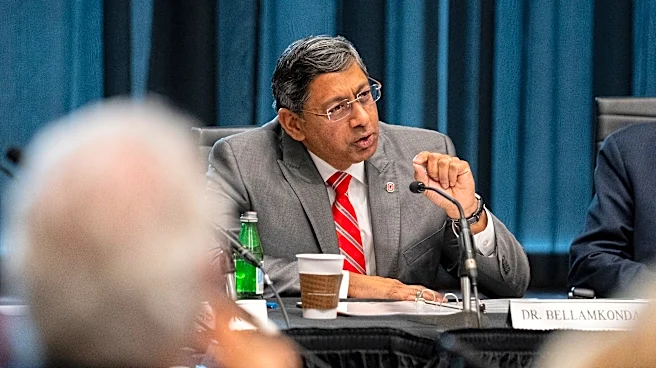





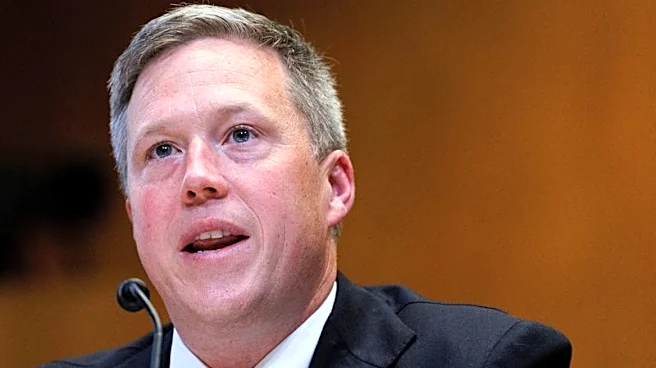
With less than six months on the job, Ohio State University President Ravi Bellamkonda will start his first full academic year with a raise and bonus.
Ohio State's Board of Trustees approved a 3% raise, totaling $42,000, and a $420,000 performance award, which equates to 30% of his base salary, during its full public board meeting Sept. 3.
Bellamkonda's new base salary totals $1,442,000.
Board Chair Jeff Kaplan praised Bellamkonda in his performance review as "instrumental" to Ohio State, first in his role as executive vice president and provost, and now as president.
"You have made a strong transition into the presidency over the past few months," Kaplan wrote. "Along the way, you have developed a deep understanding of this institution, and you have articulated
a compelling vision of where it can, and must, go. You are moving with urgency to propel the university forward while building an infrastructure that can sustain that progress over time. The Board is deeply appreciative of your instincts, your judgment and the enthusiasm you bring to your work and this university."

Bellamkonda was named the university's 18th president in March, mere days after former President Ted Carter resigned when an inappropriate relationship with military podcaster Krisanthe Vlachos became public. Bellamkonda served as Ohio State's executive vice president and provost for about a year under Carter, who was at the helm for just over two years.
The new president's five-year contract put at an inital annual base salary of $1.4 million – $300,000 more a year than what Carter started at in 2024.
Bellamkonda sets priorities
In addition to the raise, Bellamkonda set forth new priorities for this upcoming fiscal year. They are:
- Academic Excellence: Relentlessly pursue excellence by enhancing Ohio State’s signature undergraduate experience, advancing life-saving and life-changing research, cultivating dynamic people and leaders, and bolstering strong colleges and programs.
- Signature Undergraduate Experience: Enhance academic preparation and provide a transformative and distinctive student experience that fosters long-term educational success and upward mobility.
- Research: Increase Ohio State’s capacity to catalyze solutions to reach communities, industries and markets worldwide.
- People: Retain and attract exceptional faculty, staff and leaders, and provide them with a rewarding place to work.
- Strong Colleges and Programs: Elevate the reputational strength of Ohio State’s already strong colleges and undergraduate, graduate and professional programs.
- Healthcare Excellence: Reshape and transform healthcare by providing world-class care for every person, every time; pursue relentless innovation to improve lives; and be the best place to work and learn.
- Athletics Excellence: Define the future of college sports by leading the nation in holistic student-athletic development, competing at the highest championship level, and shaping the evolving intercollegiate landscape

Bellamkonda joined the meeting virtually from Washington, D.C., as he was attending an event hosted by Vice President JD Vance as the Trump administration announced Foundry School, a new national workforce program to train the engineers, technicians, and industrial leaders needed for the future. The event included State Department officials, university leaders and representatives from technology companies like Meta.
Ohio State was recognized as one of seven universities nationwide joining the program, which will begin a novel manufacturing curriculum aiming to help fill an estimated 3.8 million skilled jobs needed by 2033.
Bellamkonda said Ohio State's inclusion in the program is "proof" that "we are a consequential university."
Trustees met in committees over the last several weeks. Here's a look at some of the board's actions and discussions:
New capital plan includes money for dorm renovations
Trustees approved a $1.539 billion capital plan for fiscal year 2027. The plan includes $754 million for previously approved projects and $785.4 million for new projects.
Amy Burgess, associate vice president of Ohio State's Office of Administration and Planning, said the plan includes $22.5 million to renovate two north campus residence halls and to demolish a third.
In March, the Master Planning & Facilities Committee approved a construction project proposal to renovate Taylor and Drackett towers to address deferred maintenance of aging mechanical systems and infrastructure, as well as improving the student living environment through interior and exterior improvements.
Taylor and Drackett will undergo full plumbing systems replacement, upgraded main electrical distribution system and sprinkler systems installation to meet current codes in both towers. As students were preparing to return to campus in January, a "significant pipe failure" flooded the 60-year-old Taylor Tower, forcing the relocation of over 700 students and staff for the spring semester.

The main entry levels in the dorms will be reconfigured and renovated to provide better Americans with Disabilities Act access. Updated finishes will also align with residence halls in the North Residential District.
The project also includes plans to demolish Jones Tower.
Trustee Reggie Wilkinson ask during the committee meeting whether Ohio State was considering the future of other residence halls.
"We've been thinking about the future of [Lincoln and Morrill Towers], and maybe this is a premature question, but it's on the minds of a lot of people," Wilkinson said.
Burgess said that the Office of Student Life is working on a survey of Ohio State's residence life portfolio, considering "the capacity and condition" of its dorms as well as dining halls and recreation spaces. Additionally, the provost's office is working an on analysis of what the university's undergraduate size should be. The work should be done by the end of the year.
Wilkinson added that given the issues that students have experienced on North Campus, more considerations might be needed.
"The buildings are 1967 vintage," he said. "I was a student there in 1968, so you know how old I am. But ultimately the deferred maintenance is going to outweigh the importance of replacement or repurposing a lot."
Trustees approve new major at the Chase Center
Trustees approved two new academic majors, one of which will be offered by the Salmon P. Chase Center forCivics, Culture and Society.
The first major is a bachelor of science in biotech science. Ohio State Provost Trevor Brown said during the Academic Affairs, Research and Student Life committee that the major addresses a growing workforce need of "Ohio's rapidly expanding biotechnology and life sciences sector." It will provide students with foundations in the biological sciences, advanced laboratory and research skills, and prepare students for careers in biotechnology, biomanufacturing, pharmaceuticals, healthcare, agriculture, environmental sciences and similar fields.
Trustees also approved a second major for a bachelor of arts in civics, law and leadership, which will be housed under the Chase Center. Brown said the major "advances Ohio State's land-grant mission by preparing students to participate thoughtfully and lead effectively in civic life through the study of history, constitutionalism, law and leadership."
According to the proposal for the major, the interdisciplinary curriculum would cover coursework in American civic life, constitutional studies and leadership with civic application and capstone experiences designed to develop research, communication, critical thinking and civic problem-solving skills.

University civic centers like the Chase Center have popped up across the country over the last few years as Republican lawmakers have narrowed in on higher education. Other centers – like the University of Florida’s Hamilton Center and the University of Texas at Austin’s School of Civic Leadership – have crafted their own degree programs, according to the proposal.
"We also have reason to believe that as the first B.A. degree of this type to be offered at a large Midwestern public university, we will have a 'first movers' advantage," the proposal read.
Several academic departments disagreed with the new major as proposed, however, and raised concerns that the proposal was underdeveloped.
In an email included in board materials, Ashely Hope Perez – an associate professor and director of undergraduate studies in the Department of Comparative Studies – said she couldn't provide concurrence for the major because the Chase Center's proposal "relies heavily on courses that do not yet exist in approved form."
That, among other concerns, made it difficult to "assess the major’s structure or impact, or how it would—in fact—overlap with existing programs and course offerings," she wrote.
Professors in the College of Education and Human Ecology took similar issue with the proposal. A memo included in board materials said the Chase Center proposal didn't include syllabi, reading lists or a detailed course descriptions, making it "impossible to assess potential overlap with existing courses or determine the academic rigor of the proposed curriculum." The memo also described the proposal as "vague and aspirational."
Faculty in the John Glenn College of Public Affairs largely approved of the new program, but did provide some feedback on removing a course from the program that is unique to the college, as well as offering some of its courses as electives.
Robert T. Greenbaum, a professor writing on behalf of the John Glenn College of Public Affairs, also suggested changing the name of the new major to something more distinct, as it "does not adequately distinguish the degree from other offerings on campus, nor does it accurately reflect the focus of the degree," according to board materials.
Higher education reporter Sheridan Hendrix can be reached at shendrix@dispatch.com and on Signal at @sheridan.120. You can follow her on Instagram at @sheridanwrites.
This article originally appeared on The Columbus Dispatch: Trustees give Ohio State president a raise and bonus six months on the job