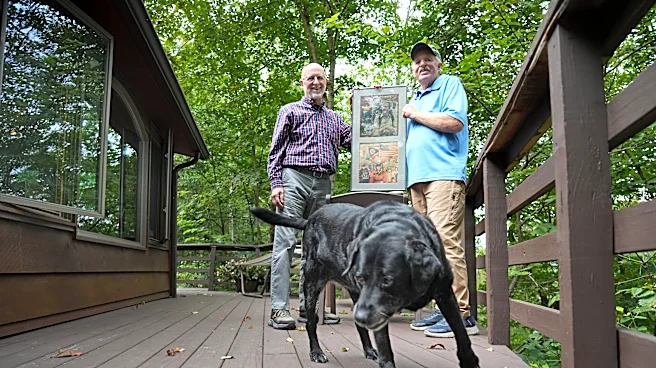




RIPLEY — Welcome to "Worldwalker Hill" greets visitors at the base of a long, steep driveway leading to the hideaway home of Steven Newman. Overlooking the Ohio River and Kentucky beyond, Newman's sharp blue eyes scan for birds, deer, coyotes, raccoons and wild turkeys on his 25-acre property.
Here, Newman embraces not just rustic beauty, punctuated by the call of crickets, Screech Owls and Blue Jays. But also a distinct view of the world. A view framed by literally walking around it.
From April 1, 1983 to April 1, 1987, he zig-zagged a more than 15,000-mile circumference, over five continents and 20 countries. An estimated 40 million steps. It earned him the name "Worldwalker," a book deal and a Guinness World's Records title for the first documented
solo walk around Planet Earth.
The odyssey that most only dream of was baked into his early childhood by a love of reading and an appreciation for life's richness. Survival, he would learn later, often depended on the goodness of others in countries where English, and Americans, were foreign, even threatening.
With only a tent, blanket and tools of a journalist — including unrelenting curiosity — he stepped from his Bethel, Ohio home. Four years later he carried away from the journey an empathy for those who struggle.
On a recent trip to Las Vegas, Newman, now 72, and his wife Darci took in an Eagles concert in The Sphere, walked the streets lined with fountains, flashing neon lights and glitzy luxury casinos.
"It's obscene," said Newman. "But it's a sign of how wealthy we are ... without question, the Romans of the modern era."
He witnessed abject poverty and hardship, but also the benevolence of those he befriended. He was scrutinized by foreign officials, four-times jailed, chased by bandits and often aided by those who had little to give.
"Some places I went, people didn't make $300 a year. And here, in Vegas, we couldn't even get breakfast for less than a hundred dollars for the two of us," Newman told The Dispatch during a recent visit to his home.
Along the way were editors from the Columbus Dispatch, the only large newspaper at the time to publish regular installments from Newman in what was then Capitol Magazine, a weekly Sunday magazine-style insert. Before the Internet, or cellphones, Newman mailed his dispatches to the newsroom at 34 S. Third St. along with rolls of film he'd shot to be processed in the paper's darkroom.
The backdrop of Newman's walk: "massive riots across Europe," Newman recalled. "People thought we were going to start a nuclear war. Poverty was at 24-25% in some of the counties here in Ohio. Inflation was high. Iran was in one of its anti-American moods. We were the 'Great Satans.' And I was walking right into the middle of all that."
Battling mistrust with body language, gestures and smiles
Several countries didn't want roving journalists, especially from the U.S. "They weren't even allowed without special permission," said Newman, a 1977 graduate of Ohio University's journalism program.
In Turkey, a police captain pulled out his pistol and pointed it at Newman during an interrogation. "He said 'If I wanted to I could shoot you right now and no one could do anything about it.'"
In his backpack nicknamed 'Klinger,' for its constant connection to his body, were notes in shorthand, maps, compass, tape recorder, film rolls and camera, "not the typical gear of an average journalist. More like a spy," he said, laughing.
When asked his occupation, Newman often would be forced to fib. "I called myself a nature photographer."
"And the police who had been following me would ask 'Well how come I never saw you take pictures of any animals?' "
Newman said he had to break through those barriers of mistrust. "I found that the best offense was smiling and showing great curiosity. And being kind."
The best of humanity 'We're more similar than different'
As much as Newman's story inspired others and resonated with Dispatch readers, those he met along the way fueled his mileage goals, day after day.
"One thing I was showing readers was that the world was filled with very curious and likeable people."
"I know from first-hand experience that a lot of fear and dangers are exaggerated. It's truly not as bad as people make it out to be."
The few who have the wealth, weapons or technology "are able to instill such fear and control," he said. "But in reality, we (everyday people) are the majority and because that's true, I don't lose hope for the future."
Often, the bonds of hope he forged with strangers were hard to break.
"There were times that I left families that I'd stayed with, who I'd just befriended. And I'd leave them maybe a week later. And I would start to cry. It was like leaving my own family again."
An unofficial diplomat
Living out of a tent, under bridges or in open fields, self-deprivation helped him understand the plight of others.
"One of the things I had to dispel right away was that everyone is rich in America."
He vowed to ask only for water. He wore a $10 Timex watched salvaged out of a garbage can. "So many people wanted that watch," he recalled, because it was supposedly American made and must be worth a lot of money. I had a hard time keeping it."
Despite brushes with crime and bandits, his survival gave him hope.
Not only did he walk, but he worked when opportunities arose.
He was roadie with a rock band in Montana, harvested almonds in Spain, filled in as an editor at a newspaper in Australia and worked in a circus in Greece. "My job was shoveling the elephant poop. But, hey, it's still a circus."
Global trekking gave him a unique lens, one he wishes others could experience.
"I actually think that the world is a safer place to walk across now than it was then. There's a lot more democracy now. And the internet has brought us a lot closer together.
"I spent four years walking around the world. But the world is actually a very tiny place," Newman says. "And don't forget most of it is water."
Readers wanted updates. Was Newman even alive?
Dispatch editors never knew if Newman's letters or phone calls would be his last.
"It was an adventure unlike anything we had covered, recalled Gary Kiefer, then-Capitol Magazine editor. "In part because it was not a story where you knew the ending at the time you started publishing."
"We had a constant stream of letters and phones calls from people, just asking 'Well, where is he now?' recalled Kiefer during a reunion with Newman after more than four decades, "And I'd have to tell them 'I don't know."
The uncertainty. The unknown obstacles. The silence. It's what made Newman's quest so compelling.
If the worst had happened, recalled Kiefer more than once, "We're not going to know. If something happens in a country that's not going to admit that you were even there, we would just never know what happened."
Going low or no-tech was part of the challenge, Newman said.
"It was kind of like this one great adventure journey right before the start of the Internet age, before high-tech moved in and took over everything. It was the last gasp of the old days, of writing in longhand like Mark Twain might have done." The Newmans have a painted portrait of Samuel Clemons (Mark Twain) prominent in their home's living room.
Kiefer agreed, telling Newman "You were the eyes and ears of our readers. They wanted to learn about the world and they loved doing it through your eyes."

Post office connections
Regular mail today, mostly unwanted ads or bills, was then a lifeline for Newman.
"We published addresses for him three or four times," said Kiefer. "Every time he'd get mail from Dispatch readers, who made the effort to send international mail. It had to mean enough to them that they actually went out to make that happen."
At one stop, in Athens Greece, there were 200 letters waiting for Newman.
In New Delhi, India, he approached a mail clerk telling him "My name is Steven Newman. You might have some mail waiting for me." And he looked at me and said "You're Mr. Newman?"
"Yes," Newman replied. "He said 'Where the hell have you been?' And it turns out there were over 600 letters waiting for me." This enraged the clerk who told him "Don't you ever walk in here again."
Personal loss a setback, but also inspiration
At one point well into his walk, Newman's mother called Kiefer, telling him "Let me know if you hear from him because I'm trying to reach him with some unfortunate news that he's going to want to hear."
"I called home. I found a public telephone in India. And it was Christmas night (in the U.S.) and the first thing my mom said was 'Steve, I have to tell you something. Your father died two months ago."
"And I had no idea. On Christmas night and learning that your father had been gone for two months."
"I didn't give up because I knew that he was my biggest fan. He had prodded and encouraged me ... whenever he got one of my stories from the Columbus Dispatch he would get on the telephone for hours later calling everyone in little Bethel, letting them where I was, what I was doing and that I was still alive."

A life of comfort, but not complacency
Walking down Worldwalker Hill, Newman carries his 6-foot 2-inch frame with confidence, joking that winter sledding can be lethal.
At the bottom a deep pond is stocked with fish. Birdfeeders, a dock and seating are a tranquil setting. Nearby is the pre-Civil War "Logan Gap School" one-room schoolhouse with attached teacher's home. The Newmans use it as a shed. Another cabin on the property is an Airbnb.
It's here that he confronts his own limits, legacy and mortality. He was diagnosed a couple of years ago with Parkinson's disease which causes him mild trembling in his hands and voice.
"It's just difficult sometimes," he said of walking. "It doesn't come so naturally anymore."
What remains natural is his quest to do more, learn more.
"What inspired my wunderlust was reading, people like Mark Twain, or Jack London or Ernest Hemingway. They're descriptions of going to other countries, other cultures just made me want to do the same and like them to share it with other people."
The dreams he's realized, and challenges he's overcome, will help guide him through new challenges.
"Almost 50 years later, the people of the walk are still reaching out to me. We're still connecting. The walk around the world will not go away," he said. "It's still alive. I'm still on it, in a sense. And that's when you know you've truly had an adventure — when it never really quite ends."
"I'm just an ordinary American and look at what I'm blessed with," Newman said, gazing across the pond. "I have truly learned to appreciate what I had left behind."
What's left after so much?
Newman's restlessness is obvious to visitors. He may skip lunch, or miss appointments. Darci remains vigilant. So does Ceili (Irish spelling of Kayley) the family's black lab, barking at a chipmunk or skunk.
A natural and prolific storyteller, he estimates he's spoken to groups more than 3,000 times. He's also been asked to run for public office, a job he has no interest in.
"I'm retired now," he said. At the same time he confesses "There's so much to see and do."
After the Worldwalk, he traversed the entire Japan archipelago, Great Wall of China, South Korea, Taiwan and summited Mount Kilimanjaro.
Closer to home, Newman has teamed with the Clermont County Visitors Bureau to blaze a 33-mile path of East Fork State Park.
The Steven Newman Worldwalker Perimeter Trail allows hikers to listen to segments of his book through smartphones along the Worldwalker Audio Trail by scanning QR codes posted along the way. Newman narrates stories from a follow-up book, "Letters from Steven" excerpts he had mailed to his parents along his walk.
Asked of any remaining bucket list trips, he quickly replies "Antarctica. To experience nature in such a raw form. And the challenge."
Always the challenge.
Dispatch reporter Dean Narciso can be reached at dnarciso@dispatch.com.
This article originally appeared on The Columbus Dispatch: Almost 40 years later, Newman's 'Worldwalker' odyssey still captivates