







Jessica Hardy did exactly what the justice system asks of someone facing abuse.
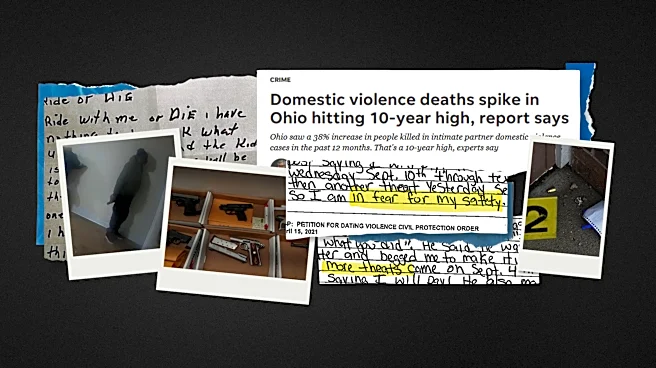
After Hardy's ex-boyfriend began stalking and harassing her, she sought a protection order. When he flooded her phone with messages, she told him to leave her alone. He sent a letter threatening her life, so she called the police.
None of those steps prevented 36-year-old Hardy from being fatally shot in March. Police say Jesse Wilson, her ex-boyfriend, waited more than two hours inside Hardy's Cincinnati apartment to kill her, ambushing her with a gun as she entered the building.
Hardy's 12-year-old daughter and 6-year-old nephew had just left for school. Her 18-year-old daughter heard the gunshot and called 911.

Hardy documented her fears when she filed for a civil
protection order. She knew Wilson carried a gun, which he wasn't legally allowed to own because of a conviction in a different killing.
"I am in fear for my safety," she wrote in the filing. Five months later, she was dead.
Hardy's death mirrors the killings last year of at least 71 people in Ohio by their partners, former partners, family members, or someone who lived with them. The rate of domestic violence deaths in Ohio rose by 38% in the year ending in June 2025, according to the Ohio Domestic Violence Network.
Most of the victims were killed with firearms. And 1 in 3 of those who killed someone they knew used a gun they weren't allowed to have under state or federal law.
Nineteen people used firearms they were prohibited from having to kill a current or former intimate partner. Nearly all were barred from gun ownership because of prior felony convictions. The remainder had misdemeanor domestic violence convictions or were subject to a protection order, which prohibits gun ownership under federal law.
If a protection order prohibiting firearms is in place, abusers must surrender their guns to police.
Officers can and do seize those guns. But they rely on information from the courts, victims or gun owners themselves. They can't know if all of the guns have been taken. State law does nothing to prevent abusers from buying another one from unlicensed sellers at gun shows or online.
Ohioans’ lives have been cut short. Many were killed with a gun that should never have been in their abuser’s hands.
Court and law enforcement officials in Ohio say they don't have all the tools they need to keep guns out of the wrong hands. The USA TODAY Network Ohio reviewed coroners' reports, court filings, police records, obituaries and news reports to identify domestic violence fatalities and the shooters prohibited from owning guns.
A 'piece of paper,' not a 'bulletproof vest'
Wilson told investigators that he met Hardy while they worked together at a Walmart. A friend of Hardy's set them up.
They were friends before they started dating in 2017. Hardy wrote that the threats started after she told Wilson, "I did not want this toxic relationship anymore."
Wilson continued contacting Hardy and begged her to "make it work," court filings state. He arrived at her apartment early one morning and didn't leave until police arrived. He threatened her in texts and on Facebook, growing angrier when she ignored his phone calls and after she blocked his number.
She obtained a five-year protection order against Wilson in September 2025, prohibiting him from carrying deadly weapons and requiring him to surrender firearms to authorities. He still kept a gun. Police called to investigate Hardy's killing found a county-issued card on her stating she had a protection order against Wilson.
Three days after she got an emergency protection order, Wilson was charged with aggravated menacing for sending Hardy a letter threatening, "Ride with me or die."

A judge issued an arrest warrant for Wilson in October 2025 after he missed a hearing in that case. He later confessed to transferring ownership of his Dodge Challenger to avoid arrest.
Police didn't apprehend him until the day Hardy was killed.
Hamilton County Domestic Relations Judge Anne Flottman oversees the court Hardy went to for a civil protection order, which requires an abuser to have no contact with the person who gets the order.
Flottman, who specialized in domestic relations law before taking the bench, said she's worked hard to remove barriers for people seeking protection orders. She encourages magistrates to grant five-year orders that survivors can modify or terminate.
"I'm not giving them a bulletproof vest," she said. "I'm giving them a piece of paper. So why not give them what little I can for as long as I can?”
The court has successfully increased the number of people who follow through with the protection order process by offering survivors more support and assigning specially trained magistrates to domestic violence cases. Despite efforts to make the process easier, sometimes people who turn to the judicial system for help are killed.
"When somebody then finally makes it through, and there's a failure elsewhere in the system, then are we all to blame? Does the whole thing need to be revamped?" Flottman asked.
It's unclear from public records whether police who served the protection order took guns away from Wilson. If they did, he got another one.
'It's illegal for me'
Cincinnati police detectives interviewed Wilson and asked about the last time he'd fired a gun. He admitted shooting at a raccoon with a handgun the day before the killing but refused to tell them where to find the gun.
"It's not illegal to have a gun," a detective said.
"It's illegal for me," Wilson responded. He knew. He had a gun anyway. Ohio law doesn't provide ways to identify and disarm prohibited gun owners.
At 65, Wilson wasn't dealing with his first murder charge. He served time in Georgia for the 1983 killing of an 85-year-old man found strangled and bound to a bed with neckties.
Police found video showing Wilson and his Dodge at Hardy's apartment when the shooting happened. They also matched the .45-caliber shell casing from the scene to a box of ammunition recovered from Wilson's car.

He repeatedly denied causing Hardy's death, even when confronted with images of his face on camera. He killed himself in jail a month later, making good on his earlier threat: "We can live together or we can die together."
Sheriff: 'There will be more lives lost'
Hamilton County Sheriff Charmaine McGuffey testified at the Ohio Statehouse against removing the state's concealed carry permit requirement. She said permits helped identify whether someone with a gun had been vetted in any way. Without them, she said, officers and all Ohioans are "in the dark" when it comes to gun safety and volatile situations.
McGuffey said people can obtain guns through numerous channels, but lawmakers have stripped away boundaries and safety measures that used to be in place.
"We're tearing those down, and we're saying, ‘We don't want to know who has a gun, and we don't want to care whether this person is a felon or not,’" she said, "because they're not going to give us any way of identifying that up front."
McGuffey warned the men and one woman on the committee about removing mandated concealed carry permits: "I said, ‘If you vote to keep concealed carry, you'll never know how many lives you save. But if you strike this down, there will be more lives lost and we will count them. And that count is going up.’”
City gun law closes 'gap' between state, fed regulations
Federal law sets a "baseline national standard" for who is and isn't allowed to own a firearm, according to the Giffords Law Center to Prevent Gun Violence. While advocates of restricting gun access for convicted criminals say federal law doesn't go far enough, Ohio's law is even less restrictive.
In Ohio, fugitives and people convicted of felonies involving drugs or violence can't own guns. But a misdemeanor domestic violence conviction or active protection order does not bar gun ownership, unlike the federal law.

The city of Columbus enacted an ordinance in 2018 making gun ownership with a domestic violence conviction illegal. Despite legal challenges from gun-rights advocates, the Ohio Supreme Court ultimately upheld the ordinance.
"We wanted to fill that gap in the state law," said Columbus City Attorney Zach Klein, whose office has a team of prosecutors focused solely on nonfelony domestic violence cases. He added that federal prosecutors have limited resources to take on the likely thousands of cases of abusers owning guns.
The federal government typically goes after unlawful gun owners by targeting individuals with known associations to violent crime, said Ben Glassman, former U.S. Attorney for the Southern District of Ohio.
Federal prosecutors can also make a case out of local police encountering a convicted abuser with a gun, though a federal agency must adopt the investigation, Glassman said.
"So, that does happen and should happen," he said. "Of course, how much it happens is crucially dependent on how good is the communication between the law enforcement agencies and the prosecutor's offices."
Aligning state and federal gun-prohibition laws would give prosecutors at every level more tools to improve public safety, Glassman said. He added that enforcing the law is one piece of the puzzle. The other is preventing shootings by making stolen or trafficked guns less available.
A gun on the streets makes it that much easier for the wrong person to get ahold of it and easier for someone to die.
"Just pull the trigger," Glassman said. "That's all you need to do."
Killing leads to tense manhunt for illegally armed abuser
Those guns in the hands of abusers with criminal records make an already tense situation even more dire for police responding to domestic violence, among the most dangerous calls officers can take.
When 25-year-old Mariah Sanders was shot and killed by her boyfriend outside the couple's Cleveland-area apartment building in March 2025, it prompted a large manhunt for an illegally armed gunman intent on dying at the hands of police.
During an argument with her boyfriend, Sanders strapped her 7-month-old daughter in a stroller and went for a walk to get away. Police say Shamar Summerall followed Sanders outside and shot her repeatedly, killing her.

He was among the 19 people identified by the USA TODAY Network Ohio as being legally prohibited from owning a gun because of convictions for attempted felonious assault and domestic violence.
A witness told police after the shooting that Summerall fled back to the apartment building. Police believed he might've been holed up inside.
Officers also spoke with Summerall's mother, who told them her son called saying he'd just shot Sanders and "wanted police to kill him."
SWAT officers arrived in an armored vehicle and surrounded the apartment building. A sniper team was set up on an adjacent building's balcony in view of the couple's apartment. Police took over neighboring apartments for better cover in the event of a gunfight.
Officers entered the apartment, but Summerall wasn't there. Authorities eventually tracked him to a local park, where they found Summerall partly under a picnic bench. He'd shot himself in the chest and died in the emergency room.
Police said Summerall owned at least two guns: the one used to kill Sanders and another that at one point belonged to a law enforcement or government agency.
Is there a better way?
Nearly half a century ago, Alexandria Ruden began her legal career focusing on Ohio's domestic violence law.
“It just became my job,” said Ruden, now 75, a supervising attorney for Legal Aid Society of Cleveland. “I wanted to become an expert in this area.”
Ruden is now Ohio’s foremost authority on the subject and has witnessed firsthand the evolution of the state’s domestic violence laws.
“It's slow, and you take five steps ahead, you go three steps back,” she said.
Ruden co-authored "Ohio Domestic Violence Law," a two-volume tome fatter than a big-city phone book. She has updated it annually since writing the first edition in 1996.
She identified gun access as one of the main holes in domestic violence law. Ruden said Ohio should codify federal law and prevent people who have been convicted of a misdemeanor domestic violence charge from owning a gun.

Six states – California, Connecticut, Hawaii, Illinois, Massachusetts and New York – have statewide gun removal programs in place, according to a 2022 report from Everytown for Gun Safety, a nonprofit focused on preventing gun violence.
The report references a California program that identifies gun owners as they are convicted or otherwise prohibited from owning guns and notifies authorities so they can remove guns that weren't surrendered, resulting in the seizure of 1,437 firearms from prohibited gun owners last year.
Many of those identified by the California program were barred from gun ownership due to protection and restraining orders, including for domestic violence.
For such a program, Ohio would need records of gun purchasers or concealed carry permit holders to cross-check against records of gun-prohibiting events like a violent felony conviction. No statewide gun registry exists and the Ohio Legislature removed the permit requirement for concealed carry in 2022.
Ohio Legislature has expanded, not restricted gun access
Ohio lawmakers trying to pass gun restriction measures for domestic violence offenders often face roadblocks.
Rep. Cecil Thomas, a Democrat from Cincinnati and former police officer, has sponsored three gun safety bills and a bill with Rep. Phil Plummer, a Dayton Republican and former sheriff, to create a registry of repeat domestic violence offenders.
“The problem we run into all the time is the gun lobbyists and the impact of the NRA on members of the legislature,” Thomas said.
Thomas said because Ohio is a red state and a “strong right-to-bear-arms state," it's difficult to get legislation through the House and Senate without members getting alarmed about a "slippery slope."
“What we're seeing is that our gun laws have been eroded to the point where we're now finding ourselves trying to piece some of this stuff back together because of all the violence that we're seeing, including domestic violence,” he said.

Dean Rieck, executive director of the Buckeye Firearms Association, said Ohio and federal law prohibit the creation of a registry of gun owners and the association "opposes gun registries in the strongest possible terms." Rieck is skeptical that the loss of concealed carry permits made Ohioans less safe.
"Those who carry illegally are those willing to commit a crime. These are criminals, and criminals will disobey the law with or without a license," he said.
State Sen. Kyle Koehler, R-Springfield, has been advocating for gun rights since he became a lawmaker 10 years ago. But he recognizes a problem with people prohibited from possessing guns having them.
"If somebody wants a gun, you can go get one. It's not hard," he said. In 2022, he pushed legislation to add prison time for people caught multiple times carrying weapons when they're legally prohibited from doing so. "I couldn't get the gun lobby on board."
Koehler hopes a new bill with some tweaks will gain support from the gun lobby. That could address some of the problems with domestic abusers being armed, he said.
Meanwhile, children are without parents. Parents are without children. And guns still find their way into – or stay in – the wrong hands.
A man illegally owned a gun. A young girl lost her mother
Looking back on what led to her daughter's death, Sherry Brown said Summerall at first seemed to care about Sanders, but "the mask" slipped away toward the end. Days before she was killed, Sanders sent Brown a photo of herself with a black eye.
"I just started getting very uneasy feelings about him," Brown said. "After she sent me that picture, I said, 'He's going to mess around and kill you.'"
Brown said Sanders was afraid to leave Summerall or call police because of threats against her family. Her relatives even went to the couple's home to urge Sanders to take her baby and leave, Brown said, but Summerall pulled out a gun.
She left that time, but the threats brought her back.
"She would always go back," Brown said.
Sanders was quiet and introverted, but she talked to her mom every day. They were on the phone when Sanders was killed, their final conversation cut short by gunfire.
Brown called her daughter her best friend. Sanders saved her life during the COVID-19 pandemic when she went into cardiac arrest, Brown said. Sanders found her mom and performed CPR.

Ever since, Brown has affectionately called Sanders her "guardian angel."
Sanders' greatest joy in life was her own daughter, Serenity.
"She was so excited about having her baby," Brown said. "That meant everything to her."
Brown is now 52, with heart issues, raising a 2-year-old. She stopped working. Her health has deteriorated. She's dealing with anxiety and depression, she said. She's also been left mourning her daughter and the relationship her granddaughter will never have with her own mother.
"I just hate that Serenity will never know her mom," Brown said. "Seven months was not long enough."
USA TODAY Network Ohio reporters Bryce Buyakie, Bailey Gallion and Amy Knapp contributed.
This article originally appeared on Cincinnati Enquirer: Guns in the wrong hands cost Ohio partners their lives