


Those undefeated Cincinnati Bengals seem like a lifetime ago.
Two weeks ago, the Bengals were 2-0 and had seemingly answered many of the questions that followed them into this season. The revamped defense looked faster and tougher, and the pass rush looked legitimate. Maybe, just maybe, this was finally the complete team Bengals fans have been waiting for.
Now they’re 2-2.
After squandering opportunities against Pittsburgh and Jacksonville in consecutive weeks, the questions are back. Some are new. Why has the offense struggled to run the football? Why has Joe Burrow, of all people, come up short with a chance to win or tie the game on Cincinnati’s final possession two weeks in a row?
Burrow says "this isn't Armageddon," but it's not exactly Zion either.
There’s another question I’ve been asking for what feels like most of the Zac Taylor era: Why in the world can’t the Bengals cover a tight end?
I’d love to hear Taylor and defensive coordinator Al Golden explain it. Because this has gone well beyond a bad matchup here or there.
Tight ends don’t just beat Cincinnati. They feast.

If you play fantasy football, here’s my free advice: Find out which tight end is playing Cincinnati that week and stream him. (I’m only half joking.)
Never heard of him? Doesn’t matter.
Third-stringer? Fire him up.
His own mother has him on the waiver wire? Pick him up.
Because opposing tight ends don’t merely have good games against Cincinnati. The Bengals have developed an unfortunate habit of helping them have career games. And you don’t have to go back very far to find examples.
Houston’s Dalton Schultz absolutely shredded Cincinnati in Week 2, catching 12 passes on 14 targets for 140 yards. Consider what he’s done since: 30 yards against Indianapolis and nine against Dallas. His other game before Cincinnati? Four catches for 35 yards against Buffalo. Cincinnati remains his only 100-yard game this season.
Then came Pittsburgh.
Darnell Washington − all 6-foot-7, 264 pounds of him − caught three passes for 67 yards, including a 47-yarder. That’s a tight end averaging more than 22 yards per catch against your defense. Washington had produced 18 yards against Atlanta and seven against New England in his first two games. Against Cincinnati? Sixty-seven.
And Washington wasn’t alone. Pat Freiermuth added 30 yards and Robert Tonyan another two, meaning Pittsburgh tight ends combined for six catches and 99 yards.
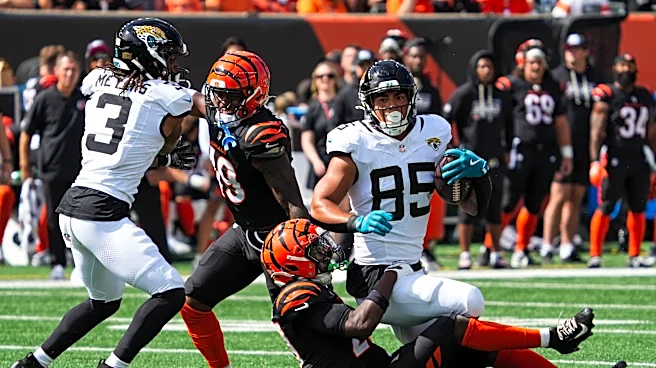
Then Jacksonville’s Brenton Strange showed up Sunday and caught seven passes for 95 yards.
See the pattern?
Over the past three games alone, Bengals opponents have completed 28 passes to tight ends for 383 yards. Through four games, the position has produced 31 catches for 409 yards against Cincinnati.
At this point, if you’re a fantasy football manager and don’t know who the Bengals are playing, don’t bother checking the quarterback or running back. Find the tight end.
This problem didn’t start Sunday

The numbers get uglier when you zoom out.
In 2024, Bengals opponents completed 111 passes to tight ends. Then Cincinnati somehow got worse. Much worse.
In 2025, the Bengals surrendered 1,444 receiving yards and 16 touchdowns to tight ends.
And this isn’t simply revisionist nostalgia for the Marvin Lewis years. Lewis’ Bengals had their own problems covering tight ends, particularly late in his tenure. His 2016 defense surrendered 1,154 tight end receiving yards, and that dreadful 2018 defense allowed 1,048 yards and 11 touchdowns while finishing dead last in the NFL in total and passing defense.
But here’s the difference: Lewis never had consecutive seasons in which opposing tight ends reached 1,000 receiving yards. Taylor’s Bengals have now done it three years in a row − 1,080 in 2023, 1,114 in 2024 and 1,444 in 2025.
That’s not an occasional bad matchup. That’s a chronic condition. And it didn’t disappear when Lou Anarumo did.
Anarumo was fired after the 2024 season, and Golden took over. The Bengals overhauled their linebacker room and invested in younger, faster defenders. Yet here we are again.
That’s what makes this so maddening from a fan’s perspective. We’ve changed the coordinator. We’ve changed linebackers. We’ve changed safeties. We’ve changed schemes.
The tight ends keep catching passes.
Different players and coordinators, same results

There isn’t one simple explanation, but the numbers point us toward the middle of Cincinnati’s defense.
In 2025, linebacker Barrett Carter allowed 54 completions on 70 targets for 691 yards in his overall coverage assignments. Even more alarming, 468 of those yards came after the catch. Fellow linebacker Demetrius Knight allowed 277 yards after the catch.
Safety Jordan Battle allowed another 342 YAC and was credited with 21 missed tackles.
Those numbers aren’t exclusively against tight ends, but they help explain what our eyes keep seeing. Too often, Cincinnati’s problem isn’t merely the catch. It’s what happens afterward.
A six-yard completion becomes 15. A routine underneath throw becomes an explosive play. A missed tackle becomes a touchdown.

Washington’s 47-yarder against Pittsburgh was a perfect example. The Bengals had a chance to stop him but couldn’t finish the play. And when Pittsburgh was done, its running backs and tight ends had combined for 148 receiving yards − more than half of Aaron Rodgers’ 292 passing yards.
That’s a toxic combination: linebackers struggling in coverage, safeties arriving late or missing tackles, and tight ends roaming the part of the field where those responsibilities intersect.
And that’s why the individual names matter. This isn’t just Travis Kelce being Travis Kelce or George Kittle being George Kittle. We’ve seen Freiermuth put up 120 yards against Cincinnati. Hunter Henry went for 115 last season. Isaiah Likely has produced 103- and 95-yard games. Schultz just went for 140. Washington went for 67. Strange went for 95.
The Bengals have an uncanny ability to turn Tight End X into Tony Gonzalez for three hours. Which brings me back to Taylor and Golden.
I don’t expect an NFL coach to reveal his scheme at a news conference. But Bengals fans deserve something better than watching the same problem resurface year after year. What do the Bengals believe is happening? Is it scheme? Personnel? Communication? Technique? Tackling? Eye discipline?
And, more importantly, how are they going to fix it?
Because seven seasons into the Taylor era, this isn’t a one-game problem or even a one-coordinator problem anymore. It’s a Bengals problem. And until Cincinnati proves otherwise, fantasy football players everywhere should keep checking the schedule.
Who’s Miami's tight end playing the Bengals this week?

Opinion and Engagement Editor Kevin S. Aldridge is a die-hard Bengals fan and can be reached at kaldridge@enquirer.com. On X: @kevaldrid.
This article originally appeared on Cincinnati Enquirer: Different Bengals defense, same old tight end problem | Opinion