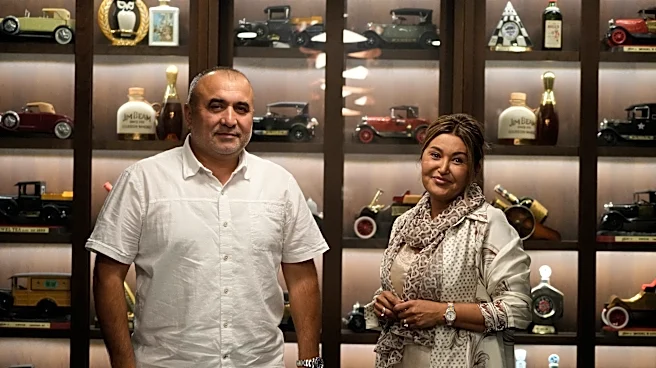







SHARONVILLE, OH – When Saida Heher first set foot in Greater Cincinnati in 2004, she knew no one but her husband.
The then-26-year-old moved to the U.S. a year earlier to pursue a political science degree in Pittsburgh, hoping one day to become a translator for the United Nations. There she met her husband and the two moved to his hometown of Cincinnati, but she was lonely. After being rejected from most jobs she applied to, she ended up working as a stocker at Michael’s, more than 6,500 miles from her native Uzbekistan. At the time, Heher knew of around 20 other Uzbeks living around Cincinnati.
Now, 22 years later, she’s a part owner of a hotel, runs two businesses and plans events for the thousands of Uzbek families who now call Greater Cincinnati
home.
The Uzbek population in Greater Cincinnati has skyrocketed since 2020, as many Uzbek families who previously lived in New York City moved to Ohio seeking fewer COVID-19 restrictions, more affordable housing and better schools, leaders in the Uzbek community said.
Greater Cincinnati has also attracted a high number of Uzbek families because of its central location to a popular industry: trucking.
As the community expanded, many new arrivals found work in trucking, an industry that has become central to recent debates involving Uzbek immigrants.
In recent months, that industry has placed the community at the center of a broader debate over foreign-born commercial drivers after an Uzbek truck driver from Maineville was involved in a crash that killed 21-year-old Tobias "Toby" Forsythe.
The incident came as federal and state officials sought rule changes to strip driver's licenses away from foreign-born drivers, including more than 100 Uzbek drivers in Ohio.
Some lawmakers have sponsored legislation targeting English proficiency among foreign drivers, including Ohio state Rep. Michelle Teska, a Clearcreek Township Republican, whose district includes Maineville. She cited "law enforcement encounters with drivers from Uzbekistan" in Warren County.
On social media, anonymous accounts and local politicians have also taken aim at the Uzbek community and its ties to trucking.
Leaders in the Uzbek community say that their involvement in Greater Cincinnati extends far beyond trucking.
Uzbek restaurants, stores and bakeries have found homes in Cincinnati suburbs such as Sharonville, West Chester, Mason and Blue Ash. Uzbeks work in education, manufacturing and hospitality. Uzbek children attend schools across southwest Ohio.
As the population continues to grow, a local group is building a new mosque in Maineville, Ohio.
“We want to become part of this society in Cincinnati and help each other," Nodirjon Ernazarov, a member of a local organization dedicated to supporting Uzbeks in the area, told The Enquirer through a translator.

Thousands move to southwest Ohio
Estimates on the number of Uzbeks living in Greater Cincinnati vary. U.S. Census data from 2024 says around 1,500 people born in Uzbekistan live in Greater Cincinnati and an estimated 3,800 live in Ohio. Uzbek community leaders place the number higher, at around 4,000 families in southern Ohio, including children born in the U.S.
Cincinnati immigration lawyer Nazly Mamedova said most Uzbeks in Greater Cincinnati have green cards or are naturalized citizens. They've moved to Cincinnati, started businesses and families and become part of the community, she said.

Federal and state rule changes to commercial driver's licenses
More than 1,200 Uzbek residents hold non-domiciled commercial driver's licenses in Ohio, according to Ohio Department of Public Safety spokeswoman Lindsey Bohrer. Non-domiciled CDLs are commercial driver's licenses held by someone who is not a permanent resident but is legally in the U.S. and authorized to work.
State changes to rules for commercial driver’s licenses have also caused disruptions for some Uzbek drivers around Cincinnati. In June, the Ohio BMV revoked commercial driver's licenses for 1,200 foreign drivers. The move to revoke licenses came after the U.S. Federal Motor Carrier Safety Administration adopted new rules this year to limit the types of immigration statuses and visas that foreign drivers can have to hold a CDL.
Bohrer told The Enquirer that the Ohio BMV is in the process of downgrading CDLs for 133 Uzbek drivers. The agency is downgrading them to standard, noncommercial licenses because they did not meet the new federal guidelines, Bohrer said.
Mamedova said her office appealed the downgrades on behalf of several Uzbek clients in the area, and their licenses were reinstated earlier this year.
Warren County Prosecutor David Fornshell told The Enquirer that his office and other law enforcement departments across southern Ohio have generally reported “a disproportionate amount" of motor vehicle fraud and forgery among the Uzbeks in the trucking industry, and his office is prosecuting at least one case. However, he said the prosecutor's office doesn't have a specific count of how many of these cases occur because there's no clear way to track and categorize these cases.
He said his office has had to hire more Uzbek translators for court cases.
Mamedova said that many of the claims that Uzbeks are cheating on tests or committing fraud come from misconceptions about drivers not speaking fluent English.
She said drivers attend schools to learn the skills and English needed to pass the test, read signs and talk with people at weigh stations. They spend months learning the rules of the road and riding along with more experienced drivers, “kind of like an internship.”
“They learned what they needed, but they wouldn’t go and converse with you about American football,” she said.
Community organization emerges

During the first decade of her time in Cincinnati, Heher said she informally helped women find jobs, fill out paperwork and enroll their children in school.
Around 2017, 10 Uzbeks decided to form a group, Hamkor Uz Cincinnati Association, that could connect the wider community. Almost a decade later, the organization has around 20 board members who help coordinate weddings, funerals, social and religious gatherings.
"That's why we decided to open [Hamkor Uz Cincinnati Association], which would help every Uzbek here in America if they need help, if they have any kind of problems, whatever, they can talk," Nodirjon Ernazarov, a board member, told The Enquirer through a translator.
In past years, the group has held events celebrating Uzbekistan's Independence Day, on Sept. 1, and other cultural events. During the Independence Day event in 2022, a field representative for Republican U.S. Rep. Warren Davidson even attended, giving a speech about diplomatic relations between the U.S. and Uzbekistan. In recent months, Davidson has posted on social media about fatal crashes and changing English proficiency requirements for foreign drivers.
The staffer, Zach Bohannon, said during his speech that Davidson wanted to recognize the "special role" that Uzbeks living in southern Ohio have in "building relations with the United States," according to a video reviewed by The Enquirer.
"I hear that many folks are involved in the trucking industry, and we thank you for that, we thank you for your hard work in making our region strong and prosperous," he said in his speech.
Hamkor Uz building mosque
Now, the group has set its sights on a new project. Around 90% of Uzbekistan's population is Muslim, and Ernazarov said Hamkor Uz wants to build a mosque to better serve the growing community.
The mosque is currently under construction off State Route 48 in Maineville. The facility will be around 19,000 square feet and have a two-story main prayer space, according to a Hamilton Township site plan review. It will also have a second-floor mezzanine and a classroom.
Ernazarov and Heher said the mosque's construction is being funded by donations from Uzbek families across Ohio. It's unclear when it will open because the construction timeline depends on them sustaining donations.
“Uzbek people are very hardworking people," Ernazarov said. "So this mosque is (being built) by the help of all Uzbeks.”

After the mosque is complete, Ernazarov said, Hamkor Uz also wants to purchase land to create an Uzbek cemetery and then establish a school.
Ernazarov became a U.S. citizen in 2008. Some of his children were born back in Uzbekistan, some in America. He said he and other Uzbeks want to feel and become part of the Cincinnati community.
"This is our motherland now, from now on," he said.
This article originally appeared on Cincinnati Enquirer: In their new 'motherland' Ohio, Uzbeks find themselves in spotlight