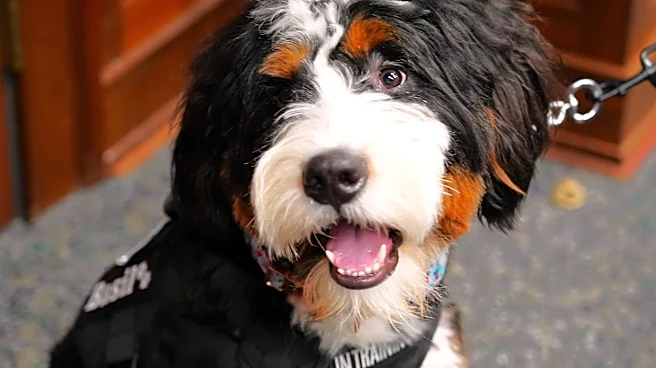


You might cringe when a jury summons arrives in your mailbox, but one type of jury duty in Hamilton County comes with an unexpected perk: hanging out with Basil the therapy dog.
You might spot him padding
through the prosecutor's office alongside detectives and attorneys. His perpetually grinning face is framed by a mop of white fur, and he's easy to identify thanks to the small vest bearing his name.
Grand juries look very little like the juries featured in television dramas. They don't meet in a courtroom. They aren't even trying to figure out if people are guilty. Yet citizens selected from voter-registration and driver's license records meet nearly every day in Hamilton County to review criminal cases.
There are other perks to serving on a grand jury in Hamilton County. During the typical two-week term, jurors avoid the courthouse's often lengthy security lines
But what is a grand jury and how does it differ from a regular jury? Here's everything you need to know.
What is a grand jury?
About half of U.S. states use grand juries to determine whether enough evidence exists to charge someone with a crime.
In Ohio, grand juries are used for serious felonies crimes, not minor ones. In Hamilton County, grand juries consider all felonies and any misdemeanors associated with a felony charge. Grand juries don't determine guilt or innocence. They don't hear from the accused person or their lawyer at all. They can, however, question police officers and others who come to present evidence.
The directive, according to the Ohio Judicial Council, is to: "determine if the evidence is sufficiently reliable or credible to determine that the person to be charged probably committed that offense." The word "probably" is important, and is the basis for the legal term "probable cause."
In Hamilton County, a grand juror serves for two weeks and may hear 100 cases or more in that time.

If seven of the nine members of the grand jury on a case decide there is enough evidence to indict, then a case will proceed.
If there are not enough votes to indict, the case is dropped. Court officials may call this a "no bill" or say the grand jury "ignored" the case. The prosecutor may bring a case before a grand jury again if there is new evidence.
5,700 cases a year
The grand jury rooms are in the same building as the Hamilton County Prosecutor's Office on Ninth Street, just a block from the courthouse. The spaces don't have the high ceilings or airiness of a courtroom, in fact, they can get a little cramped. But Kate Burroughs, the Chief of Grand Juries and Intake since January 2025, has tried to spruce things up.
Her daughters volunteered to help clean and refresh the rooms. They patched up the well-worn chairs. Tables were brought in where there had been none, and now there's a TV monitor. Burroughs said that, in the past, detectives often had to walk around the room holding up their phones so jurors could see videos and photos.
Hamilton County Prosecutor Connie Pillich said grand juries convene in Hamilton County Monday through Friday, with the exception of some holidays, 52 weeks a year.
Some counties in Ohio hold grand juries less frequently due to their lower population. But the volume in Hamilton County means there are two grand jury panels of nine jurors plus alternates working every weekday.
More than 5,700 cases were presented to Hamilton County grand juries in 2025, Pillich said.
Knowing the pace of the work, it's no surprise that the wood-paneled walls show deep wear from the backs of chairs of rubbing against them for hours, day in and day out for decades.

It is in these rooms that grand juries perform one of the justice system's most important gatekeeping functions. On day one, there's a presentation covering basic legal principles: what terms such as knowingly, recklessly and possession mean; what gun laws are active in Ohio. The jurors get a light docket that day to get their footing before moving on to bigger cases, Burroughs explained.
"You don't have any theatrics," Pillich said.
The biggest slice of cases are drug trafficking and possession cases, she said, which make up about 35% of all cases that go before grand juries.
Grand juries are secret
All members of the grand jury take a permanent oath of secrecy to never share what they see and hear in the process. The Ohio Supreme Court says this secrecy has several advantages, but it is also one of the chief criticisms of grand juries.
Since the point of a grand jury is to act as a check on whether a person should be charged or not, secrecy can protect the reputations of people who ultimately are not charged.
The Ohio Supreme Court says the secrecy may also encourage reluctant witnesses to testify and potentially stop a suspect from finding out about an investigation and fleeing.
The problems arise when grand juries decline to indict a police officer or public official. Since the grand jury process is operated by the prosecution, critics argue prosecutors can shape their presentation to influence the outcome.
The tradition of the grand jury came to the United States from England, which stopped its use of grand juries in 1933.
The states that don't use grand juries rely on preliminary public hearings before a judge instead. The Ohio constitution would have to be amended in order to replace the grand jury system.
'Can we do this as a career?'
For many jurors, the experience is surprising and emotionally taxing, Burroughs said. Most people are not regularly exposed to the level of trauma discussed in the jury room.
When the prosecutor's office brought in Basil the therapy dog, it was assumed he would mostly help the victims of crime and their families, but Pillich quickly found that he was very appreciated by grand jurors as well.
Jurors regularly view crime-scene photographs and hear testimony involving shootings, sexual offenses and other violent crimes.
Despite that, many jurors come away with a deeper appreciation for the role they play in the criminal justice system, she said. In a survey of jurors, they reported they learned what's really happening in their community. They have changed where they give their time and money. One even person described it as the greatest experience they've had.
Burroughs said people also form real connections with their fellow jurors. She knows of one group that meets quarterly for brunch.
"Can we do this as a career?" one juror wrote in a post-service survey.
Unfortunately no, Burroughs said. Grand juries don't even accept volunteers.
This article originally appeared on Cincinnati Enquirer: This Hamilton County jury assignment comes with Basil the dog