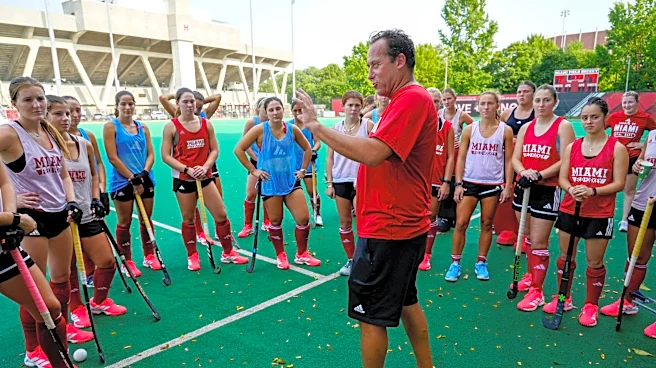






OXFORD — Head coach Iñako Puzo doesn’t say much at Miami field hockey practice.
Decked out in a red Miami tee, baggy gym shorts and chunky white sneakers, he spends most of the RedHawks’ training session with his arms crossed, looking on as his players compete in 7 v. 7 scrimmages. Occasionally, he’ll whisper something in Spanish to an assistant, or chat with a player taking a water break.
But to take his casual silence as weakness is a mistake. Puzo also just happens to have more MAC championships than any other coach, current or former, in RedHawks history.
“You just see him in practice, and you wouldn’t think this man’s literally a legend in the game,” said Miami associate head coach Chip Rogers. “He is humility, he preaches that and shares
that, and he’s very quick to point out that this is all about the players.”
Puzo’s former players describe him as a second dad. He hosts team dinners at his house every Thursday with his wife, Kelly. He drives a van to help get his athletes to road games, where they’ll discuss everything from NCAA eligibility rules to the electoral college. He recruits girls to Oxford by befriending their grandmothers, and he’ll show up to their weddings after they’ve graduated.
But Puzo is also the man who, upon leaving Miami's campus after interviewing for the head coaching job in 2011, looked former athletic director Brad Bates in the eye and said he’d resign if he didn’t bring his team a MAC championship within two years. He then went on to claim 11 of them, and now, he looks at the massive banner hanging up at his field to remember the years he didn’t win his conference.
In 2024, Puzo became the first field hockey coach to be inducted in Miami’s Cradle of Coaches. And just last fall, he led Miami to the NCAA quarterfinals for the first time – a run where the RedHawks upset No. 4 Virginia in Charlottesville, before nearly taking eventual national champions Northwestern to overtime.

With the 2026 season kicking off Aug. 28, Puzo’s preseason No. 10-ranked RedHawks are motivated to improve upon their 2025, with a freshman class that he calls his best-ever. But to know how he got to this point – how he turned Miami from a team without a postseason appearance into one just two steps away from a NCAA championship – is to know that his two personas are not a contradiction.
Puzo’s boldness instilled a winning mentality into Miami, a perennial underdog program competing in a sport dominated by Big Ten and ACC schools. But, in a way that’s perhaps overlooked, he also did it through his emotional IQ; by understanding each of his players personally and coming down to their level.
“Iñako has his way of things, his mannerisms. But at the end of the day, he speaks the language of hockey, and I think he’s a brilliant communicator,” said Jon O’Haire, Miami’s goalie coach from 2018 to 2024. “I don’t think he plays favorites, but I do think he makes everybody in their own way feel special.”
From Caracas to Oxford
Inspired by his dad, Puzo started playing field hockey at age seven when he moved from Spain to Caracas, Venezuela. He worked his way up the rankings and eventually started playing for the Venezuelan National Team in 1988.
Puzo’s life changed when he took his first trip to the United States for a coaching course in 1996. Taking inspiration from the visit, he decided to chase new beginnings in America a year later.
“My friends in Venezuela, they all say ‘you’re crazy, man. You cannot even go to a restaurant and ask for a meal in English. How are you gonna (coach)?’” Puzo said. “And I said, ‘Don’t worry about me. I cannot speak English, but I can coach and play hockey. So I’ll figure it out.’”
Puzo got his first NCAA job in 1997 as an assistant coach for American University. He also coached at Ohio State (2001-07) and top-division Spanish men’s club CD Terassa (2008), before landing an associate head coach role at the University of Virginia (2009-10).
Soon, Puzo realized he wanted to captain his own ship. And in Oxford, he got that opportunity when former Miami coach Jill Reeve chose to move on from her role following the 2010 season.
When Reeve left, Bates asked for her input on a possible successor. Knowing Puzo from playing alongside his wife, she recommended him to replace her, and Bates invited him in for an interview in March 2011.
To court Miami, Puzo researched the university extensively, crafting five and 10-year plans for the future of the team he’d take over. But for Rogers, who worked with Puzo at Virginia, it wasn’t just that effort – or his seemingly lofty MAC title promise to Bates, for that matter — which foreshadowed their eventual success in Oxford. It was how Puzo behaved when his first son, Xavi, was born in 2010.
“I probably got 30 pictures of Xavi as a one-day-old, two-day-old, three-day-old,” Rogers said. “And the fact that those wanted to be shared, just underlines that if you build a culture based on family and trust and belief, great things are going to happen.”
Puzo inherited a Miami team that broke a 29-year MAC title drought in Reeve’s final season. They finished with a winning record for the last three years. But he saw cobwebs within the program’s culture that prevented it from reaching the next level, and he took it upon himself to change that.
Changing the Miami culture
When Puzo first arrived in Oxford, he heard the tired adage commonly expressed by mid-major schools across the NCAA.
“I got here and I got very mad with the culture, especially outside the athletic department. That was, ‘Well, you’re Miami,’ in a negative way. ‘Well, but you’re in the MAC’ in the same negative way,” Puzo said. “‘You guys have to stop talking like this about Miami.”
Seeing this, Puzo started telling his players that they’d win because they were at Miami, and not despite it. Puzo and Rogers decided they wouldn’t “fly the flag,” or waving the MAC conference flag any time a member school beat a power conference team, after the tradition was introduced. And sensing a disconnection between the alumni and current players, Puzo organized events to bring them together and instill greater RedHawk pride in the former group.
Amidst it all, Puzo says he refused to blame outside factors for any shortcomings his team faced.
“I don’t have a 110,000-person football stadium. I don’t have the salary of many other coaches in the U.S. I don’t have the operational budget of other programs in the U.S.,” Puzo said. “But at the end of the day, when it’s game day, I have 11 players on the field, and the other team has 11 players on the field. That is where I have to win.”

Miami’s first MAC title came in 2012, Puzo’s second year – just like he promised his AD. In 2013, the RedHawks qualified for their first-ever NCAA tournament. But in 2014, they went 7-12, recording a losing record for just the second (and last) time in Puzo’s head coaching career. That year, conflicts arose within the team, leaving Puzo to think of off-the-field solutions.
Puzo hired a team sports psychologist. He read Legacy, a book about New Zealand’s renowned All-Blacks rugby squad, and started a weekly team book club so his players could learn how to embody the All-Blacks’ qualities. He described his players' problems as "skeletons in the closet," and had them write those problems down on printed paper skeletons.
The result of these exercises, according to Puzo and his players, was a team that understood both itself and each other more.
“He wanted us to create the identity of the team,” said former RedHawk Carla Romagosa, the 2016 MAC Player of the Year. “It was through conversations, and it wasn’t done in one year, and it was probably not done when I left. It’s been a working process.”
That process continued throughout the late 2010s, when Miami became the singular dominant force in the MAC. 2017 was the start of the RedHawks’ nine-year MAC win streak that is still ongoing today, and the year they won their first-ever NCAA Tournament game to reach the Round of 16. In 2021, they brought the city of Oxford together to host Maine in the opening round of the NCAA Tournament – the first time Miami hosted an NCAA tournament game in any sport.
During those years, Puzo developed all-time greats at his program by recognizing and harnessing their strengths.
Romagosa came to Miami as a defender, but Puzo took her out of her comfort zone to play midfield, where she ended up producing career-best stats. He told Paula Portugal, a two-time MAC player of the year, that she needed to fix her body language because it was contagious for her teammates – advice that Portugal still carries with her today. When 2018 MAC Defensive Player of the Year Mariona Heras missed her first two NCAA seasons with injuries, Puzo developed her into a team leader on the bench.
Many of the players Puzo recruited came from overseas and were initially hesitant about leaving home to play field hockey in Southwestern Ohio. They left Miami after contributing to an ascending powerhouse, but also carry with them wisdom from a man who changed their lives.
“I’ve argued with him before, and I disagreed with him on some things…but when we leave that program, the relationship with him is amazing, and he will be in our lives for the rest of our life,” Heras, who came to Oxford from Spain, said. “Iñako is my American dad, and it’s not just (for) me; it’s many of us. That tells you a lot.”
Building on success
When Miami scored the winning goal in the 59th minute to beat No. 4 Virginia 2-1, Paula Portugal teared up.
Preoccupied with her own professional field hockey career in Belgium, Portugal doesn’t have much time to watch her alma mater nowadays. But seeing that the RedHawks had the Cavaliers on the ropes in the 2025 NCAA tournament Round of 16, she knew she had to tune in – even if it meant following on FaceTime through her American friend’s TV because the ESPN+ stream was geoblocked in Europe.
“I had tears in my eyes because for a long time, that was the end of our season, in the Sweet 16,” Portugal said. “So me and all the other alumni have been waiting to the moment that we made it to the Elite Eight.”
Indeed, Miami had lost in the NCAA Round of 16 for five consecutive years before 2025. The win at this stage over Virginia, and the close quarterfinal battle against Northwestern afterward, finally placed the RedHawks in field hockey’s upper echelon of national contenders – to the point where Puzo was showered with praise at the National Field Hockey Coaches' Association's annual coaching convention for how he played Northwestern.
And while Miami’s 2025 run is objectively the biggest milestone the program has ever had, its importance within the team isn’t perceived to be as grand scale. Rogers brings up Mississippi State women’s basketball breaking UConn’s 111-game winning streak in 2017, and how the Bulldogs couldn’t capitalize on that to become a national powerhouse. He doesn’t want the RedHawks to suffer the same fate.
“It’s a great talking point, to say we beat No. 4 Virginia. Those are huge building blocks,” Rogers said. “But if they’re not taken in context with other things, then they become one-offs.”
For Miami, every moment is program-defining, and not just the big wins. This fall, it started with the team’s first practice of the year on Aug. 10.

Once training ended, Puzo huddled everyone in a circle and asked them to share their opinion of the practice. Only after several of his players talked did he speak himself, reminding them that they must play with intensity but also take care of their bodies before they get hurt.
Later, Miami freshman Ella Clayton said that Puzo was the first coach she had which made a team communicate like this.
The players then filed out of Miami’s field hockey complex, making way for the youth clinic that followed. Soon, that ended too, and the sun went down. The parking lots started emptying, and the lights turned on. Before he finally left the field for the night, Puzo was asked about what his legacy could be, 15 years into his head coaching job.
“I want to be remembered as someone that really loved Miami,” Puzo said. “As someone looking not just to build a good field hockey program, but to help the institution get the status and spotlight it deserved.”
Then, the most decorated coach in Miami University field hockey history left campus for the night, driving away like everyone else.
This article originally appeared on Cincinnati Enquirer: How this coach turned Miami field hockey into a national powerhouse