







The effort to revive Cincinnati's abandoned subway tunnels is not over.
And some of the world's leading design and engineering experts have vied to study how to repurpose them, a sign that this could be more than a city daydream.
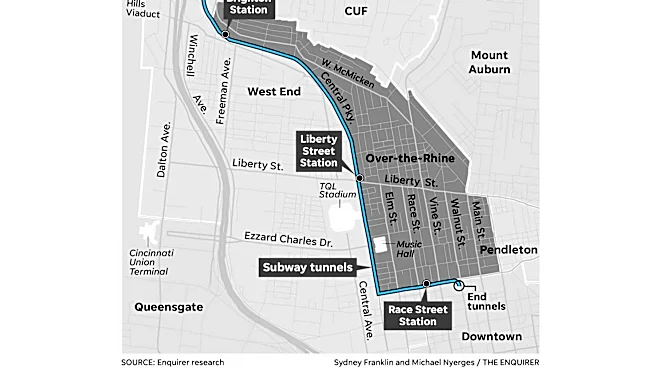
Last fall, The Enquirer reported that the city's Department of Transportation and Engineering issued a request for proposals for a feasibility study to explore possible uses for the 2.2-mile-long tunnel under Central Parkway. Eight firms submitted proposals, including Downtown's GBBN, Blue Ash's Stantec and Transdev North America, which helps operate Cincinnati's streetcar.
Over-the-Rhine-based Woolpert Inc. was ultimately chosen to lead the study for $284,073, according to city records. Woolpert is a global design, geospatial,
and infrastructure firm that has worked on some of Cincinnati's highest-profile projects in and around Downtown.
The company is teaming up with several other regional firms, Strand Associates Inc., Megen Construction, ASC Group and Gibraltar Development Corp., for the study. Combined, they've worked extensively in stormwater detention and management, land use planning, cost estimating, and ecological surveying − not just development and construction, with work on major local projects like Central Parkway, the Brent Spence Bridge, the Western Hills Viaduct, Lunken Airport, Hard Rock Casino Cincinnati and Covington's former Internal Revenue Service site.

When will the study be complete and what will be in it?
City records obtained by The Enquirer reveal that Woolpert and its team have likely been working on the feasibility study throughout this year. Emails between city employees show it's on City Manager Sheryl Long's "radar," and the procurement team has been asked "to be aggressive" about finishing it.
The final study is estimated to be done by early 2027.
In the report, Woolpert is expected to:
- Recommend specific paths to revive the tunnels.
- Provide a summary of its existing conditions.
- Explain how best to relocate utilities in the tunnels.
- Conduct an analysis of stormwater detention.
- Detail how much it might cost to clean up and reuse the tunnels.
- Outline an economic development and market feasibility analysis.
Conceptual drawings and renderings could also be part of the report.
A peek at who wasn't chosen

The range of companies that applied to study the subway tunnels says something bigger about Cincinnati: Experts are paying attention and taking the potential reuse of the city's aging infrastructure very seriously.
Here's a look at some of the teams that applied and their work across Greater Cincinnati and beyond.
Arup, out of Chicago, an experienced rail and adaptive reuse firm, submitted a proposal with HR&A Advisors, Inc., Lawhon & Associates, Inc., and Bjarke Ingels Group, which is expected to design a new building for the University of Cincinnati.
- Arup is currently working with Cleveland on an 80-acre shoreline park on Lake Erie and previously worked on Cincinnati's Union Terminal restoration, Chicago's Union Station renovation, the construction of New York's Second Avenue subway, and Little Island, a new park hovering over the Hudson River.
- Arup's study for the city would have cost an estimated $370,700.
Public transportation operator Transdev also submitted a proposal with a slew of expert consultants including Megen Construction from Forest Park, KZF Design Associates out of Downtown, and John Deatrick, the Cincinnati's former transportation department director.
- Together, their experiences range from developing plans for LA Metro, WeGo Transit in Nashville, the Long Island Rail Road, the city of Cincinnati and the Ohio Department of Transportation, among others.
- Their study would have cost over $996,000.

GBBN's proposal included a partnership with global consultancy JS Held, the University of Cincinnati, several area cultural institutions as well as Kimley-Horn, a top engineering firm with offices on Court Street that was behind the redesign of the Lindern Family Tennis Center.
- GBBN also led Cincinnati Union Terminal's restoration and submitted a proposal to the city in fall 2024 for "Cincinnati Arts Underground," which reimagined the subway tunnels as an art walk.
- Their feasibility study would have cost $867,500.
Stantec, a Blue Ash firm with offices worldwide, submitted a feasibility study proposal with Queensgate's Elevar Design Group, Downtown's Metric Environmental and Pendelton's Gray & Pape, a historic preservation consultancy. Their $561,500 plan was based on their combined experience in stormwater detention, sewer management, roadway design, bridge replacement and downtown planning and development.
This article originally appeared on Cincinnati Enquirer: Cincinnati firms chosen to plan next steps on reviving subway tunnels