






Cincinnati's streetcar story has always been one of numbers: riders, delays and dollars.
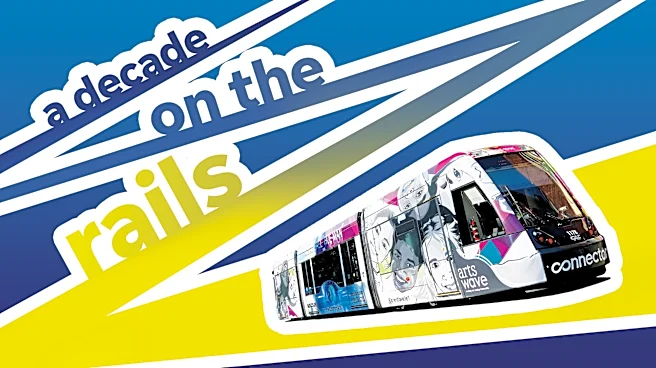
Ten years after launch of the Cincinnati Connector, those numbers show growing demand and fewer operational headaches but lingering questions about the system's growth and financial needs.
"The 10th anniversary should be a celebration of beating the odds," said Brian Boland, a transportation advocate through a group called Bridge Forward. "The streetcar has become an embedded, important part of the neighborhood."
An Enquirer analysis of the system bears that out, proving the streetcar has outperformed its early critics.
But data also shows the city will have spent close to $300 million in local and federal funds on the streetcar by the time it is paid off, about
30% more than early projections.
In 2026, as in 2016, the chief question about the 3.6-mile Downtown to Over-the-Rhine system remains: Is the streetcar worth it?
How we got here
The streetcar was named for Cincinnati Bell, the telecommunications company now known as Altafiber.
When the line launched Sept. 9, 2016, The Enquirer published a 15-year look back at its history. The headline: "Streetcar timeline: Long, winding, arduous journey."
And so it was:
- The streetcar survived not one but two votes on ballot issues aimed at stopping it.
- Gov. John Kasich pulled $52 million in state funding − the top reason the streetcar doesn’t extend Uptown.
- Cost overruns and a $22.7 million funding gap cemented opponents’ fears that it was a waste of money.
- And then, in 2013, John Cranley was elected Cincinnati mayor with a plan to stop the project.
The early years remained arduous.
Traffic was slow to grow. Service was blocked (and still is) by other vehicles on the tracks. Two years in, Altafiber threatened to pull out. Four years in, the city took over management from the operator of the Metro bus system, the COVID-19 pandemic killed ridership and fare revenue disappeared when the city restarted the system free to all.
“We've all worked really hard on trying to alleviate some of the pain points that we had at the beginning," Lori Burchett, the city's deputy director of streetcar services, said in interviews with The Enquirer. "People are really excited about it."
Transformation but also millions in costs

On its 10th anniversary, the Connector has cause to crow: It now transports more than 1 million people a year, with total ridership of over 7.5 million since 2016. It has helped spur millions worth of economic development in Downtown and in Over-the-Rhine, according to city officials.
And, for some supporters, it has bolstered Cincinnati's reputation as a place to be.
"Streetcars have the ability to transform urban areas," said Mark Mallory, the streetcar's chief political cheerleader during his years as mayor, 2005 to 2013. "We did it in Cincinnati."
But the system, which cost $144.6 million to build, has also come with ongoing costs, an Enquirer analysis of city records shows. Those include:
- Close to $53 million in construction debt, with $42 million of that due in annual payments through 2042.
- More than $37 million in operating expenses since 2016, with $13 million more anticipated in the next two years. The city is currently spending about $6 million a year to run the streetcar, twice the initial predictions, because of rising prices of labor, utilities, materials, insurance and other costs, Burchett said.
- At least $90 million more in operating expenses through the end of debt payment period. That estimate assumes the city continues to spend $6 million on operations each year and does not account for continued inflation.
- More than $12 million in capital needs through 2031, with only $9 million allocated.
At the same time, the city is in search of new sponsors, with Altafiber deciding not to renew an agreement that brought in $3.4 million over a decade.

On the plus side:
- Federal dollars covered about 30% of the construction costs and a variety of grants are providing 25% of the annual operating expenses, according to Burchett.
- Federal transit data shows the streetcar's operating cost per rider is lower than the region's two bus systems. In 2024, the streetcar required $4.61 in operating support per person per trip, compared with $11.04 for Metro and $12.59 for Tank.
- Delays in service – some 15,000 over the decade, caused by other vehicles on the tracks, along with everyday traffic tie-ups – have declined sharply over time.
The Connector is also clean, safe and reliable, added John Schneider, a transportation advocate dubbed "Mr. Streetcar" for his work to birth the system. "I give it a solid B at this point."
But has the streetcar been worth the millions spent and the millions still needed?
It depends on who you ask.
Have politics affected streetcar ridership?
Despite the streetcar's uptick in riders, its politically tumultuous history has inarguably stuck with it.
“The streetcar appears to be more toxic than it actually is,” said Brad Thomas, an attorney and former board member of the Southwest Ohio Regional Transit Authority, Metro's operator. “Most of the anti-attitudes you hear are from people who haven’t come downtown and used it."
Cranley, the former mayor, remains one of the project's most prominent skeptics.
“I opposed the streetcar because I believed it was the wrong investment for Cincinnati and I still do," he said.
Cranley said he's not against public transit. In fact, he was a key supporter of Issue 7, a 2020 ballot measure that increased the county sales tax to support Metro and city infrastructure.
But in a city grappling with poverty, housing affordability and public safety challenges, he continues to believe the money spent on the streetcar "could have accomplished far more somewhere else."

Yet people do use the streetcar.
On busy summer weekends, Reds and FC Cincinnati fans pack the cars before and after games. Riders stand nose to nose when big events generate big crowds, a la Taylor Swift and Blink light festivals. Wedding couples charter cars for parties. (Thomas attended one of those, as the groom.) Streetcars also transport people who use wheelchairs or other mobility devices, people pushing strollers and people with unstable housing.
The streetcar also serves as an attraction to the urban core outside of game days and special events, said current Cincinnati Mayor Aftab Pureval. It brings visitors, too.
"The streetcar sets us apart, compared to many of our peers, for folks who are considering coming to our city," Pureval said in a statement. "It's a huge marketing pitch for our tourism efforts that folks can get Downtown and travel around freely and easily without a car."
Supporters argue the streetcar's value isn't limited to tourism. They say it has fundamentally changed how people move between and view these once-separated neighborhoods.
"I think the most important thing the streetcar has done is it has made The Banks, Downtown and Over-the-Rhine one contiguous unit," said Brad Hughes, co-founder of cookware store Artichoke by Findlay Market. "It has become a circulator, and a circulator has value too."
Has the streetcar spurred development?

Streetcar supporters point to the tidal wave of real estate investment in Over-the-Rhine and Downtown as a marker of the streetcar's success.
Part of that can be linked to already-planned catalytic projects near the line like Washington Park, which opened the same year construction started on the streetcar, and Music Hall, which was renovated in 2017.
Real estate consultancy Urban Fast Forward found that between 2012 and 2019, 83% of construction projects within the 45202 ZIP code were located within 1,000 feet of a streetcar stop. Their combined value was $1.1 billion, the firm reported.
That report backs up predictions made in a 2007 feasibility study that estimated the streetcar would bolster property values along the corridor by $379 million over 30 years. It also predicted streetcars would spur $1.5 billion in private investment along the line over 15 years.
While those numbers may be outdated, they can't be that far off: Projects like the newly opened Cincinnati's Fidelity Hotel cost $88 million to build alone.
Market Wines by Findlay Market is among the stores that's seen a bounce in business since the streetcar opened, owner Michael Maxwell said. More regular customers live nearby and join weekend visitors who frequent his shop.
"The difference between now and 10 years ago is all those buildings that were under construction are now housing tenants or businesses," he said. "Because of that, we have a lot more people who feel safer living or coming to Over-the-Rhine."

Is the streetcar a failure without expansion?
Most streetcar systems expand in their first decade of operation.
That was the original plan in Cincinnati − to build an Uptown link that connected Downtown with the University of Cincinnati, the hospital systems and the Cincinnati Zoo & Botanical Garden.
A series of public meetings in 2024 helped restart the conversation about going north and potentially building eight other routes. But the effort, hosted by an advocacy group called the Greater Cincinnati Coalition for Transit and Sustainable Development, has yet to lead to anything concrete.
Cincinnati City Council member Mark Jeffreys said he'd support studying expansion if the city can identify a federal funding source and a sustainable financial model. He favors a route connecting Union Terminal, the Hard Rock Casino and Sawyer Point − where major attractions are connected and more housing could go up. But any investment, he said, must be weighed against the need to provide basics like public safety, paved roads and trash collection.
That's all a normal part of the process, said Tom Gerend, executive director of Kansas City's streetcar system. Gerend, who chairs the national networking group Community Streetcar Coalition, said it typically takes a decade to plan, assess and advance an expansion project. That's what happened with KC Streetcar.
Of the dozens of streetcar systems in the U.S., Kansas City's is the most comparable to Cincinnati's because it opened at the same time, with cars from the same manufacturer. But KC Streetcar has added two extensions, planned two more, and recently drawn over 2.1 million riders in one year.
"What we've always said in Kansas City is the best case for expansion is a really successful operation that people use and they like," he said. "The public will ultimately want more of what they like."
Cincinnati City Council member Meeka Owens thinks it's time to start talking more seriously about expansion with the Brent Spence Bridge Corridor project underway.
“If we are already prioritizing transportation and connectivity, you can’t leave out the streetcar," Owens said. "It's an inevitable part of the conversation."
Burchett, the city's streetcar point person, said the No. 1 question she gets relates to expansion.
But her office has no money for that right now or even funds to study the question. A push to expand must start in the community and win the support of elected officials and top administrators, she said.
"I'm not saying that anybody is necessarily opposed to it. It just that that hasn't happened yet," she said.
Can the next mayor push it forward?

The community has, of course, already weighed in, via the advocates who drew up nine new route possibilities.
In the short-term, other advocates suggest these less-expensive improvements:
- Create dedicated streetcar lanes to keep other vehicles off the tracks and reduce blockage time.
- Install signs at stops for real-time reports of arriving streetcars.
- Adjust traffic lights to reduce streetcar stops.
- Sign up new sponsors to replace Altafiber.
Schneider does not see current local officials banging the drum to expand the Connector. He also thinks now is not a good time to count on new federal dollars. "The climate for expansion could not be worse," he said.
The best hope might come from whoever serves as Cincinnati's next mayor, Schneider said. A pro-streetcar mayor, especially if elected to two terms, might have long enough to energize the expansion conversation.
Fellow supporter Thomas calls the Connector a success, even without expansion plans.
"Worst case, even if we never go any further with this one, it's been a total success because we're actually moving people in the urban core," he said. "The most important thing you can do for Cincinnati is repopulate the Downtown and Over-the-Rhine."
This article originally appeared on Cincinnati Enquirer: Cincinnati's streetcar has become 'embedded.' But is it a success?