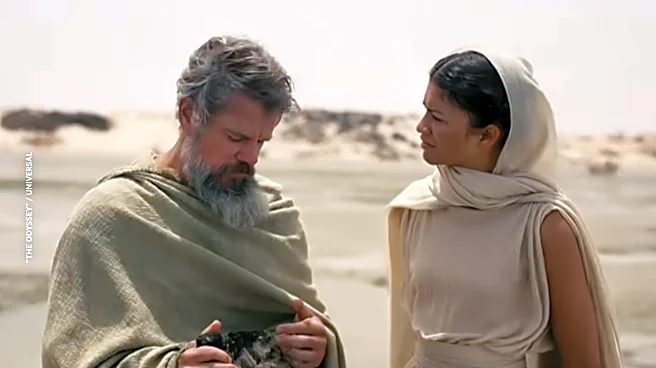








Christopher Nolan’s "The Odyssey" is more than another retelling of an ancient adventure. It reminds us that some stories endure because they speak to something deeper than plot: They awaken the part of us that still knows what we owe one another.
I began reading Emily Wilson’s translation of Homer weeks before the film opened. Reading the poem alongside Nolan’s version, one theme emerges with unusual clarity. "The Odyssey" is ultimately about how we treat the people who cross our path.
The sacred duty of hospitality
Early in the film, a character names the code that governs that world. Zeus’ law is simple: Treat others as you would be treated. Feed the stranger at your door. Shelter him. You never know when the person at the threshold may be more than he appears. That ancient
idea has a name: xenia, the sacred obligation to welcome the traveler. In Homer’s world, hospitality is not a courtesy. It is a duty.
In the theater, when that law was explained, the audience accepted it. No one shifted in their seats. Reviews have taken issue with casting choices or with the film’s departures from the poem, but almost no one disputes the principle itself. We grow up with the Golden Rule. Something in us already recognizes the duty.
That duty is not confined to tribe or religion. It reaches across centuries and cultures, pointing to a moral truth people have recognized wherever they have tried to live together without tearing each other apart. A stranger deserves welcome. Those without power deserve protection. Betrayal leaves damage that does not stay neatly contained. Honor these obligations and life holds its shape; ignore them and the unraveling begins.
That is why the poem feels larger than the story of a king trying to get home. Odysseus is forced to confront what victory has cost him. The successful trick at Troy is no longer just a clever triumph. It carries a moral weight that does not end with the fighting. War leaves marks, and those marks do not disappear when the battle is over.
One of the striking things about "The Odyssey" is how steadily it pulls our attention away from power and toward responsibility. The stranger is not an interruption; he is a test. The loyal servant is not background; he is a measure of a household’s character. Even the beggar at the gate is not beneath notice. In Homer’s world, those with the least status often reveal the most about those who hold it.
Why great stories endure

This is where the ancient world and the biblical world meet. The Golden Rule feels familiar the first time we hear it because it speaks to something already present in us. As Paul suggests, the law is written on our hearts. Hebrews says, "Do not neglect to show hospitality to strangers, for by doing that some have entertained angels without knowing it." The language differs, but the intuition is the same: There is a standard of right that does not depend on whoever holds power. Some things are true because they are true. Some obligations remain binding even when they are inconvenient.
Great stories endure because every generation discovers itself within them. "The Odyssey" has lasted nearly 3,000 years not simply because it is an epic of adventure, but because it speaks to conscience − to what Paul called the law written on the heart. Where conscience survives, the possibility of home survives with it.
Ray Watford of Hilliard, Ohio, is a retired newspaper production director.
This article originally appeared on Cincinnati Enquirer: The moral conscience at the heart of 'The Odyssey' | Opinion