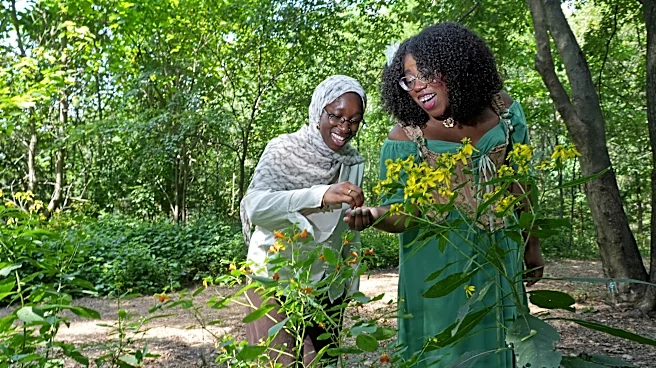









She sings about poisonous plants, gathers ingredients from sidewalks and turns the weeds most people ignore into meals worth sharing with millions.
Cincinnati native Alexis Nikole Nelson – who now lives in Columbus and is far better known online as Black Forager – has built a platform around encouraging viewers to reconsider what counts as food.
With her colorful outfits, impromptu songs and unmistakable laugh, Nelson has become one of Ohio’s most prominent social media creators. Behind the joyful videos is an educator using food to teach history, reconnect people with the natural world and preserve knowledge that was nearly lost between generations.
Nelson – who graduated from Walnut Hills High School in 2010 and Ohio State University in 2015
with degrees in environmental science and theater – has built an audience of millions, won a James Beard Award and hosted the 15-episode PBS series "Crash Course Botany."

She now adds published author to her list of accomplishments.
Nelson's first cookbook, "Happy Snacking, Don’t Die!," was released Sept. 22. The 272-page book combines a guide to foraging with vegan recipes showing readers how to use common plants, flowers and fungi growing around them.
Nelson joined the "Columbus in Color" podcast to discuss the family traditions behind her work, the history carried through wild foods and how a theater student who once believed she belonged behind the scenes created a stage of her own.
'Happy Snacking, Don’t Die!' puts inherited knowledge on paper
The idea for Nelson’s cookbook partly grew from a practical problem: Her followers wanted to recreate her recipes but struggled to find old videos once the ingredients returned to season.
Social media was not designed to function like a cookbook. A recipe Nelson posted months earlier could be buried beneath dozens of newer videos by the time someone found the plant growing near them.
Nelson initially considered creating a small e-book. Then Simon Element, an imprint of Simon & Schuster, approached her about publishing a physical cookbook.
Justin Schwartz, the imprint’s executive editor, said Nelson made foraging feel accessible to people who might have assumed it required extensive training or a trip deep into the woods. Her videos show viewers that they can start paying attention to plants in their own yards or local parks.
"Alexis is the earth science teacher we all wish we had in high school," Schwartz said. "It just happens that her vegan recipes are delicious too."
For Nelson, transferring knowledge from videos and family conversations onto paper proved more emotional − and more difficult − than she anticipated.
In both sides of her family, she said, foraging traditions were passed down orally and practically. A person learned by walking with a relative, watching what they picked and listening as they explained how to prepare it.
"Translating oral history into written word was harder for me than I expected it to be," Nelson said.
A book offered her the chance to preserve that knowledge in a form that would not disappear with a loved one or the closure of a social media platform.
Nelson compared the responsibility to finding a grandmother’s collection of recipe cards and rushing to digitize them before they could be lost. The book includes recipes she developed, but it also carries inspiration and information inherited from her ancestors.
That preservation is particularly significant for Nelson because her father’s family moved from the South to Ohio during the Great Migration. Leaving the places where generations acquired their plant knowledge made it harder to pass down lessons tied to a particular landscape.
"They can't walk you through the same places that they were walked through as children and adolescents when they were learning that information," Nelson said.
Foraging as reclamation. 'The odds were stacked against us'
Nelson describes foraging as the practice of identifying and gathering plants, fungi and other natural materials that a person did not intentionally grow, then using them to care for themselves or their household.
That can be as simple as gathering onion grass from a lawn. Nelson believes people earn the title "forager" through their interest and willingness to learn, not through decades of experience.
But for Nelson, foraging also represents reclamation.
She teaches followers about the long history of Black and Indigenous communities sharing knowledge of plants, food and medicine − and the deliberate efforts that later separated Black Americans from that knowledge.
Enslaved people were often forced to become self-sufficient because enslavers did not adequately provide for them, Nelson said. They learned to forage, fish, trap and identify plants with medicinal uses.
After emancipation, laws restricting hunting and gathering on land a person did not own disproportionately harmed newly freed Black people, few of whom owned property. Later, segregation and the danger of sundown towns made many rural and wooded spaces unsafe for Black Americans.
Those barriers helped sever generations from practices that had once sustained their families.
"I do try to take a lot of time to sit with how lucky I am, because the odds were stacked against us to lose this knowledge," Nelson said.
Some traditions survived. Nelson pointed to poke salad, a dish prepared from carefully cooked pokeweed greens, as one of the most recognizable wild foods preserved in Black foodways.
Each spring, when she discusses pokeweed online, Black followers share memories of relatives who gathered it or talked about eating it as children. Others say her videos finally taught them how to reconnect with a dish they had only heard about.
"Getting to help rebuild some of those splintered connections," Nelson said, "is really what I do it for."
She is careful, however, not to position herself as the sole authority. Her name is Black Forager − not "the" Black Forager.
"I am just a Black forager, because there is no ‘the’ Black forager," Nelson said. "If you’re Black and you forage, you’re a Black forager. Congratulations."

Joy is part of the lesson
Nelson's videos are recognizable not only for what she teaches but for how she teaches it.
She sings, changes costumes, tells jokes and presents lessons with the energy of someone delighted by what she has discovered. The playfulness makes lessons about botany, food and history feel less like lectures.
That approach is part of what drew Schwartz to her work.
“Once you start watching Alexis’s delightful videos, you can’t get enough of them, and then suddenly you realize you’re learning about the environment and ways to help save the planet as well,” he said.
Nelson said some of that delivery is intentional, inspired by the teachers whose personalities made difficult subjects easier to understand.
She remembered a high school math teacher who used jokes, songs and an electric keyboard to explain concepts. Before taking the class, Nelson often felt as though she were running to keep pace with other honors students. Her teacher’s approach changed the way she understood math and eventually helped her reach AP calculus.
Nelson hopes her videos can create a similar opening for someone who might otherwise believe plant science is not for them.
But much of the joy is also simply who she is.
"I’m just naturally a very loud, singing, joyful person," Nelson said.
She has learned that the traits people once considered too noticeable are the same traits that helped her find an audience. Her videos do not separate the educator from the person. Her lessons works because Nelson allows viewers to experience both.

Trending reporter Amani Bayo can be reached at abayo@dispatch.com.
This article originally appeared on The Columbus Dispatch: How an Ohio woman got 5M followers eating mushrooms, saying 'don't die'