







July's final astronomical event will be its full moon, known as the buck moon. When the calendar flips to August, we have a whole array of astronomical events to look forward to, including a total solar eclipse, which Ohio last saw in 2024.
Will Ohio get a glimpse of the 2026 solar eclipse? When does it happen? Here are the details.
When is the 2026 total solar eclipse?
In the United States, the Aug. 12 total solar eclipse will begin around 11:34 a.m. ET and it will end around 2:52 pm ET, according to Norwegian time zone website Time and Date.
Will the total solar eclipse be visible in Ohio?
Guess what? Ohio will be able to see the 2026 solar eclipse! However, the Buckeye State will be on the fringe of the eclipse path and will see only a partial solar eclipse.
With proper viewing gear, some parts of the Buckeye state will be lucky
enough to spot the solar eclipse. According to National Eclipse, here is the percentage of visibility in some of Ohio's cities:
- Cleveland - 3.0%
- Toledo - 1.8%
- Columbus - 0.6%
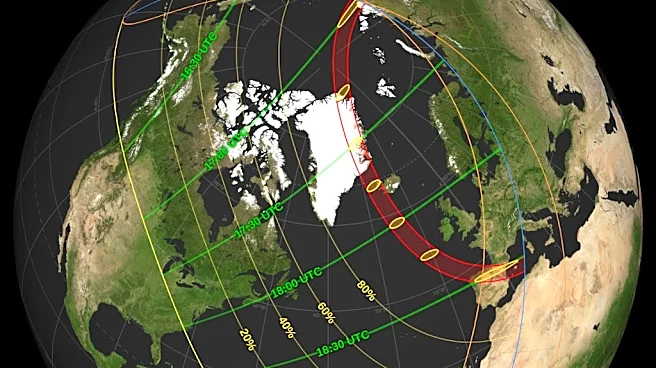
Where the solar eclipse will be visible in the US
What really impresses during these total solar eclipses is totality, or the period when the moon completely blocks the face of the sun.
The maximum totality on Aug. 12 will be 2 minutes and 18 seconds, according to National Eclipse, which provides information on upcoming eclipses. According to NASA, among the lucky viewers in or near the path of totality are those in Greenland, Iceland, Spain, Russia and a small part of Portugal.
People in Europe, Africa, Canada and the northeastern United States will be able to see a partial eclipse. So too will those near the Atlantic Ocean, the Arctic Ocean, and the Pacific Ocean.
Come Aug. 12, people near the far western tip of Iceland's peninsula will be in luck. According to National Eclipse, visitors there can access an unpaved road that reaches a lighthouse and seaside cliffs, and this road will allow them to see about 2 minutes and 13 seconds of totality.
In Spain, those in the northeastern city of Gijón will be able to experience 1 minute and 45 seconds of totality. People in Oviedo, part of northern Spain, will get about 1 minute and 48 seconds.
Per National Eclipse, those in the following U.S. states will see a partial eclipse:

- Alaska
- Connecticut
- Delaware
- Iowa
- Illinois
- Indiana
- Massachusetts
- Maryland
- Maine
- Michigan
- Minnesota
- Montana
- North Carolina
- North Dakota
- New Hampshire
- New Jersey
- New York
- Ohio
- Pennsylvania
- Rhode Island
- South Dakota
- Virginia
- Vermont
- Wisconsin
- West Virginia
What is a total solar eclipse?
A total solar eclipse happens when the moon passes between the sun and Earth, blocking the face of the sun, per NASA.
People in the center of the moon’s shadow when it hits Earth will be able to see the total eclipse. The sky will darken as if dawn or dusk have arrived.
Depending on the weather, people in the path of a total solar eclipse can see the sun’s corona or outer atmosphere, which is usually impossible to see, according to NASA.
Are there any more eclipses this year?
According to NASA, there will be a partial lunar eclipse between Aug. 27 and Aug. 28 for people in the Americas, Europe, Africa, and western Asia.
For those wanting to know if they'll be able to see the eclipses on Aug. 12 and Aug. 27, Time and Date has tools to check specific locations in the U.S.
When will Ohio see a total solar eclipse again?
For the Buckeye State to see a total solar eclipse and be in the path of totality, we will have to wait until 2099.
Where to see the lunar eclipse over Ohio. Dark sky locations for astronomy
If you're hoping to get a better view of astronomical events in Ohio, then you're in luck. Of the 159 locations in the United States that are designated dark sky communities (those having little to no light pollution to interfere with astronomy), two are in Ohio:
- Geauga Observatory Park: Located in Montville Township in Geauga County, this park was selected as a dark sky site in 2011, the Columbus Dispatch reports. The park is centered around the Nassau Observatory, which moved from Cleveland to Geauga County in 1957 due to light pollution. It fell out of routine use in the 1990s.
- Fry Family Park: Located in Magnolia, about 10 miles south of Canton, the park also earned the distinction of being an IDSP-certified urban dark sky area, which means stargazers still get a good view of the night sky despite its proximity to a city.
Other dark sky destinations around Ohio, according to Ohio Magazine, include:
- Burr Oak State Park: The nearest village is four miles away and has a population of less than 2,000, so it produces little light pollution.
- Stonelick State Park: The night skies here are some of the darkest in Ohio, according to the magazine, and it's a common destination for Cincinnati-area stargazers.
- Wayne National Forest: Per the magazine, the isolated Lamping Homestead Recreation Area is arguably the darkest site in Ohio's only national forest.
This article originally appeared on Cincinnati Enquirer: Will Ohio see 2026 solar eclipse? Yes, but not everyone gets a view