





Cincinnati Public Schools' Board of Education members have clashed over a myriad of issues in recent meetings, most notably their vote to tax residents' income that they rescinded in favor of a 7-mill property tax levy.
But through their disagreements, all seven members could agree on one thing: CPS needs more money.
And now that the district is on the ballot for a new-money levy for the first time in a decade, voters are asking: what exactly will the new dollars be used for?
Amid inflation, a statewide push to abolish property taxes entirely and some residents bracing for this year's property reappraisals, the ability to cough up more tax dollars is out of the question for select voters.
Nevertheless, CPS is forging ahead with its tax request.
Why does Cincinnati Public Schools need more property tax dollars?
The district's 7-mill property tax spanning five years would amount to $245 per $100,000 of a home's assessed value. It would provide over $66 million for CPS annually.
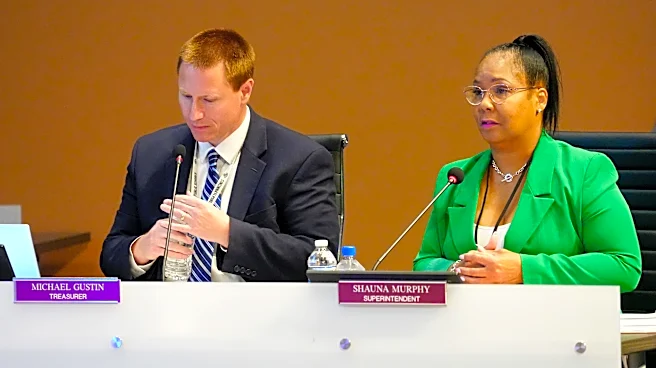
It's crucial for the district to secure new funds, the district's treasurer Mike Gustin told The Enquirer, in order to avoid a negative cash balance and possible state takeover in as few as three years.
The board balanced its budget this summer, meaning it ensured its expenses did not exceed its revenue through a sweeping round of cuts to 81 central office positions, 12 social workers, 10 assistant principals and eight counselors.
But in budget forecasts made under the assumption that the 7-mill property tax does not pass, the region's largest district could see a negative cash balance of $30.6 million in 2029. That could dive to a negative balance well over $156 million by 2031, per a forecast presentation that Gustin shared at the board's Aug. 17 meeting.
The greater CPS's cash deficit becomes, the greater likelihood that the district could be placed under fiscal watch or fiscal emergency by the state, Gustin said. Those levels of oversight could involve a state team assuming control of the district's financial planning.
Currently, there are four districts statewide under that umbrella, including Mount Healthy City Schools, which declared fiscal emergency in 2024.
More property tax revenue would also prevent the district from making significant cuts to its transportation services, arts and extracurricular activities, consolidating schools and expanding class sizes.
Changes to transportation, Gustin said, would likely start with increasing the 1-mile minimum distance students are expected to walk to school to 2 miles before they're guaranteed transportation, which is the state standard.
Districts officials have also talked about implementing a pay-to-play fee for athletics and extracurriculars like band, he added. With that comes the inevitable cancellation of programs that don't have enough students willing to pay the fee to participate.
What voters who support, oppose CPS's levy have to say
The overwhelming majority of speakers during CPS school board's public comment in recent months have promoted a new-money levy, including teachers union officials, district staff and parents.
"Please take my money," district parent Angie Wilson said during public comment at the May 18 board meeting. "I want my tax dollars to fund Cincinnati Public Schools."
Included among the supporters was Ohio Sen. Bill Blessing, R-Colerain Township. Days prior to the meeting where the board reversed its income tax vote and opted for a property tax, Blessing submitted a letter to the board urging them to counteract state and federal funding cuts by securing new property tax dollars.
"I think it would be a pro-active, and conservative, move to ask for more money," Blessing wrote in the letter shared with The Enquirer.

Other voters, like those behind Ax Ohio Tax, a committee to abolish property taxes, argue that property taxes proposed by schools unfairly distribute the tax burden on property owners who haven't had kids in school in decades.
"I don't mind paying taxes to get educated kids," Ron Shumate, an Ax Ohio Tax volunteer based in Springfield Township said. "But I think it should be divided equally among every individual in the state and go through the state. That's what sales tax does."
Shumate, 84, said he and his wife have owned several homes throughout their lives and have paid off their current house. But the taxes they pay on their property after the reappraisal in 2023 are draining them, he said.
"If you own something, you shouldn't have to pay the government to own it. That's like renting your toilet after you bought it," Shumate said.
He plans to vote against both CPS's property tax levy and the county's increased children's services property tax.
"There's a difference between necessity and overspending," Shumate said about CPS. "And they do not give the general public that’s paying the bills a spreadsheet to show where the money went."
How did we get here?
The makings of CPS's current, dire financial state can be placed in two buckets: recent property tax reform and a skewed state funding formula, CPS treasurer Mike Gustin said at an April board meeting.
Last year, Gov. Mike DeWine signed a series of bills Dec. 19 that slash property taxes by roughly $3 billion to help homeowners cope with rising property values. But in turn, tax revenue growth was limited for schools, meaning, as property values in the district climb, CPS' tax revenue won't climb with it.
The "really nasty part" about the set of new policies, Gustin previously told The Enquirer, is that the way the state calculates school funding has not changed to reflect the property tax reforms. So, districts like CPS will appear to have more local revenue than they really have and, thus, will continue to lose state aid.
Ohio's school funding has prompted significant criticism from public education advocates in recent years, after the Republican-led legislature strayed from the Fair School Funding Formula in its two-year budget passed last year.
This article originally appeared on Cincinnati Enquirer: Why does Cincinnati Public Schools need more property tax dollars?