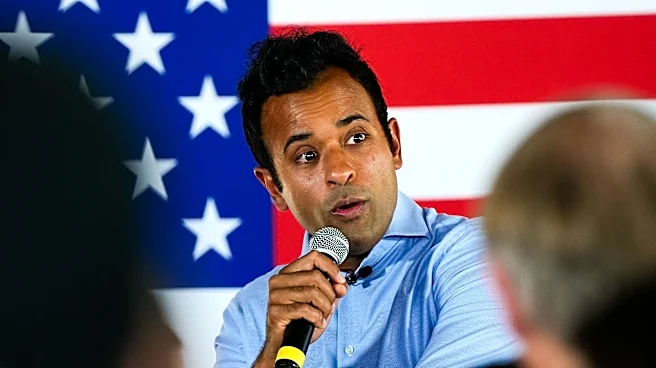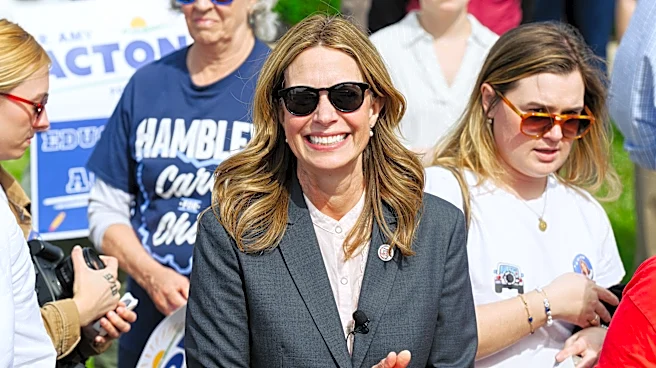





Amy Acton does not want to debate Vivek Ramaswamy. That has prompted the predictable accusations that she is afraid to face Ohio voters. Her campaign says it has no interest in giving a platform to a candidate who has spent the campaign attacking Acton and her family.
Then, on Sunday, an armed man forced his way through a crowd toward Acton as she spoke at the Canfield Fair, knocking two people to the ground before being stopped by law enforcement. Authorities say he had two handguns and brass knuckles. Acton was unharmed.
There is no evidence that the man's actions were caused by campaign rhetoric, and it would be irresponsible to suggest otherwise. But the incident
is a sobering reminder that political rhetoric does not exist in a vacuum − and that there are consequences when our politics becomes less about disagreement and more about vilifying the people on the other side.
Which brings me back to debates.
Debates have become political theater

The bottom line is that a good debate performance does not necessarily elevate a candidate, and a poor one does not necessarily harm a candidate. It takes a truly catastrophic performance to sink a campaign. For a competent candidate, the calculation is obvious: If your opponent's objective is simply to jab, provoke and generate viral clips, why volunteer for the risk?
Trade the podium for a mouth guard and give the voters some real entertainment. But maybe that is exactly the problem.
There was once at least an expectation that candidates could muster a faux smile and acknowledge that their opponent possessed some legitimate quality, even while preparing to dismantle everything they had just said. Today, debates increasingly reward the moment rather than the message. George H.W. Bush looking at his watch. Rick Perry forgetting which federal agencies he wanted to eliminate. Joe Biden's disastrous 2024 performance. These moments live on because they are easy to clip, share and remember.
So, does Acton's decision to skip the debate help her? Not obviously. Does it necessarily hurt her? Not obviously either.
Voters lose something when candidates do not appear together. The irony is that a debate should be one of the few places where political opponents are required to share the same stage, answer the same questions and defend their ideas without a campaign advertisement doing the talking for them.
Instead, the modern debate can look less like a civic forum and more like a roast of Kevin Hart. If that is what we have built, why should we be surprised when candidates decide the risk is not worth the reward?
We are also no longer living in the age of three television channels, when a televised debate was itself a groundbreaking form of political communication. Voters already know what candidates look like. They have their websites, advertisements, social media accounts and carefully produced videos. Younger voters, in particular, increasingly get political information somewhere other than television.
What exactly are debates giving voters that they cannot get somewhere else? That should be the question.
Ohio deserves something better

The answer should not be to abandon debates. It should be to make them valuable again. Moderators should ask meaningful follow-ups. Candidates should have to explain how they would govern Ohio, not simply attack one another. Formats need to encourage actual comparison rather than create confrontation. Networks, meanwhile, could focus less on producing the next viral clip and more on producing something worth watching.
Candidates deserve a campaign environment where disagreement does not come with threats to their safety. Voters deserve the opportunity to hear competing visions without watching a public execution.
And perhaps most importantly, candidates need to be able to stand across from one another, disagree honestly and forcefully, without convincing the people watching that their opponent is something less than human.
If the political debate is going to survive, it needs to become something more than a dogfight. It needs to become useful again.

Nick Anderson lives in Walnut Hills and is a member of the Enquirer Board of Contributors.
This article originally appeared on Cincinnati Enquirer: Acton should debate. But Ohio deserves a better debate | Opinion