




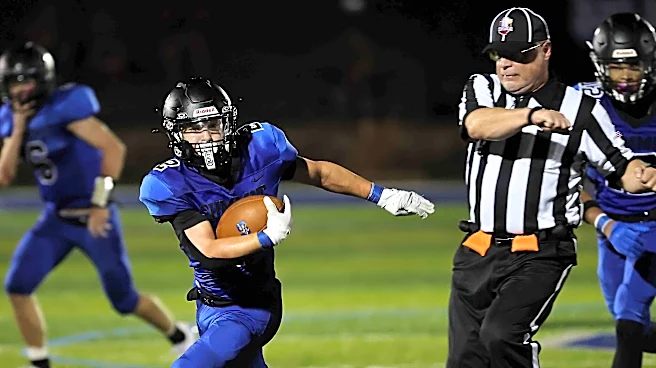


A federal appellate court in New Hampshire recently ruled that a school there could not sanction parents who wore wristbands to a soccer game to protest the participation of a transgender athlete. The court found that the school officials could not establish that the parents' protest created a substantial disruption.
In July 2024, the New Hampshire legislature enacted legislation that barred transgender girls from participating in girls' sports in public schools. Two transgender students, Parker Tirrell and Iris Turmelle, challenged the statute, asserting it violated their rights under the Equal Protection Clause of the 14th Amendment and Title IX.
On Sept. 10, 2024, a federal district court entered a preliminary injunction permitting Tirrell
to continue playing on, and Turmelle to try out for, their schools' girls' sports teams while the litigation proceeded. Tirrell's Plymouth High School team was scheduled to play against Bow High School on Sept. 24.
Before the Sept. 17, 2024, game, a group of Bow parents expressed their opposition to these athletes participating in female high school sports. On Aug. 1, 2024, a parent, Kyle Fellers, sent an email to Superintendent Marcy Kelley and other school administrators, criticizing those who support transgender participation in female sports as "a mentally ill cult."
As an example of those concerns, Fellers described a transgender competitor in an Olympic boxing match as a "mentally ill man" and "maniac," and asserted that the female opposing boxer left the match "crying in pain and in shame" and stating that she had "never been hit as hard." (Spoiler alert − this never happened. Fellers apparently was talking about an Algerian female boxer who was incorrectly identified as transexual by right-wing media. Never let facts get in the way of a good narrative.)
The day before the game, Anthony Foote, another parent, posted on Facebook, urging others to "come out to support (the) XX Lady Falcons" as they "face a team that includes a biological male on the roster." The post emphasized Foote's view that the participation of transgender athletes in female sports could pose safety risks and leave the non-transgender players "vulnerable." Foote also posted a picture of approximately 30 pink wristbands, some of which bore the "XX" symbol and others the female gender symbol or the term "NAD," which is shorthand for "gonad."
Classy.
The evening before the game, Athletic Director Michael Desilets emailed the Bow team parents an excerpt from the Bow High School Athletics Handbook. The email stated that, while Desilets "under(stood) that there (were) some differing opinions regarding tomorrow's game, and that (was) perfectly fine," the game would be a "contest between high school student-athletes and should be treated as such."
Foote responded by email to Desilets the next morning, copying the other parents, and stated: "I'm a leader, and a real leader doesn't stand by while their players are thrown into harm's way ... And you don't sit around waiting for someone to get hurt before you take action."
During the first half of the match, Anthony Foote quietly distributed pink "XX" wristbands to the other appellants and to approximately half a dozen other spectators whom he understood supported his views. Foote instructed the group not to wear the wristbands until halftime. Once halftime arrived, Foote walked to the Bow High School parking lot and placed a poster picturing an activist opposed to transgender participation in female sports on the windshield of his car.
After the parents donned the wristbands in the second half, Desilet asked several to remove them. Following the game, the school district issued no-trespass orders prohibiting Fellers and Foote from attending Bow School District athletic or extracurricular events. Fellers and Foote, among others, filed suit in federal district court, contending the district violated their First Amendment rights. The district court denied their claim. The appellate court, however, reversed that decision.
The case presented a classic content-based speech restriction, which typically violates the First Amendment. The school district argued, however, that it was entitled to act because the parents' protest constituted a "substantial disruption." If that were the case, the district could restrict the speech. Unfortunately for the district, though, there wasn't any disruption.
As the appellate court noted, "(t)here is no evidence that (the) protest caused a material disruption. There was no disruption until school officials chose to intervene, after which the referee suspended the game for approximately fifteen minutes, and the school officials chose to impose restrictions on appellants' speech and impose sanctions. The appellants did not stage any pregame demonstrations; did not march, shout, chant, or otherwise disrupt the game; and did not confront Tirrell or any other player. Instead, they waited until halftime before donning the 'XX' wristbands in a passive, silent gesture of protest. There is also no evidence of harassment, given there is no evidence in the record that any player actually saw the wristbands."
Facts may not get in the way of a good narrative, but they can doom a legal defense. Just like they did here.

Jack Greiner is a Cincinnati attorney. He represents Enquirer Media in First Amendment and media issues. He can be reached at greinerjack46@gmail.com.
This article originally appeared on Cincinnati Enquirer: Schools can't silence a viewpoint because they dislike it | Strictly Legal