


One hundred years ago, the best amateur baseball team in the nation was from Cincinnati.
The Comellos, sponsored by the Comello Brothers clothiers, made plenty of headlines when they won back-to-back amateur baseball championships in 1926 and 1927.
A century later, they may be remembered only by family. But the Comello name was mentioned with respect over the years.
“Cincinnati used to have some of the finest amateur teams in the country. Twice the Comello team, led by the late Tony Comello, brought national championships to Cincinnati,” Enquirer sports editor Lou Smith wrote in 1966.
The Comello Brothers Clothing Co., a pioneer in selling tailored clothes by mail, was founded by Augustino “Gus” W. Comello Sr. and Charles W. Comello in 1910. Though
they were in the clothing business for more than 50 years, Comello became even more of a name in baseball.
“We win customers like we do ball games,” reads the tagline of a 1928 Comello Brothers ad.

Deathbed wish to win a championship
In 1915, the brothers began backing a local amateur baseball team, paying for uniforms and equipment. They co-managed the team until Charley died in 1923.
“Charley’s death-bed wish was that Gus would lead the name of Comello into a city championship,” the Cincinnati Post reported.
Charley’s wish came true in 1926. After the Comellos won the Class A Cincinnati championship, they were off to compete for the national title in Philadelphia as part of the nation’s Sesquicentennial celebration there. (The team managed to squeeze in a sightseeing trip to Valley Forge.)
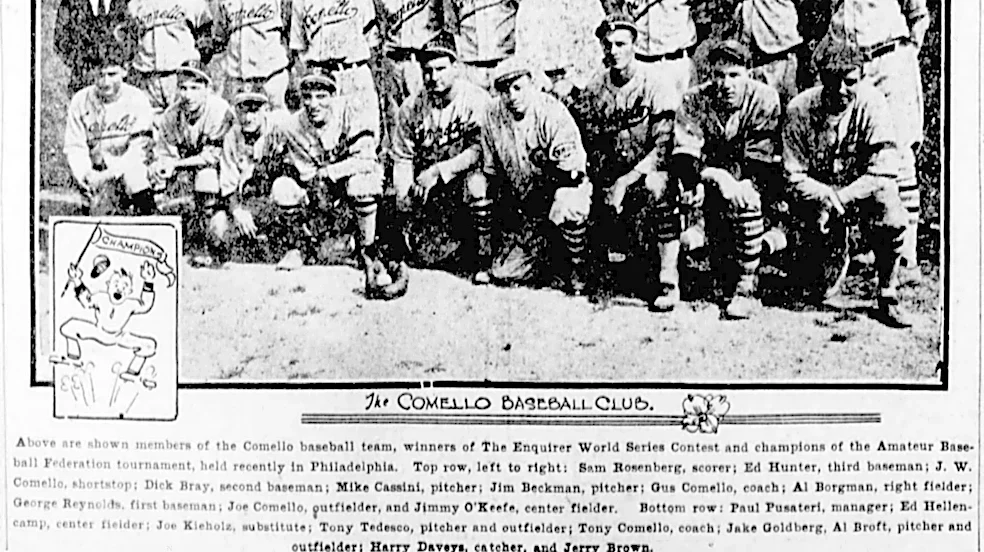
The team was a family affair. Gus was president (and backer), his brother Tony Comello was coach, his son Joseph “Little Joe” Comello at shortstop was one of the top amateur players in the nation, and nephew J.J. “Big Joe” Comello played in the outfield.
The other Comellos players were pitchers Jim Beckman, Mike Cassini and Tony “Blackhawk” Tedesco; Harry Davey, catcher; George Reynolds, first base; Dick Bray, second base; Eddie Hunter, third base; Al “Abby” Brofft, left field/pitcher; Jimmy O’Keefe, center field; Al Borgman, right field; and outfielders Ed Helmecamp and George Keilholz. Paul Pusateri was the manager.
All the Cincinnati newspapers covered the tournament each day, but attention to detail was lacking. The Comellos’ first opponent, from Berkey, Ohio, was called Berkley in several stories, and players’ names had a variety of spellings.
The newspapers made up for it with enthusiasm. “Atta Boy! Go On, Comellos!” The Enquirer shouted after a victory.
1926 amateur baseball championship series

The Comellos easily dispatched their opponents in the early rounds – Berkey; Waterbury, Connecticut; and Detroit. The Johnstown, Pennsylvania, team had to forfeit when it was discovered several players were professionals.
The final round was a best-of-three series against the Detroit Checker Cab team. The Comellos lost the first game, 10-7, in 10 innings, but rebounded to win Game 2, 6-3.
The final game, on Oct. 4, was a nail-biter. The Comellos’ star pitcher Beckman had a sore arm and was “knocked off the mound” by Detroit, but third-string pitcher Brofft came to the rescue. After Borgman’s home run tied the game in the seventh inning, Brofft hit a triple in the 10th inning and scored on a Bray single.
Comellos 6, Detroit 5. Amateur baseball world champions.
The Comellos repeated as champs in 1927, defeating Kennedy Clothes of Detroit. By then, Joe Comello had turned pro, signing with a minor league squad in Indianapolis.

Dick Bray became a sports broadcaster, creating the “Fans in the Stands” segment at ballgames for WSAI radio.
Tony Comello worked as a scout for the Reds and athletic trainer for Xavier University.
Gus Comello Sr., who fulfilled his brother’s dream, also owned an amateur basketball team in the 1930s. When he died in 1956, the Post quoted a member of his 1926 baseball team.
“Mr. Comello never paid us a cent in cash. But he took care of us in other ways. When I needed a suit of clothes, he gave me one. If I had a large hospital bill, he paid it. If it weren’t for Mr. Comello, I wouldn’t have gone to college.
“He was barely five feet tall, but his generosity was a mile high.”
This article originally appeared on Cincinnati Enquirer: How a deathbed wish brought back-to-back baseball titles to Cincinnati