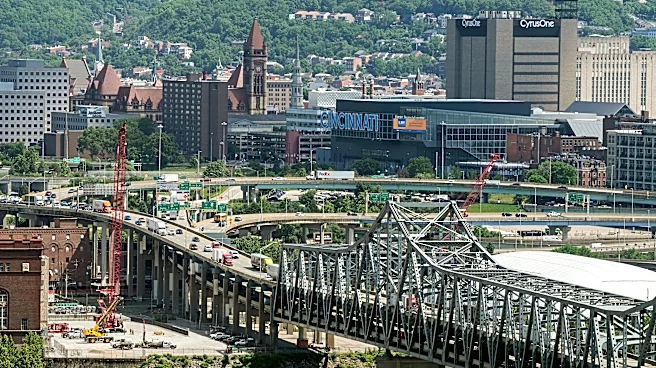






Most everyone is excited about the recent groundbreaking of the Brent Spence Bridge Corridor project. Traffic is frustrating, and driving over the Brent Spence is nerve-wracking. At the groundbreaking ceremony, Gov. Mike DeWine said this bridge will stand for 100 years. He is correct.
The companion bridge is a decision about what Cincinnati will be for the next century. Yet, Cincinnati is not really the institution making that decision. Cincinnati's interests were never the primary lens through which the Brent Spence problem was defined.
For Christmas, my mother gave me a 1925 edition of Cincinnati's official city plan. A paragraph on page 10 reads:
"Again, the rugged topography is a disadvantage from a city planning standpoint, in that it forces
the city to spread out abnormally and involves the city in exceptionally heavy cost for public works and public services, due to the unusual distances that have to be covered and the difficulty of surmounting the steep slopes. This is the chief reason for a relatively high per capita cost of city government in Cincinnati in proportion to the results. From a City Planning standpoint, it presents the problem of so planning the future growth of the city as to avoid, or at least to counteract, these two setbacks to economic development."
In other words, because of Cincinnati's hills, we require more infrastructure to connect our neighborhoods. A flat city can fill a connected grid with productive, tax-generating land. Cincinnati cannot. Our geography naturally tilts the balance toward more fiscally unproductive, non-tax-generating space between our neighborhoods.
There is no way to solve that problem, only manage it. Which leads to the first law of holes: if you find yourself in one, stop digging.
Cincinnati was already in a hole

A hard truth for our city is that when we ran the interstates through our core, we didn't just destroy a community and displace thousands of our neighbors; we dug deeper into that hole. The interstates converted hundreds of acres of tax-generating land into non-tax-generating infrastructure, compounding Cincinnati's natural disadvantage.
The eleven acres reclaimed by the companion bridge project are worthwhile, but they hardly tip the balance back. Instead, our state and federal partners are spending $4.4 billion reinforcing the transportation system that deepened the problem.
Why? Because they defined the problem.
When state and federal agencies declared the Brent Spence "functionally obsolete" in 1985, the implication was that the interstate was underbuilt and failed to meet interstate standards. Once the problem was defined in those terms, the debate became how to modernize the corridor and how to pay for it.
But was Cincinnati ever in a position to decide whether organizing our city around this infrastructure remained in our long-term interests? I don't believe we were.
Who gets to choose Cincinnati's next century?

The Brent Spence is undeniably part of a national transportation network, but a national interest in moving traffic through Cincinnati should not erase Cincinnati's interest in how that infrastructure shapes the city itself.
Subsidiarity holds that decisions should be made by the most local authority capable of making them. If Cincinnati truly had agency over its own future, we would be extraordinarily cautious about spending billions to reinforce, for another century, a transportation system that compounded our city's natural land-use disadvantage − especially when so much of the project's promised economic value rests on the theoretical time savings of today's drivers.
If Cincinnatians truly want a highway-dominated future for the next century, so be it. But that choice should belong to us.
If the companion bridge will shape Cincinnati for the next 100 years, Cincinnati should be the one choosing that future.

Danny Guthrie lives in Kennedy Heights.
This article originally appeared on Cincinnati Enquirer: Brent Spence will shape Cincinnati for 100 years. Who decided? | Opinion