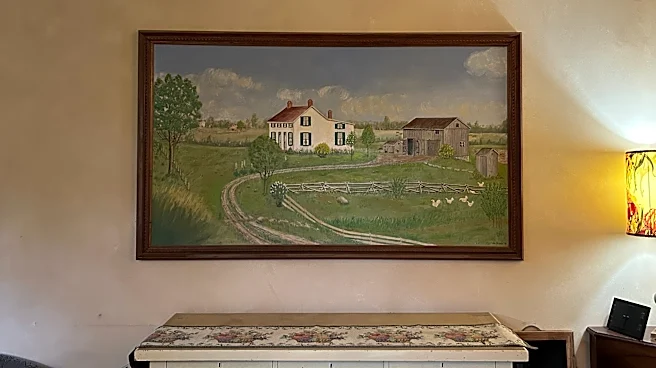







When we were buying our house – an 1885 farmhouse in White Oak – I was enamored of a very large framed painting in the living room.
At nearly 4 feet tall and more than 6 feet wide, the painting dominated the main wall.
It was a pastoral scene of a white saltbox farmhouse with a barn, an outhouse, the curve of a dirt road, a buck-and-rail fence and a smattering of cows and chickens.

I asked the owner, Mike, about the painting. He said it was done by the man who owned the house before him, showing what the farm looked like in the 1930s when he had bought it. Mike pointed to the signature. Joe Frisch, ’70. He was an artist at the newspaper, Mike said.
Mike used to help Joe out with work on the house and bought it from the family after he died.
We asked
if we could keep the painting, and wrote it into the purchase agreement. The painting felt like a part of the house. Turns out, it’s nailed to the wall.
It’s been the centerpiece of our living room, hanging over my shoulder as I write every day.

We also acquired the local history book “Remember When … Monfort Heights,” which has an old photograph of “Frisch Farm” that was obviously Frisch’s reference for the painting.
On the next page is a reminiscence from Joseph J. Frisch of the meeting in 1936 that formed the Monfort Heights Civic Association, on which he served as secretary.
Wanting to know more about Joe Frisch, I dug into the newspaper archives – and quickly ruled out any relation to the family that owned Frisch’s Big Boy.
His obituary in the Cincinnati Post in February 1986 gave me an overview, which I fleshed out from other news stories and records.
Joseph Jerome Frisch was born March 19, 1896, and grew up in Covington. After serving in World War I, he married Hilda A. Klinkicht in 1923, and they had three sons. They moved into the farmhouse in White Oak about 1933.

A photo of Joe Frisch ran in the Western Hills Press in 1961 when he announced he’d retire from a career as the clerk-treasurer of the Oak Hills Board of Education and Monfort Heights Board of Education. At various times he worked as a tool inspector, a draftsman and a zoning inspector.
But he started out as a commercial artist. In the 1920s, Frisch was art director of the Gibson Art Co., makers of greeting cards.
He also created a daily syndicated comic strip called “Jolly Polly” that ran in The Cincinnati Enquirer and other newspapers from 1928 to 1941.
The feature starred 1920s flapper Polly in a single-panel cartoon that also offered tips on English grammar and etiquette. Frisch collected 300 of his cartoons in “Jolly Polly’s Book of English and Etiquette,” published in 1931 – a rare, pre-Superman comic book.

Frisch frequently wrote letters to The Enquirer to comment on language. In 1968, he responded to a rather verbose column by “that well-known orotund hypersyllabicscesquipedalist, William F. Buckley, and his penchant for the excitation of grandiloquent and turgescent expostulations,” telling him: “Only show-offs use big words.”
Hilda died in 1967, at age 70. Joe died Dec. 30, 1985, at age 89. They are buried in Spring Grove Cemetery.
One day, a few years after we bought the house, a car parked in our driveway and two women got out to look around. They turned out to be Frisch’s daughter-in-law and granddaughter. We invited them in.
Much had changed since Joe and Hilda lived there. They told us the parlor, where we have our piano, was the original master bedroom. They smiled when they saw Joe’s painting of our house on the wall.
Joe built the stone steps and planter at the back of the house. His wild grapevines still twirl through our bushes. Under the porch we found a handmade sign for Hiljo Acres. Hilda and Joe.
We also found a connection to the people with whom we have shared a home. (Did I get the grammar right, Joe?)
This article originally appeared on Cincinnati Enquirer: Why I have a 6-foot painting of my house nailed to my living room wall