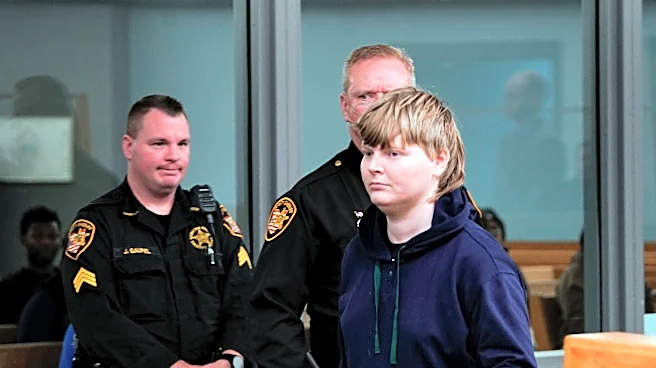







When Cincinnati police arrested William DeFoor after Secret Service agents said he smashed windows at Vice President JD Vance's home, an officer refused to file a felony charge.
Officer Antonio Evans knew the 26-year-old had schizophrenia and believed his mental illness should factor into the charging decision. Days later, the 12-year veteran was disciplined by the department for his decision.
Records obtained by The Enquirer through a public records request reveal a behind-the-scenes dispute between local police and federal agents, showing that concerns about DeFoor's mental health shaped the case long before it reached a courtroom.

Records: Secret Service and local police disagreed
DeFoor is accused of causing roughly $28,000 in damage to the vice president's East Walnut Hills residence and a Secret
Service vehicle on Jan. 5. Cincinnati reviewed its police response that night after a lieutenant did not show up and a supervising sergeant arrived late. Neither Vance nor his family were home at the time.
Evans was on scene within a minute of Secret Service radioing that DeFoor was running away from the house with a hammer. Federal agents turned DeFoor over to Cincinnati police.
Evans filed three misdemeanor charges against DeFoor in Hamilton County Municipal Court. But disciplinary records show there was a dispute over what level of charges to file.
The Secret Service wanted police to charge DeFoor with felony vandalism, which carries a possible prison sentence. Evans refused, according to the records, and his supervisor supported his decision.

Although Ohio law allowed a felony vandalism charge, local police were "apprehensive about charging Mr. DeFoor with any criminal acts due to their assessment of his mental health challenges," records state.
DeFoor was involved in three Hamilton County court cases in 2024 where he received mental health treatment instead of jail time. In a court filing, DeFoor's attorney previously wrote his client was "in the midst of a mental health crisis" when he walked from his family's home to Vance's with a hammer on Jan. 5.
Evans sent an officer to the Hyde Park house where DeFoor lived with his parents, records show. He also allowed the 26-year-old to call his parents while in the back of a police cruiser.
The officer was "trying to do the right thing," said retired New York Police Department detective and criminal justice professor Michael Alcazar. "This alleged perpetrator is mentally ill and needs some sort of treatment."
Discretion in charging decisions
Cincinnati police policy gives officers a lot of discretion over charges they file. When there is enough evidence that a crime occurred, officers are required to "file appropriate criminal charges." Two policing experts said what is "appropriate" is a matter of opinion.
Policy encourages Cincinnati officers to use their judgment regarding whether to file charges for lower-level offenses "if little harm to others or property was caused or when criminal behavior is known to have resulted from a known mental illness."
"Just because a case can be a felony doesn't mean it should be," said DeFoor's attorney, Paul Laufman. "This was a couple of broken windows. I am sure officers charge broken windows as misdemeanors all the time."
Evans received a write-up and Sgt. Torry King was verbally reprimanded in part because of how the officers handled the charging decision, according to disciplinary records. In a statement, Cincinnati police declined to explain why Evans' decision was not treated as a legitimate exercise of officer discretion.
"After a thorough review of the facts, the investigation was completed and appropriate disciplinary action was taken consistent with department policies, procedures and practices," said department spokesperson Brad Underwood.
The decision to discipline Evans raises questions about the role of departmental culture in charging decisions, according to Howard Henderson, who directs a research center at Texas Southern University focusing on criminal justice reform.
"Culture is more influential than law," Henderson said. "Something may be legal, but against the culture. Policing is a militarized structure."
Cincinnati police declined to answer how the Secret Service's request for a felony vandalism charge factored into the department's decision to discipline Evans.

DeFoor pleads guilty to federal charges
Laufman suspects federal officials requested a felony state charge to ensure DeFoor remained in custody following his arrest. Despite a March attempt to be transferred to a secure psychiatric facility, DeFoor has been in custody since January.
The felony vandalism charge was filed by another Cincinnati officer before all state charges were dropped as the Hamilton County Prosecutor's Office handed the case to federal prosecutors. On Sept. 1, DeFoor pleaded guilty to two federal felony charges. He pleaded guilty to damaging property of the United States and a charge related to vandalizing property in a restricted building.
He faces up to 10 years in prison on each charge. His sentence will be determined at a future hearing.
"This case has been about mental health from the very beginning," Laufman said. "And to Officer Evans' credit, I think he saw that. ... I can only hope and trust the federal court will see and understand the same mental health issues Officer Evans saw."
Matthew Cupelli is a breaking news reporter for The Enquirer. You can reach him at mcupelli@enquirer.com and follow his work on Facebook and X.
Enquirer reporter Kevin Grasha contributed to this story.
This article originally appeared on Cincinnati Enquirer: Records reveal dispute over charges in JD Vance home vandalism case