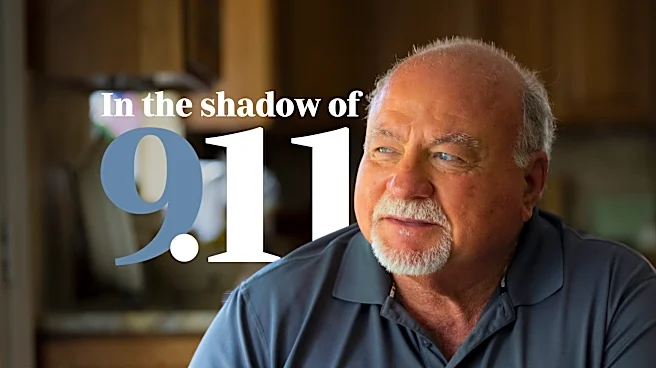








Neighbors still leave flowers around the flagpole in Lynn Faulkner’s yard on Sept. 11, but not as many as they once did.
Faulkner wouldn’t be shocked if the bouquets disappeared entirely one of these years. It’s been a long time, he says, and not everyone in his Mason, Ohio, neighborhood knows, or remembers, why he put up that pole a quarter of a century ago.
They don’t recognize the bright red flag with two towers framed by a pentagon. They don’t understand why he flies it every day or why he keeps buying a new one when it turns a ruddy pink from too much time in the rain and sun.
“Everyone said, ‘never forget, never forget, never forget,’” Faulkner says. “But, you know, people forgot.”
He considers this and decides maybe “forget” isn’t the right
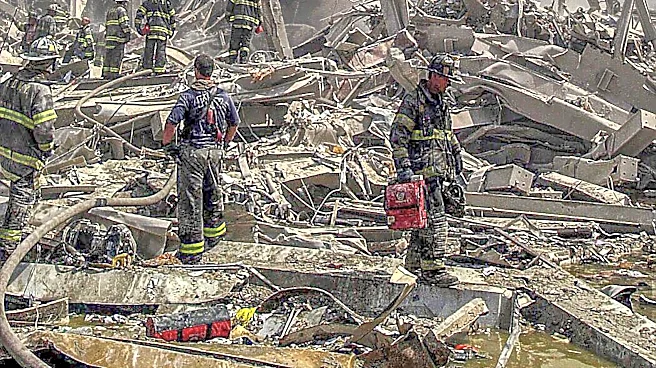
word. Any American alive on Sept. 11, 2001, remembers what happened that day, when planes crashed into the World Trade Center’s twin towers, the Pentagon and an empty field in Pennsylvania. Certainly, they recall the smoking ruins in New York and Washington, the endless news tickers and the days of silent skies, the hastily made “missing” posters for almost 3,000 people lost in the smoke and ash.
No, Americans didn’t forget 9/11. Faulkner thinks what has happened in the past 25 years is about more than memory. It’s about how the passage of time has widened the gap between the nation’s grief and his own.
At first, in the weeks and months after 9/11, it seemed as if Faulkner and his two daughters weren’t alone while mourning the loss of his wife, Wendy Faulkner, who was on the 104th floor of the South Tower for a business meeting. Americans rallied around families like his. They held vigils. They erected memorials.
But now, all these years later, there’s a distance. There are fewer calls and notes and moments of silence. Fewer flowers around the flagpole.

Maybe this was inevitable. No matter how public or traumatic, every loss is a personal loss. Only those closest to the dead feel their absence at the dinner table, in the stands during a high school soccer game, on stage when a child’s name is called on graduation day.
Wendy always would mean more to Faulkner and his daughters than to anyone else. And for that reason, so would 9/11.
“I think about it every day,” Faulkner says. “It never goes away.”
Waiting for a call that never came

Just off the foyer of Faulkner’s home, a few steps from the front door, a small piece of steel rests on a table next to a photo of Wendy. In the photo, she’s dressed in black, smiling and leaning slightly forward, as if on the move, or about to be.
The metal block is rectangular, no more than 6 inches across. Its battered, rust-colored face bears the date September 11, 2001, the day it became wreckage from the World Trade Center.
Behind both is a plaque Faulkner received in 2016 at the dedication of Mason’s 9/11 memorial.
May We Always Remember.
Twenty-five years ago, as he got ready for his job in corporate communications, Faulkner paced the floors of this house while watching TV reports from New York City. A plane had hit one of the towers. Like everyone else, he was transfixed. How could this happen? What would happen next?
He knew Wendy, a vice president with Aon Corporation, was in New York for a business meeting. They’d talked about it on the phone the night before. But as he watched, he couldn’t recall if she’d told him where, exactly, the meeting would be. New York is a big place.
Then the phone rang. It was Wendy’s mom.
“Lynn,” she said, “that’s where Wendy is.”

In an instant, Faulkner went from being one of the millions of Americans watching the tragedy to one of the few who were part of it. He called his oldest daughter, Loren, who was away at college. He told his youngest, Ashley, when she got home from school.
Together, they waited for days, then weeks, for news about Wendy, hoping she’d call to tell them she was OK or that she’d turn up in a hospital, bruised but alive. The call never came.
The steel block is Faulkner’s only physical connection to the place where she died. Her remains were never found. He walks past it now, as he does every day, and is reminded of the madness that took her from him.
He says it makes no sense that she is gone and he is here. He rides motorcycles, races cars and flies a small plane. She read Agatha Christie novels by the fireplace, mailed care packages to orphanages and hated heights and tall buildings.
“When you look at the chances of something happening to her versus the chances of something happening to me, it’s impossible,” Faulkner says.
He pauses. His voice falls to a whisper.
“Nothing is impossible.”
Alone in a house filled with memories
For years, Faulkner kept the last note Wendy wrote to him taped to the refrigerator door.
It was scribbled in pen on a tear-away sheet of notebook paper, the kind people used to keep near their landline phones to jot down messages or reminders to pick up eggs at the grocery store.
“Dinner Plans,” it began.
It then listed the dinners she’d made in advance so Faulkner and Ashley could eat healthy meals while she was away on business the week of Sept. 10. Chicken breasts with noodles Monday. Ham and broccoli quiche Tuesday. Shepherd’s pie Wednesday. Each meal was in the freezer, individually packed and ready to put in the oven or on the skillet.
“I don’t know how she did it,” Faulkner says, sitting now in the same kitchen where Wendy prepared those meals.
He rises from the table and excuses himself. A minute or so later, he returns with a crumpled piece of notebook paper. It’s Wendy’s list. After finally taking it down from the fridge years ago, he couldn’t bring himself to throw it away.
For him, this scrap of paper has as much meaning as photos and old anniversary cards. This was Wendy taking care of the family, doing what she’d always done. An ordinary moment made extraordinary by circumstance.

For years, Faulkner couldn’t escape those moments. The house became a kind of living memorial, filled with relics of the life they’d built together over 30 years, since the day they struck up a conversation after a freshman English class in college.
The daughter of missionaries, Wendy was worldly and smart, graduating high school early and starting college at 16. She was, he says, the most amazing girl he’d ever met.
Losing her left Faulkner rudderless. He stayed up late, watching the news, following the wars in Iraq and Afghanistan. He struggled to sleep, tossing and turning at night, dozing during the day.
He fell asleep at a traffic light driving Ashley to soccer practice and in his chair at the kitchen table. Once, he fell asleep while riding his motorcycle.
Faulkner didn’t know how he was supposed to live without Wendy. When a reporter asked him two years after 9/11 how he was doing, he told him.
“I’m as lonely as a man can be.”
'Fewer people were thinking about 9/11'
Faulkner logs into his email and shares a message from an old friend, Madhava Rao. It’s a note about charity work Rao is doing in India with poor and orphaned kids.
“We sincerely thank you and your entire family for your faithful love, prayers, and generous support to our children,” the message says.
Rao’s charity, the Mercy and Grace Charitable Trust, has been feeding and housing children for two decades with help from the Wendy Faulkner Memorial Children’s Foundation.
Faulkner and his daughters started the charity after finding a box Wendy had begun to fill with donations for needy families overseas. She’d been doing this sort of thing for years, sending help to people she’d never met, and had planned to finish packing the box when she got home from New York.
Her husband and daughters finished the job instead. After mailing it, they decided to set up the foundation so they could keep doing it, week after week, month after month. It felt like a productive way to channel their grief.

For the first several years, donations rolled in. Wendy’s name and her connection to 9/11 attracted attention. Donors seemed eager to help, giving so much clothing and school supplies that Faulkner turned the hangar where he kept his small plane into a warehouse, from which they shipped packages around the world.
In time, though, the contributions slowed. “Fewer and fewer people were thinking about 9/11,” Faulkner says.
He considered shutting down the foundation, but the thought pained him. The charity was doing Wendy’s work. It was her legacy. So instead of closing, Faulkner narrowed its focus, zeroing in on a few trusted groups and people who needed help most. The email from Rao suggests the strategy is working.
“Your gift is not simply financial assistance,” Rao says in his note. “It is an investment in the lives, dreams, and futures of children.”
Faulkner says he’s happy the foundation’s work continues, even if the donors now are mostly family and close friends. They don’t collect as much as they once did, but it’s enough to make a difference.
“We’ll do it as long as we can,” he says.
Tired of being alone, frustrated with dating

For years, Faulkner carried on that work in solitude. His daughters left for college, careers and families of their own, just as he and Wendy had hoped they would. Faulkner stayed behind in a house that felt impossibly big and quiet without them.
He kept as busy as he could, not just with the foundation, but by learning as much as he could about 9/11. He devoured government reports, news coverage, congressional committee hearings, anything that could shed light on what happened and why.
The hijackers who flew the planes were dead, but Faulkner believed U.S. and foreign governments knew more than they were revealing. He talked often with relatives of other victims. He sent emails and letters. He joined lawsuits.
The work was worthwhile, he says, but it wasn’t enough. He still struggled with being alone.
Faulkner, a gregarious, self-described “talker,” was spending most of his time by himself. It wasn’t a life that suited him, and he didn’t think Wendy would be happy about it, either.
Four years after 9/11, he created a profile on Match.com. He chose a photo, wrote a brief description of himself, noting that he was a widower, and hit the button. He didn’t mention 9/11.
He went on four or five dates and decided he was wasting his time. It felt strange. He didn’t like being alone, but he didn’t want to do this anymore. One day, while driving home, he pulled over and prayed.
“If I’m supposed to be alone, OK,” he said. “But if you’ve got something in mind, don’t be subtle. I’m not good at subtle.”
That same day, he logged in to delete his dating profile and noticed a message from a woman he’d reached out to months earlier. Her name was Aletha. She asked if he could meet for lunch.

He liked her immediately. She was bright and pretty. And when he told her about Wendy and 9/11, she didn’t seem overwhelmed. Instead, she asked about his family. She asked about his daughters. She cared about the right things.
It took some time to get their bearings. He was grieving, that was plain to see, and she understood grief couldn’t be turned on and off. When she arrived for her first dinner at the house, Wendy’s note listing the meals she’d prepared for the week of Sept. 10, 2001, was still on the fridge.
After seven years of dating, they married. She took his name, becoming Aletha Faulkner, and lives with him now in that same house, alongside the memorials and the memories. Sometimes, she says, people ask how she deals with that.
“Wendy made him the man he is,” she says, sitting beside him in the kitchen. “Without her, I wouldn’t have this wonderful man.”
A white rose on her birthday
Faulkner won’t go to New York City this year for ceremonies honoring the victims of 9/11. He went once, weeks after the attacks, and decided that was enough.
“The wreckage was still smoking,” he says.
He’s heard good things about the memorial, though, about the water falling into the giant spaces once occupied by the towers’ foundations, about the bronze plates bearing the names of those lost.
On Wendy’s birthday, July 25, he received a photo of a white rose next to her name on the memorial. Every family gets a photo like this on their relative’s birthday, and Faulkner looks forward to it.

It reminds him of something his grandfather told him years ago: The worst thing that could happen to a person isn’t dying, it’s being forgotten.
“I wouldn’t want her to think she’s been forgotten,” he says.
Faulkner reaches for his phone and starts scrolling through his photos, looking for the one with the rose. Aletha sees him struggling to find it and reaches across the table, touching his arm.
“I’ll find it for you,” she says.
When she does, she taps the image and leans close to show him. Faulkner looks at the photo and smiles.
The rose is brilliant white against the dark, reflective bronze. Anyone who walked by the memorial that day would have noticed it. And if they’d stopped, even for a moment, they would have seen Wendy Faulkner’s name, resting between the falling water and the blue sky above.
This article originally appeared on Cincinnati Enquirer: 'It never goes away.' 9/11 victim's husband endures as nation moves on