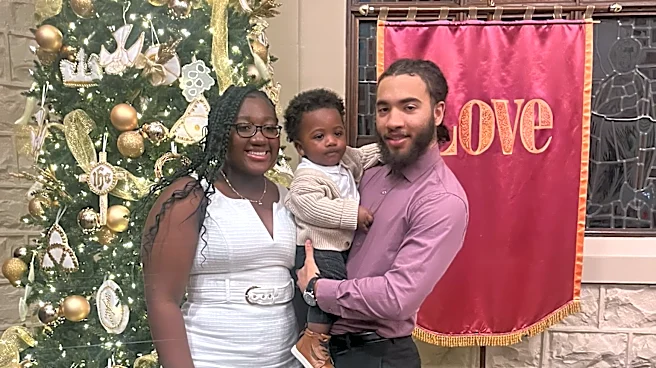







As I write this, Armelle Bondonga Bradshaw has not seen her husband or held her 19-month-old baby in over two weeks.
On Aug. 12, Armelle and her husband, Terrance Bradshaw, voluntarily appeared for what was supposed to be a final interview in the process of obtaining her marriage-based green card. Instead, immigration agents separated the family and took Armelle into custody.
Armelle did exactly what Americans who favor stricter immigration enforcement say immigrants should do: She followed the law. She showed up, followed the process and did the paperwork. Now she is detained. Sitting in a detention center while her husband is home trying to comfort their son, who cries when he hears his mother’s recorded voice.
Armelle was 9 years old when she
landed in Maine with her family from the Democratic Republic of the Congo. They arrived here legally on a visitor visa. While they were visiting, violence in their home country erupted. Their home was invaded, family members were assaulted, and her father’s colleague was murdered. Armelle’s parents made the difficult decision to seek asylum in the United States.
They changed their legal status from visitors to asylum seekers.
Then, over the next decade, while the family navigated our complicated American immigration system, fraught with political tensions, Armelle grew up. She went to school. She made friends. She found mentors. She built a life.
Louisville became home
Armelle came to Louisville, Kentucky, as a high school student amid the COVID-19 pandemic. In the wake of Breonna Taylor’s murder, she was inspired by the social justice movement. Alongside classmates, she helped found Future Ancestors, an organization that puts young people at the center of community action.
For six years, she and her peers organized the Race4Justice, raising money for community nonprofits while honoring Breonna Taylor’s life. Participants run or walk 26 laps on the track at the Norton Healthcare Sports and Learning Center. One lap for each of Breonna Taylor’s 26 years.
Armelle graduated from high school and kept working. She mentored younger students. She helped keep Future Ancestors youth-led. She also returned to Waggener High School as a substitute teacher, working alongside the educators who had once taught her. The people who helped raise her were now her colleagues.
This is what growing up in America looked like for Armelle. The people who helped raise her became the people she came back to serve.
She also fell in love with an American citizen, Terrance Bradshaw. She and Terrance had a son and got married. They were building a family. Armelle's life is unmistakably intertwined with the country that raised her.
That is how she ended up in the immigration office on Aug. 12. Her marriage had opened another pathway to permanent residency in the United States.
It should have been one more step to solidifying her immigration status. But instead, Armelle was separated from her family. She appeared voluntarily for her scheduled meeting. She was not hiding from immigration authorities or attempting to evade the system. She has no criminal history.
What does 'Do it the right way' mean?

What happened to Armelle is part of a growing pattern. People are being told to follow the process, only to discover that showing up puts them in handcuffs anyway.
So what exactly is America asking of people like Armelle now?
She may have been born in the Democratic Republic of the Congo, but Armelle is American. America raised her; she has spent most of her life here, and now she is being told that she somehow doesn’t belong. Not by the teachers she learned from. Not by the students she has mentored. Not by the nonprofits working alongside her in the community. Certainly not by the husband who loves her. But by a government that does not see her.
This is Armelle's story, but it also raises questions for every asylum seeker. What happens to asylum seekers who spend years navigating a legal system they didn't create while building a life in the United States?
While Armelle’s family navigated the bureaucracy, the United States became the only home Armelle has ever really known, and Louisville, Kentucky, is a better place because she is a part of it.
The government sees an immigration case. Our community sees Armelle.
What happened to Armelle should make anyone who believes in following the legal process ask themselves what we mean by, "Do it the right way." If we want people to trust the legal process, we cannot make following that process a trap.
Bring Armelle home
If Armelle is sent to the Democratic Republic of the Congo, she will not be "going home." Home is where her husband and child are.
The country she left at age 9 remains dangerous. It is also facing its largest and fastest-moving Ebola outbreak on record, according to the World Health Organization.
We can have a national conversation about immigration policy. We can debate borders, asylum and citizenship. We can also question the billions of dollars of funding for ICE and deportations when that money could be better served streamlining our asylum-seeking processes.
But my question is this: What kind of country watches a child grow up, build a family and serve her community, only to tell her that she doesn't belong?
America asked Armelle's family to trust its legal system. Armelle has done exactly that. She showed up. She followed the process.
We cannot tell her now that she doesn't belong.

Bonnie Jean Feldkamp is a nationally syndicated columnist and the co-editor of the forthcoming Anthology “Fast Forbidden Women” (Woodhall Press, 2027). She lives in Louisville and is the former opinion editor of the Courier Journal.
This article originally appeared on Cincinnati Enquirer: America raised Armelle Bondonga. Now it wants to send her away | Opinion