

Ohio removed guardrails around homeschooling students, letting families educate their kids with little state oversight or enforceable requirements.
In 2023, lawmakers included homeschooling reforms into
the state budget bill. The law eliminated requirements that instructors have a high school diploma, submit academic progress reports or assessment tests, or provide a minimum number of instructional hours.
Under the new law, parents only have to notify the local school district and swear to instruct the students in English, math, science, history, government and social studies. The law provides limited mechanisms to make sure that those subjects are being taught unless a child protective services complaint is lodged against the family.
Homeschool students no longer have to ask to be excused from compulsory attendance. Under the new law, they are exempt from compulsory attendance when the parents notify the district, according to Melanie Elsey of the Christian Home Educators of Ohio, which lobbied for the changes.
It's proving to be popular. The year following the changes, the number of homeschooled students increased 15% to 61,000 for the 2024-25 academic year. Numbers for the 2025-26 school year will be available in mid-September. Nearly twice as many Ohio children are now being homeschooled than there were eight years ago.
Advocates for homeschooling applauded the changes, which lessened the paperwork burden on parents.
Elsey said families continue to have students take assessment tests, but they're no longer required to share the scores with public school districts, which in the past only received them for informational purposes.
Elsey added that parents failing to teach required subjects would be a rare situation.
"Parents who are entering into home education have a commitment not just to cover six core subject areas, they're covering everything. They're covering health and foreign language and phys ed," said Elsey, who homeschooled her now adult children.
Homeschooling parents share resources to cover a variety of subjects. "Parents figure out how to do things well," Elsey said. "I'm just not concerned about an abstract concept of whether somebody has to step in to the home and look at exactly what an individual family is teaching."
Ohio dropped the requirement that the home instructor have at least a high school diploma. Elsey said that allows parents who were homeschooled and don't have a diploma to in turn educate their own children at home.
Ohio House Education Committee Chair Sarah Fowler Arthur, R-Ashtabula, who was homeschooled and is now homeschooling her three children, said the new law aligns Ohio with about 35 other states. Previously, Ohio was among the 12 most regulated homeschooling states, she said.
She noted that some homeschooling advocates wanted Ohio to eliminate the notification requirement. Ohio also retained a requirement that kids returning to a public school can be tested by the superintendent and assigned to a grade level, she said.
"We also very firmly believe that parents want to see their children succeed and excel, but every kid has a different need and a different trajectory to do that," Arthur said. "So, this allows flexibility while maintaining similar regulatory structures to the majority of states across the nation."
Where is homeschooling popular in Ohio?
By sheer numbers, the most homeschooled students reside in the bigger school districts. Columbus, Southwestern City, Cincinnati, Lakota Local, Beavercreek City, Toledo City and Westerville each have 500 or more homeschooled students.
Districts with the highest number of homeschooled students as a percentage of district enrollment tend to be in more rural areas.
Cedar Cliff Local in Greene County, Bloomfield-Mespo Local in Trumbull County and Vanlue Local in Hancock County each reported that more than 1 in 5 students in their districts are homeschooled.
Reasons for homeschooling
A national study found that families often homeschool their children because they're unhappy with public schools' environment or academics, want to emphasize family life together or want to provide religious or moral instruction. Other parents pull their children from public schools because of bullying or other issues.
During the COVID-19 pandemic, Ohio saw a surge in families that left remote classes with public school teachers and opted to homeschool their children. Some families stuck with it.
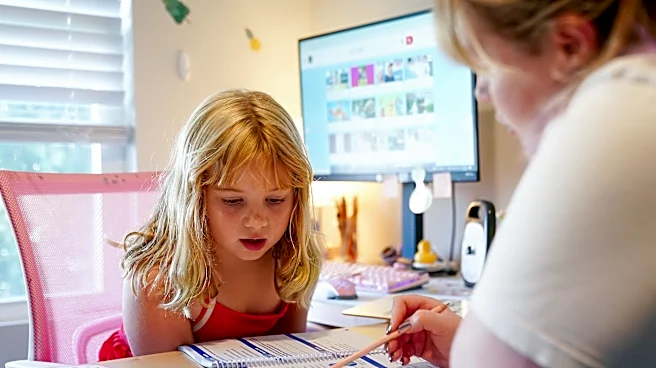
After nearly 15 years working in classrooms as a behavior analyst, Caitlyn Lynch of Morrow pulled her daughter, Nora, out of Little Miami Local Schools near Cincinnati to begin homeschooling this year.

Lynch said she and her husband witnessed Nora, 8, lose the curiosity and joy she once had for learning due to high-pressure assessments she experienced through second grade. Nora had difficulty reading and spelling, but wasn't struggling enough to qualify for an Individualized Education Program.
"We would pick up on little things here and there where you can just tell as much as the teachers were trying ... she was falling through the cracks," Lynch said.
A "big red flag," Lynch said, came when the school advised on a report card to work on reading with Nora at home, but Lynch had already been doing that for hours on end.
Earlier this summer, Lynch notified the district that she'd be homeschooling Nora for third grade – a process she said was a "lot easier than I was expecting."
And she's not surprised to hear lots of other parents in the state are making the same switch.
"Based off of families I've talked to, clients I've worked with ... between the academic expectations that keep getting tougher and tougher ... the ripple effects of teachers being stressed out and funding not happening," Lynch said, "all of these negative things are affecting the kids and the kids are picking up on them."
Columbus Dispatch reporter Anna Lynn Winfrey contributed to this report.
State government reporter Laura Bischoff can be reached at lbischoff@usatodayco.com and @lbischoff on X.
This article originally appeared on Cincinnati Enquirer: Why more Ohio parents are taking kids' schooling into their own hands