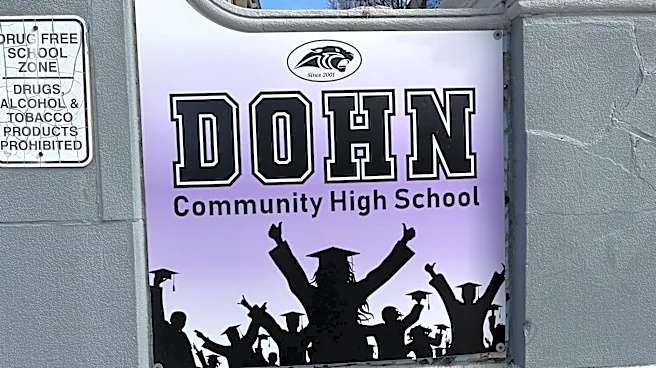







The Enquirer recently reported how taxpayer money intended for Dohn Community High School, a state-funded Cincinnati charter school, allegedly helped finance Rolls-Royces, Bentleys and a $30,000-a-month luxury vacation rental near Miami. The cars and vacation property make for a captivating headline. But they are not the most important part of the story.
The real story is that Buckeye Community Hope Foundation, the state-authorized overseer of Dohn, did not report the suspected fraud until the alleged scheme had been operating for nearly three years, more than $8 million had been pilfered, and the school was collapsing. Yet, Ohio has entrusted that same organization with overseeing more than 50 other charter schools.
That calls for a forensic
examination of all 50 schools.
A federal grand jury has indicted Dohn’s former superintendent and operator, Leondo Ramone Davenport, and contractor Jonathan Ballew. Prosecutors allege that Ballew submitted false or inflated invoices through several companies, that Davenport authorized Dohn to pay those companies more than $8 million and that Ballew returned more than $4 million to entities controlled by Davenport.
Both men are presumed innocent, and the allegations have not been proven in court.
Ohio required monthly oversight
But the oversight question does not depend upon their guilt. There is no dispute that millions of public dollars passed from Dohn to private contractors. There also is no dispute that Dohn later ran out of money and closed abruptly in 2025, displacing students who had already struggled in traditional schools.
What has not been established is what other financial and management problems may have caused it. That is another reason a complete financial examination is needed.
Ohio charter schools are publicly funded but operate independently of traditional school districts. Each must have a state-authorized sponsor responsible for monitoring its finances, legal compliance and performance.
Dohn’s sponsor was Buckeye, a Columbus-based nonprofit that sponsors and monitors more than 50 charter schools across Ohio.
Buckeye was not a passive adviser. Ohio law requires sponsors to monitor their schools, intervene when problems arise and suspend or terminate a school’s contract when necessary. A sponsor representative must meet with each school’s governing authority or fiscal officer and review its financial and enrollment records at least monthly. A written report must follow each review.
Yet prosecutors allege that the Dohn scheme operated from 2021 through 2024.
What did Buckeye know?

Buckeye did not alert the state auditor until June 2024. By then, according to the federal indictment, Dohn had paid more than $8 million to companies controlled by Ballew.
Buckeye’s referral also raised separate concerns about Dohn’s declining cash balance, unpaid vendors, payroll problems, questionable expenditures and payments for work that may not have been performed. Those concerns are not the same as the federal charges, and the public record does not yet tell us how all of Dohn’s financial problems fit together.
It does tell us that Buckeye acted very late.
Did Buckeye conduct every required monthly financial review? What did its representatives examine? Did they inspect the underlying invoices? Did they verify that the services being billed were actually performed? Did they identify who owned the contracting companies and investigate their relationships with Dohn’s operator?
Or did the monitoring consist primarily of reviewing financial statements prepared from information supplied by the people being monitored?
The Ohio Department of Education and Workforce should obtain and publish Buckeye’s monthly reports on Dohn. It should determine what Buckeye knew, when it knew it and why it did not intervene sooner.
But examining Dohn alone is not enough.
The state should commission an independent forensic examination of every charter school sponsored by Buckeye. Investigators should trace major vendor payments, verify the work behind large invoices, identify the true owners of contracting companies, uncover relationships between vendors and school officials and determine whether contracts were competitively awarded.
That examination must go beyond conventional annual audits. The central allegation at Dohn is not that money simply vanished from the accounting records. The payments were allegedly recorded as expenses to contractors. Detecting such a scheme requires looking behind the entries to determine whether the vendors, services and invoices are legitimate.
One alleged fraud at one school does not prove that misconduct is occurring at any of Buckeye’s other schools. But it would be irresponsible to assume Dohn was an isolated failure without examining them.
Who watches the watchdogs?

The structure of Ohio’s charter-school system makes that scrutiny even more necessary. The overseer − Buckeye − was paid by Dohn to monitor it. Buckeye can likewise receive oversight fees from the more than 50 other schools it monitors, even though it may eventually be called upon to discipline or close any one of them.
In other words, the schools being regulated provide revenue to their regulator. The more schools a sponsor oversees, the more potential revenue it receives. That arrangement does not establish wrongdoing by Buckeye, but it creates an obvious conflict that demands strong state supervision and independent financial safeguards.
The Rolls-Royces are symbols of the extravagant lifestyle alleged by prosecutors. The larger public concern is an oversight system that did not sound an alarm until millions of dollars had been paid out.
Ohio should not wait for another school to collapse − or another set of indictments − to find out what is happening at Buckeye’s other schools.

Dennis Doyle is a member of the Enquirer Board of Contributors.
This article originally appeared on Cincinnati Enquirer: Don't let the Rolls-Royces distract from Dohn's real scandal | Opinion